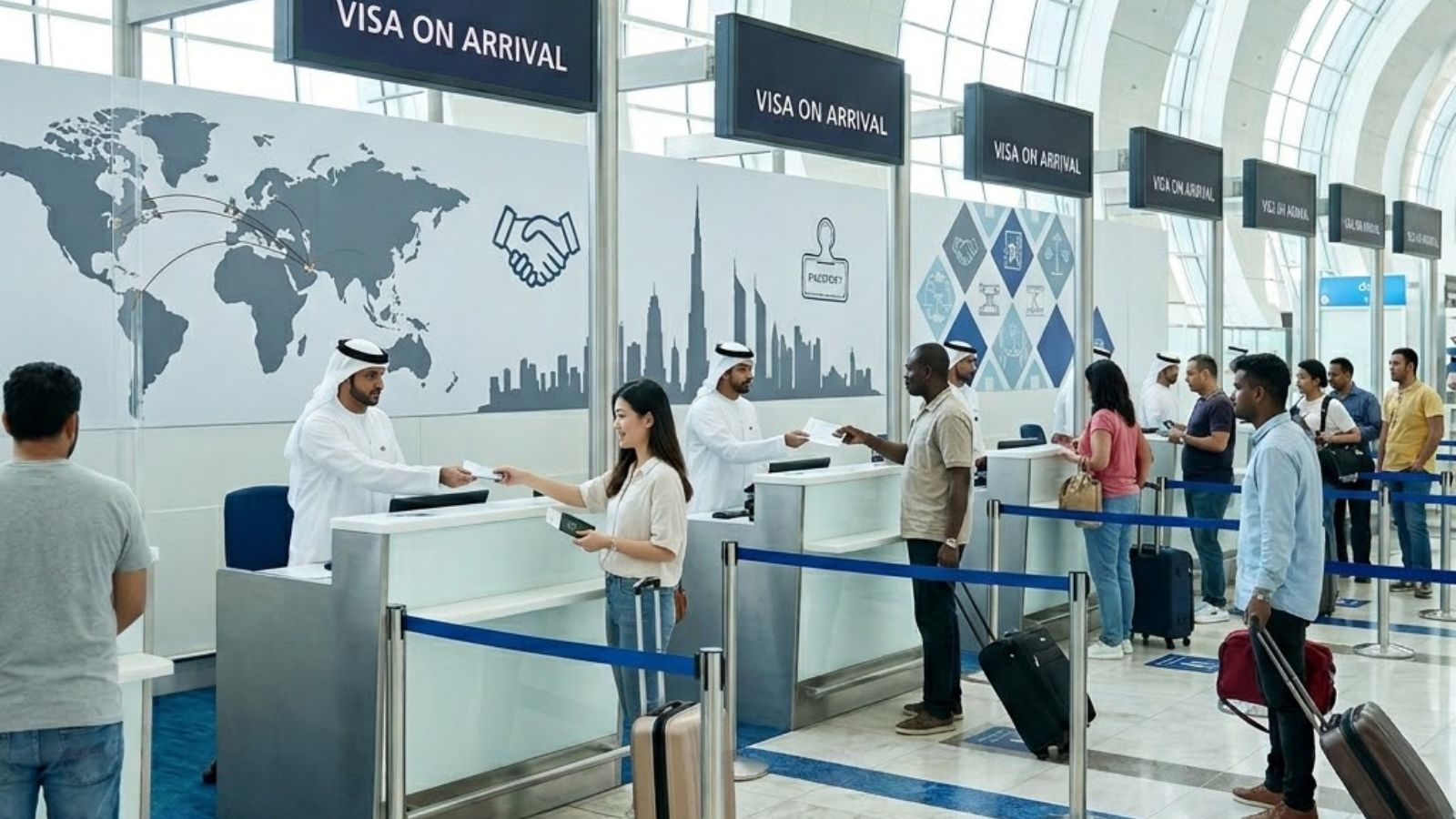
The United Arab Emirates (UAE) operates its border control as a direct extension of its economic diversification strategy, balancing the friction-free influx of human capital against strict regulatory enforcement. The recent expansion of the visa-on-arrival facility to six additional nations demonstrates a deliberate shift from bilateral visa bureaucracy to an open-access model designed to capture immediate tourism and business expenditures. However, this asymmetric openness requires an equally rigid internal enforcement mechanism. By standardizing the overstay penalty at a fixed rate of AED 50 per day, immigration authorities have replaced a fragmented, discretionary fine structure with a predictable, scalable cost function that acts as a financial deterrent.
Understanding the operational realities of this system requires analyzing both the onboarding mechanisms (the entry pipeline) and the enforcement architectures (the exit penalties).
The Entry Pipeline: Strategic Expansion of Visa-on-Arrival Mechanics
The expansion of visa-on-arrival access to six new target nations alters the friction dynamics of entry. In international migration logistics, administrative friction—such as the requirement to secure a pre-arranged visa through an embassy or third-party agency—acts as a non-tariff barrier to entry. Removing this barrier shifts eligible travelers from a planned, long-cycle decision matrix to an impulse or short-cycle travel pattern.
This entry mechanism relies on specific structural parameters:
- Bilateral vs. Unilateral Access: While true visa-on-arrival policies are frequently rooted in reciprocal diplomatic agreements, the UAE frequently deploys unilateral visa easing to stimulate specific source markets based on macroeconomic indicators, trade volumes, and tourism trends.
- The 30-Day vs. 90-Day Operational Window: The visa-on-arrival facility is not an indefinite entry permit. It typically grants a fixed operational window—either a 30-day single-entry stay or a 90-day multiple-entry validity period within a 180-day window, depending on the specific passport origin. This structural limitation prevents long-term residency without formal capital investment or employment sponsorship.
- Passport Validity Thresholds: The operational execution of this facility remains contingent on strict documentation baselines. Inbound travelers must possess a passport with a minimum validity of six months from the date of entry. Bureaucratic failure to meet this baseline results in immediate boarding denial at the point of origin, bypassing the visa-on-arrival mechanism entirely.
The Cost Function of Non-Compliance: Deconstructing the Overstay Penalty
To prevent the open-access entry pipeline from converting into a backlog of undocumented residents, the immigration system relies on an optimized financial penalty model. The standardization of the overstay fine to a flat rate of AED 50 per day simplifies a previously complex calculation that varied based on the specific visa category or the jurisdiction of entry (such as Dubai vs. Abu Dhabi).
The mechanics of this cost function are purely mathematical and cumulative:
$$\text{Total Financial Liability} = (\text{Days of Overstay} \times 50) + \text{Administrative Service Fees}$$
This formula operates under a strict set of operational rules:
- Elimination of Grace Periods: The current regulatory framework removes ambiguity regarding grace periods. The daily fine accrues immediately upon the expiration of the authorized stay duration, turning the day after expiration into Day 1 of financial liability.
- The Outpass Mandate: Accumulating overstay fines introduces significant legal friction at the exit boundary. A traveler cannot simply pay the fine at an airport immigration counter if the overstay duration exceeds specific thresholds or enters a litigation phase. In such instances, the individual must secure an immigration outpass (exit permit), which incurs separate administrative processing fees and requires a physical clearance window prior to departure.
- Sponsorship Liability: When entry is facilitated via corporate or individual sponsorship rather than an independent visa-on-arrival, the financial liability of the daily fine structurally shifts. While the individual remains subject to detention or deportation, the registered sponsor faces administrative blocks on their portal with the General Directorate of Residency and Foreigners Affairs (GDRFA) or the Federal Authority for Identity, Citizenship, Customs and Port Security (ICP), halting all future visa processing until the account is settled.
Systemic Bottlenecks and Operational Risks
The interaction between simplified entry and rigid enforcement creates specific systemic bottlenecks that travelers and corporate mobility managers frequently miscalculate. The primary point of failure rests in the assumption of automation.
The immigration architecture relies on digital tracking systems that register entry and exit timestamps via e-gates and manual counters. A data mismatch—such as an exit stamp that fails to log within the central ICP database—triggers an active overstay flag even if the individual has physically departed the country. Resolving these systemic errors requires manual intervention, turning the burden of proof back onto the traveler, who must produce physical boarding passes and exit stamps to retroactively clear the financial liability.
Furthermore, the financial calculation fails to account for the compounding legal consequences of extended overstaying. Beyond the daily AED 50 tariff, long-term non-compliance triggers the issuance of an absconding report by sponsors, or an automated immigration blacklisting. Once an individual is blacklisted within the unified federal database, the penalty shifts from a purely financial friction to a permanent administrative ban, rendering future entry impossible regardless of visa-on-arrival eligibility.
Risk Mitigation for Corporate and Independent Mobility
Navigating this optimized border framework requires a systematic approach to compliance. Reliance on manual tracking or informal reminders is the primary driver of regulatory non-compliance.
The first tactical step demands the decoupling of visa validity from passport validity. While a passport must be valid for six months, the visa validity operates on an independent, shrinking timeline. Mobility managers must implement centralized tracking software that calculates the exact expiration date based on the actual entry stamp timestamp rather than the visa issuance date.
The second step requires an immediate transition to official verification channels. Checking status via third-party travel blogs or outdated aggregators introduces unacceptable regulatory risk. Compliance verification must be executed exclusively through two primary federal nodes:
- The ICP Smart Services Portal: This platform serves as the single source of truth for visas issued under the federal framework covering Abu Dhabi, Sharjah, Ajman, Umm Al Quwain, Ras Al Khaimah, and Fujairah. Inputting the passport number and expiration date yields the exact authorized last day of stay.
- The GDRFA Dubai Portal: For entries processed specifically through Dubai's ports of entry, the GDRFA portal provides real-time tracking of the internal files, active fines, and exact financial liabilities accrued to date.
When an overstay event occurs, the optimal strategic play is immediate regularization through an authorized typing center or the official portal rather than attempting to negotiate or settle the fine at the airport departure gate. Settling the account via the portal generates a digital receipt that updates the border control database within minutes, eliminating the risk of missed flights or terminal detentions due to unresolved administrative flags. Ensure all processing occurs during standard banking and government operational windows to avoid delays caused by batch-processing queues in the immigration network.