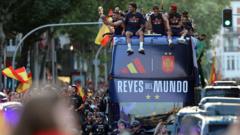
Large-scale civic sports celebrations operate at the intersection of urban logistics, municipal security, and high-yield national branding. When the Spanish national football team returned to Madrid following their World Cup victory, the resulting public gathering was not merely an emotional release point for millions of spectators. It represented a complex civil engineering challenge requiring the synchronized execution of crowd control, broadcast infrastructure, transport routing, and public safety protocol across a dense urban corridor.
Deconstructing the event requires examining three core operational domains: spatial management of dense urban corridors, civic infrastructure load balancing, and the commercial capture of public sentiment.
Spatial Mechanics and Route Economics
The physical architecture of Madrid dictated the flow and density of the celebration. Urban victory parades function as dynamic high-throughput conduits. To maintain safe crowd densities along a multi-kilometer transit route, event planners must manage static gathering nodes against mobile spectator streams.
The Transit Corridor Model
The procession utilized Madrid’s primary arterial thoroughfares, starting from arrival infrastructure points and converging on centralized plazas such as the Plaza de Cíbeles and Moncloa. The choice of route serves two distinct functions:
- Volume Dispersion: Linear corridors spread gathering crowds across broader surface areas compared to enclosed stadium settings. A four-kilometer avenue with a effective spectator depth of fifteen meters on either side offers roughly 120,000 square meters of standing space. At standard safe standing densities of 2.5 persons per square meter, the primary transit path naturally accommodates 300,000 active viewers without triggering dangerous surge pressures.
- Pedestrian Filtration: Intersecting side streets act as secondary pressure valves, allowing arriving spectators to merge into the main line while offering continuous exit channels for departing individuals.
Focal Point Capacity Constraints
The terminal node of the celebration—typically the Plaza de Cíbeles—presents an entirely different structural profile. Unlike linear avenues, a centralized plaza creates a converging vector where spectator streams from multiple directions collide.
When crowd density exceeds 4 persons per square meter, localized fluid dynamics govern human movement. At this threshold, shockwaves transmit through the crowd upon minor movements, increasing the probability of progressive crowd collapse. Managing this risk requires physical perimeter segregation:
- Hard Barrier Outer Rings: Deflecting incoming crowds at peripheral intersections 500 meters from the focal stage.
- Filter Checkpoints: Regulating flow rates into the primary square to match real-time exit rates.
- Emergency Egress Lanes: Maintaining a minimum 6-meter wide unencumbered corridor reserved strictly for medical response vehicles and security personnel.
Municipal Infrastructure and Load Management
A sudden influx of hundreds of thousands of active citizens into a downtown core exposes every friction point in municipal utilities and public transportation systems.
Mass Transit Dynamics
The Madrid Metro system bears the primary operational load during major celebratory events. Standard baseline scheduling cannot absorb a localized demand spike that often exceeds 300% of peak rush-hour volumes. Successful mitigation depends on three concrete interventions:
- Station Bypass Protocols: Inbound trains bypass high-density target stations (e.g., Banco de España, Sol) when platform capacity reaches critical safety thresholds, forcing passenger dispersion to peripheral hubs.
- Headway Minimization: Reducing train arrival intervals to theoretical operational limits on primary transit lines to maximize continuous hourly throughput.
- Surface Traffic Isolation: Total vehicle restriction within a defined perimeter surrounding the parade route, eliminating vehicle-pedestrian conflict points and freeing road surface strictly for foot traffic and emergency support.
Resource Allocation Matrix
Beyond transport, municipal management must scale sanitation, temporary medical stations, and mobile telecommunications capacity.
+------------------------+------------------------------------+---------------------------------------+
| Operational Vector     | Primary Failure Point              | Mitigation Strategy                   |
+------------------------+------------------------------------+---------------------------------------+
| Mobile Networks        | Bandwidth saturation at core nodes | Deployment of temporary COWs          |
| Emergency Medical      | Delayed access due to crowd block  | Staged foot-patrol paramedic teams    |
| Sanitation             | Post-event debris accumulation     | Phased mechanical sweeping sweeps     |
+------------------------+------------------------------------+---------------------------------------+
Telecommunication networks experience severe uplink congestion during public events as thousands of users simultaneously stream video and upload images. Cell on Wheels (COWs) must be strategically positioned along high-density zones to expand localized cellular bandwidth and preserve emergency band frequencies for public safety personnel.
The Economics of National Athletic Brand Capture
While the physical event demands significant municipal expenditure, the economic impact extends across immediate local retail revenue and long-term athletic brand equity.
Immediate Local Economic Influx
Public celebrations drive localized consumption spikes across three main sectors:
- Hospitality and Food Service: High-density gatherings yield immediate turnover increases for brick-and-mortar dining and street vendors situated within two blocks of the transit corridor.
- Public Transportation Revenue: High passenger volumes generate elevated single-fare transaction counts, partially offsetting operational overtime costs for transit workers.
- Licensed Merchandise Sales: Event-adjacent retail zones capture high-margin sales of official jerseys, flags, and commemorative apparel.
Long-Term Value Creation
The imagery generated during a national team’s public victory celebration serves as long-term marketing collateral for national sports federations, corporate sponsors, and municipal tourism boards.
A central televised celebration generates billions of global impressions. The primary valuation metrics include:
- Earned Media Value (EMV): The calculated financial equivalent of paid advertising time across international television networks and digital distribution channels broadcasting the celebration live.
- Sponsor Placement Retention: High-visibility placements of official technical sponsors on player attire during extended television coverage deliver substantial brand exposure beyond standard match broadcasts.
- Soft Power and Municipal Destination Marketing: Visually compelling broadcasts showcasing historic city landmarks packed with celebratory crowds act as a indirect marketing campaign for international tourism.
Strategic Operational Playbook for Future Major Civic Celebrations
Executing an event of this scale without operational failure requires strict adherence to quantitative management principles rather than reactive crowd handling.
First, establish real-time density monitoring utilizing high-altitude optical sensors and cellular location metadata. When crowd density indicators in any quadrant approach 3.5 persons per square meter, automatically trigger perimeter access restrictions to prevent dangerous overcrowding.
Second, decouple transit hubs from primary event stages. Forcing spectators to complete the final 800 meters of their journey on foot naturally meters the arrival rate at target destinations, preventing instantaneous crowd surges at central plazas.
Third, integrate national sporting authorities directly into the municipal command center. Player transportation schedules, stage appearances, and media obligations must strictly conform to urban safety timelines to prevent prolonged, static crowd gatherings that heighten security risks.