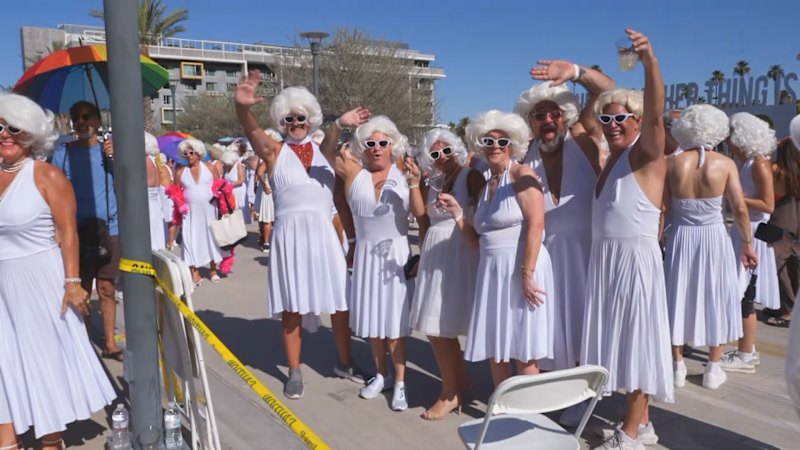
Mass look-alike gatherings are frequently dismissed as mere novelty spectacles, yet they operate under the same operational constraints, logistical bottlenecks, and economic principles as any large-scale live entertainment asset. When organizers attempt to set a world record for the highest concentration of a specific historical figure—such as Marilyn Monroe—the challenge shifts from a simple cultural celebration to a complex optimization problem. Success requires managing strict standardization criteria while scaling participant acquisition and crowd throughput.
To analyze these events rigorously, one must evaluate the intersection of brand equity preservation, demographic participation elasticity, and the strict validation protocols enforced by official adjudicating bodies. The difference between a successful record and a costly logistical failure lies in an organizer's ability to treat cultural iconography as a measurable operational framework.
The Dual-Constraint Framework of Impersonation Records
Every look-alike record attempt operates under two competing forces: the Volume Requirement and the Fidelity Threshold.
                       High |  High-Fidelity Group
                            |  (Professional Impersonators)
                            |  * Low volume, high cost
                            |  * Low operational scalability
                            |
Fidelity (Standardization)  |--------------------------------------
                            |
                            |  Mass Participation Group
                            |  * High volume, low cost
                            |  * High operational risk (rejection)
                        Low |______________________________________
                             Low                             High
                                    Volume (Throughput)
The Volume Requirement dictates the absolute minimum number of participants needed to surpass the existing benchmark. This is a pure logistical throughput metric. The Fidelity Threshold represents the qualitative standard every single participant must meet to be officially counted. If the standard is too low, the adjudicating body disqualifies the attempt. If the standard is too high, the talent pool shrinks below the minimum volume required to break the record.
The Elasticity of Participant Adherence
Professional look-alikes possess high-fidelity assets—custom-tailored garments, period-accurate styling, and developed performance traits. However, this demographic is statistically small and geographically dispersed. To achieve the volume necessary for a world record, organizers must rely on amateur participants.
Amateur participation is highly elastic and inversely proportional to the cost and complexity of the required attire. For a Marilyn Monroe record attempt, the baseline uniform is typically anchored to a highly recognizable cultural touchstone: the white dress from the 1955 film The Seven Year Itch.
By restricting the entry criteria to this specific, easily replicated visual asset, organizers lower the economic barrier to entry for amateurs. This optimization creates a predictable cost function for participants:
- Tier 1: Professional (Low Elasticity): High investment ($500+), custom fabrication, high fidelity, low total volume.
- Tier 2: Enthusiast (Moderate Elasticity): Medium investment ($100–$300), off-the-rack replicas with minor modifications, medium fidelity.
- Tier 3: General Public (High Elasticity): Low investment (<$50), mass-produced costumes, variable fidelity that threatens the verification process.
The operational risk escalates within Tier 3. If mass-produced costumes fail to meet the minimum structural definitions set by adjudicators (e.g., incorrect dress cut, wrong wig color), the rejection rate at the gate rises, directly threatening the total volume count.
Verification Logistics and Gate Bottlenecks
The primary operational failure point in mass gathering records occurs during the verification phase. Adjudication agencies do not accept aggregate crowd estimates; they require individual, auditable verification. This transforms the entry venue into a strict queuing system that can be modeled using standard operations management principles.
The Queue Bottleneck Formula
If the arrival rate of participants exceeds the processing capacity of the verification gates, a bottleneck forms. In a limited time window—often dictated by venue permits or talent availability—long wait times lead to participant attrition, where individuals leave the queue before being counted.
To prevent this, organizers must calculate the required number of verification channels based on three variables: the target record number ($T$), the time window available for assembly in minutes ($W$), and the average verification time per participant in minutes ($V$). The minimum number of parallel verification gates ($G$) required is defined by the following relationship:
$$G \ge \frac{T \times V}{W}$$
If an organization aims for 1,000 participants within a 120-minute window, and an adjudicator takes 15 seconds ($0.25$ minutes) to verify the outfit, wig, and makeup of each individual, the system requires a minimum number of gates calculated as:
$$G \ge \frac{1000 \times 0.25}{120} \approx 2.08$$
Accounting for human variance, arrival spikes, and registration errors, operational design dictates doubling this theoretical minimum to at least four active gates. A failure to scale these entry points results in a collapsed queue, reduced participant morale, and an under-count of verified individuals.
The Rejection Vector
Verification gates must enforce a binary pass/fail metric based on pre-published guidelines. For a Marilyn Monroe attempt, the criteria generally include:
- The Platinum Blonde Wig: Must match the specific short, curled hairstyle associated with the mid-1950s era. Straight hair or alternative colors are rejected immediately.
- The White Halter Dress: Must feature a pleated skirt and a plunging halter neckline. Deviations into other iconic outfits (such as the pink silk gown from Gentlemen Prefer Blondes) introduce visual heterogeneity that adjudicators may reject if the record category is strictly defined by the specific white dress iconography.
- Cosmetic Signifiers: The presence of the characteristic facial mole and red lipstick.
When a participant fails any of these criteria, they enter the rejection vector. Organizers can mitigate this loss of volume by establishing an on-site "remediation station"—a supply depot stocked with extra wigs, makeup, and safety pins to rapidly upgrade Tier 3 participants to meet the Fidelity Threshold before they re-enter the verification queue.
Value Capture and Brand Exploitation Strategies
A look-alike record attempt is rarely an isolated philanthropic endeavor; it is an optimization engine for brand equity, tourism, or intellectual property monetization. The economic value generated by these events relies on the density of visual assets captured for media distribution.
The Attention Economy of Mass Replication
The visual impact of hundreds of identical individuals creates an uncanny valley effect that commands high editorial value in media landscapes. This value can be quantified through Earned Media Value (EMV). Instead of purchasing traditional advertising, the event leverages the surreal nature of the imagery to secure organic placement across global news networks, digital publishers, and social feeds.
The ROI of the event can be tracked by comparing the total operational cost (venue rental, adjudication fees, marketing, remediation infrastructure) against the equivalent advertising spend required to achieve the same reach:
$$\text{Net Event Value} = \text{Earned Media Value} - \text{Total Operational Outlay}$$
Geocentric Tourism Impacts
For municipal hosts, these events serve as regional activation strategies. The influx of participants and spectators drives short-term demand in localized hospitality sectors. The economic impact is calculated using a standard multiplier effect, factoring in average spend per attendee on lodging, transport, and dining.
However, the geographic draw depends heavily on the enduring global relevance of the icon. Icons with cross-generational and international recognition lower the geographic acquisition cost of participants, drawing travelers from wider radiuses compared to localized or contemporary figures whose cultural footprint is regionally constrained.
Longevity and Decay of Iconographic Equity
The viability of a specific look-alike record depends on the cultural lifecycle of the subject. Marilyn Monroe represents a unique case of a high-equity, slow-decay brand. Decades after her death, her visual signifiers remain universally recognizable, separating the icon from the historical individual.
The Semiotic Reduction Loop
The success of a mass impersonation event relies on "semiotic reduction"—the process by which a complex human identity is simplified into a few distinct, easily reproducible visual symbols.
[ Historical Individual ] ---> [ Media Representation ] ---> [ Semiotic Reduction ]
                                                             * Platinum curls
                                                             * White pleated halter
                                                             * Red lipstick
                                                             * Facial mole
                                                                     |
                                                                     V
                                                       [ Mass Impersonation Asset ]
This reduction allows the general public to instantly recognize the impersonation, even when executed by individuals who deviate significantly from the subject's physical archetype.
The long-term risk for organizers targeting older historical figures is the eventual widening of the generational gap. As the primary audience with direct exposure to the subject's media catalog ages, the participation pool shifts from genuine fandom to ironic or novelty participation. This shift alters the demographic profile of the event, typically lowering the average participant's willingness to spend on high-fidelity attire, which subsequently forces organizers to allocate more capital toward on-site remediation to preserve the verification rate.
Executing the Tactical Blueprint
To execute an unassailable look-alike record attempt, operational leaders must bypass emotional appeals and deploy a strict, data-driven deployment strategy.
- Establish a Multi-Tiered Ticketing and Registration Matrix: Require participants to upload a photograph of their attire 14 days prior to the event. Categorize registrants into Fidelity Tiers based on these uploads. This provides a predictive model of the gate rejection rate before the event begins.
- Over-Index on Entry Gate Infrastructure: Deploy double the calculated number of required verification gates. Separate the professional impersonators from the amateur tiers. Route the professional tiers through accelerated lines to anchor the front rows of the media staging area early, ensuring the highest quality visual assets are positioned center-frame for press cameras.
- Capitalize the Remediation Depot: Allocate at least 15% of the operational budget to on-site compliance kits (wigs, lipsticks, adhesive beauty marks). Treat this not as an expense, but as volume insurance. Converting a non-compliant participant into a verified record contributor at the gate is significantly more cost-effective than acquiring a new participant through last-minute marketing channels.
- Align Media Capture with Maximum Density: The official count must occur simultaneously with the peak press window. Do not allow the crowd to linger in an un-staged format post-verification. Move verified assets directly into a high-density grid formation to maximize the visual scale of the photograph, which directly drives the Earned Media Value that justifies the entire event capitalization.