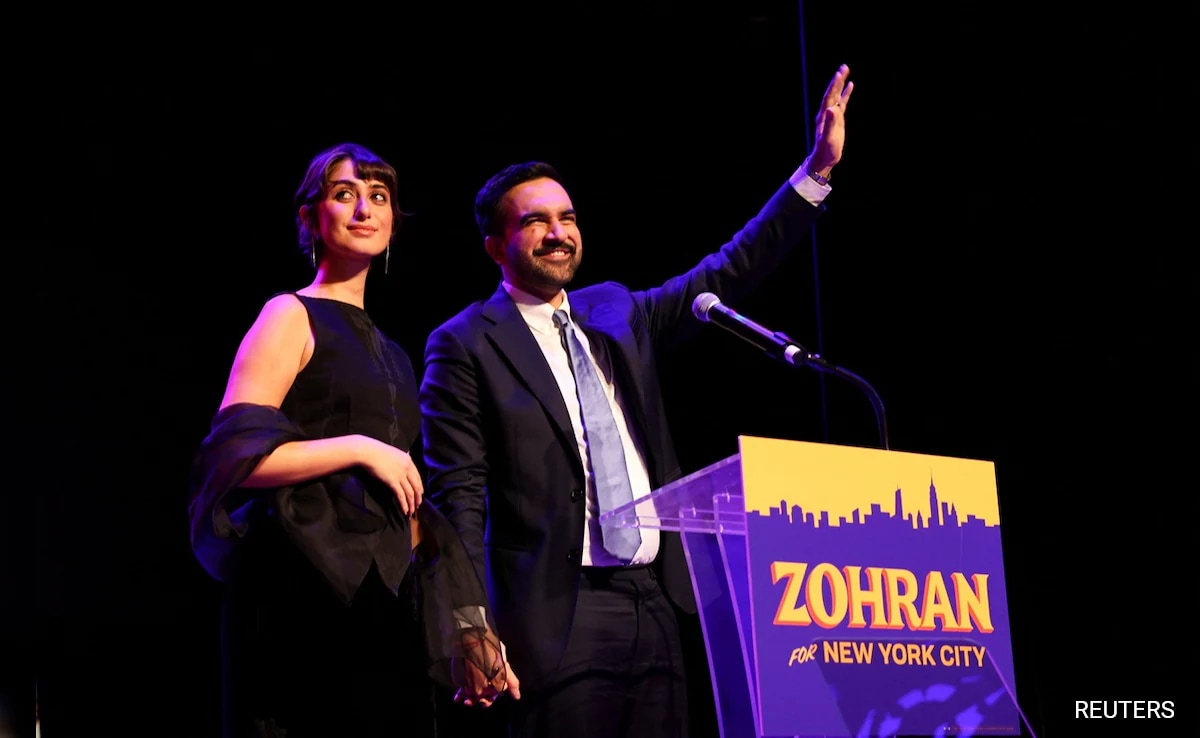
The political viability of an individual no longer rests solely on their own record but extends to the digital footprint of their immediate domestic unit. In the case of Zohran Mamdani, a New York State Assemblyman and mayoral candidate, the emergence of xenophobic and "harmful" social media posts made by his wife, Aditi Malhotra, during her adolescence, functions as a case study in the non-linear depreciation of political capital. This phenomenon operates through three distinct vectors: the erosion of the "purity of brand," the weaponization of historical data by opposition research, and the breakdown of the mitigation timeline. When a public figure’s spouse must issue a formal apology for rhetoric that contradicts the figure's core platform—in this case, an anti-colonial, inclusive, and socialist-leaning identity—the fallout is not merely a social gaffe; it is a structural failure of the candidate’s vetting and narrative defense systems.
The Lifecycle of Social Media Toxicity
The controversy surrounding Malhotra’s posts, which surfaced during Mamdani's high-profile mayoral run, demonstrates the permanence of the digital record. The posts, which reportedly included anti-black and anti-Palestinian sentiment from her teenage years, represent a "latent liability." In data-driven political strategy, a latent liability remains dormant until the candidate reaches a specific threshold of visibility or influence. At this juncture, the cost of discovery increases exponentially.
The mechanism of this crisis follows a predictable trajectory:
- The Discovery Phase: Opposition entities or independent actors mine deep-indexed social media archives.
- The Contextual Collision: The historical data is contrasted against current platform promises (e.g., Mamdani’s vocal support for Palestinian rights and racial equity).
- The Forced Reconciliation: The individual is compelled to issue a statement that attempts to bridge the gap between their past "juvenile" identity and their current "mature" brand.
Aditi Malhotra’s apology articulated a specific defense: that the posts were "harmful" and "shameful," yet were the products of a version of herself she no longer recognizes. From a strategic standpoint, this is an attempt to de-couple the current political asset (the wife of a candidate) from the historical data point. However, the efficacy of this de-coupling is limited by the audience's perception of "authentic evolution" versus "expedient pivot."
Structural Contradictions in Identity Branding
Mamdani’s political identity is heavily reliant on a specific ideological consistency. When a spouse’s past rhetoric mirrors the very systemic issues the candidate claims to dismantle, it creates a "reputation gap." This gap functions as a tax on the candidate's messaging efficiency. Instead of focusing on housing or transit, the campaign is forced to allocate cognitive and media bandwidth to damage control.
The severity of the damage is calculated via the Consistency Index:
- Direct Conflict: Does the past statement directly oppose a current policy pillar? (High Impact)
- Time Delta: How many years have passed since the post? (Moderate Mitigation)
- Corrective Action: Has the individual demonstrated a tangible shift in behavior prior to the discovery? (Low Mitigation if only reactive)
In the Malhotra instance, the "Time Delta" is the primary defense. The argument that teenage viewpoints should not be used to indict adult character is a standard cultural defense, yet it rarely holds up under the scrutiny of modern political hyper-polarization. This is because the "Harmful Post" acts as a synecdoche for the candidate's private life. If the domestic sphere is perceived as inconsistent with the public platform, the candidate's perceived integrity is diminished.
The Failure of the Pre-emptive Vetting Protocol
The surfacing of these posts indicates a failure in the campaign's internal auditing. In contemporary politics, a "scorched earth" digital audit is a prerequisite for any candidate seeking higher office. This process involves the systematic review of all public and semi-private digital footprints of the candidate, their family, and their key staff members.
A robust vetting protocol would have identified these posts during the exploratory phase of the campaign. The failure to do so creates a Reactive Disadvantage. When a campaign is forced to respond to external leaks, they lose control over the timing, the narrative framing, and the medium of the apology. Had these posts been addressed proactively—perhaps through a long-form interview or a self-published essay on personal growth—the "sting" of the discovery would have been neutralized. Instead, the apology appears as a defensive reaction to a looming political threat, which skeptics interpret as a move to save a campaign rather than a genuine moral reckoning.
The Dynamics of Modern Political Apologies
Malhotra’s statement utilized the "Evolutionary Framework," a common tactic in reputation management. This framework follows a rigid logic:
- Admit the Act: No denial of the original posts.
- Label the Harm: Using terms like "racist" or "xenophobic" to show alignment with the victim’s perspective.
- Distantiate the Self: Explicitly stating that the past self is a different entity.
- Re-affirm the Present: Pledging ongoing commitment to current values.
While this fulfills the immediate social requirement for a "response," it fails to address the underlying data problem. In the age of the "perpetual present"—where a tweet from 2011 is as visually accessible as a tweet from 2024—the human brain struggles to apply the necessary temporal context. The image of the post exists simultaneously with the image of the apology. This creates a cognitive dissonance that the opposition can easily exploit through visual repetition in attack ads or social media cycles.
Quantifying the Political Fallout
The impact of this controversy on Mamdani's mayoral bid can be measured through three key metrics:
- Donor Elasticity: Will high-level donors or institutional endorsements (like unions or advocacy groups) distance themselves to avoid "guilt by association"?
- Base Fragmentation: Does this alienate the "purist" wing of the progressive movement who view any past transgression as disqualifying?
- Media Saturation: Does the "apology story" garner more impressions than the "policy rollout"?
If the "Media Saturation" of the scandal exceeds 30% of the total campaign coverage over a seven-day period, the candidate suffers a "momentum stall." At this point, the campaign must pivot to a high-impact policy announcement to shift the focus, or risk the scandal becoming a defining trait of the candidacy.
Strategic Recommendations for Reputation Recovery
To stabilize the brand, the campaign must move beyond the "Statement of Regret" and enter the "Evidence of Change" phase. This requires moving from the abstract to the concrete.
The campaign should implement a Neutralization Strategy:
- Third-Party Validation: Enlist respected leaders from the communities harmed by the original posts to speak on the individual’s growth.
- Policy Doubling: The candidate should introduce a policy specifically aimed at the issues touched upon in the controversy (e.g., specific anti-discrimination legislation) to signal that their commitment is legislative, not just rhetorical.
- Digital Hygiene as Policy: Use the incident to advocate for "Right to be Forgotten" laws or digital literacy, turning a personal liability into a public advocacy point.
The ultimate test of a political brand is not the absence of failure, but the structural integrity of the recovery. For Mamdani, the challenge is to prove that his political project is larger than the individual flaws of his inner circle. If the campaign fails to integrate this apology into a broader narrative of growth and systemic change, it will remain a persistent anchor on his upward mobility. The political market is increasingly unforgiving of historical data that contradicts present-day branding, and the only viable defense is a combination of radical transparency and aggressive pre-emptive auditing.