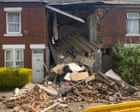
The destruction of residential property through deliberate gas manipulation represents a convergence of high-velocity physical risk and specific legal intent. When an individual intentionally compromises a domestic gas system to cause an explosion, they are not merely engaging in property damage; they are weaponizing critical infrastructure. An 11-year custodial sentence reflects a judicial calculation that balances the immediate kinetic impact—the leveling of a dwelling—against the psychological and societal costs of domestic terror. Understanding this case requires an examination of the chemical kinetics of natural gas, the legal threshold for "recklessness versus intent," and the structural economic impact of total property loss.
The Chemistry of Explosive Atmosphere Formation
The incident centers on the deliberate creation of a Stoichiometric Mixture. For a residential gas explosion to occur with enough force to destroy a structure, the ratio of natural gas (methane) to air must fall within the Lower Explosive Limit (LEL) and the Upper Explosive Limit (UEL).
- LEL (Lower Explosive Limit): Approximately 5% methane by volume. Below this, the mixture is too lean to ignite.
- UEL (Upper Explosive Limit): Approximately 15% methane by volume. Above this, the mixture is too rich, lacking sufficient oxygen for combustion.
The perpetrator in this instance creates a ticking clock by severing gas lines or opening valves. The time-to-detonation is a function of the room volume and the flow rate of the gas supply. Once the concentration reaches the 5-15% window, any ignition source—a pilot light, a refrigerator compressor kick-starting, or a deliberate flame—triggers an instantaneous release of energy. The blast wave moves at subsonic speeds (deflagration), but within the confined space of a brick or timber-frame house, the pressure rise is so rapid that the structural integrity of the walls is compromised before the gas can vent. This results in the "total loss" profile seen in the 11-year sentence case.
Legal Categorization of Intent and Endangerment
The judiciary assesses these crimes through three distinct layers of culpability.
1. Malicious Damage with Intent to Endanger Life
This is the most severe tier. It requires proof that the defendant specifically intended for the explosion to kill or seriously injure occupants. In the case of the 11-year sentence, the focus shifts to whether the perpetrator knew, or should have known, that the partner or neighbors were at risk. The law treats gas as an "inherently dangerous substance," meaning that once a person tampers with it, the burden of proving they didn't realize the danger becomes significantly harder.
2. Recklessness as to Whether Life is Endangered
Most convictions in this category hinge on "Cunningham Recklessness." This occurs when the defendant perceives a risk but chooses to take it anyway. Severing a gas pipe is an objective act of high-risk behavior. Even if the defendant claims they "only wanted to destroy the house," the law dictates that the unpredictability of gas expansion makes the endangerment of life a mathematical certainty rather than a speculative risk.
3. The Arson Equivalent
While gas explosions are not technically "arson" (which involves fire), they are prosecuted under similar sentencing guidelines. The destruction of a home—the primary asset and sanctuary of an individual—is viewed by the court as a form of "social murder." It terminates the victim's stability, financial standing, and physical safety in a single event.
The Cost Function of Residential Destruction
The 11-year sentence is not just a punishment for the physical act; it is an accounting of the total destruction of a life's infrastructure. The "Cost Function" of this crime includes variables that standard news reporting often overlooks:
- Total Capital Loss: The immediate evaporation of home equity. In many domestic sabotage cases, insurance policies contain "intentional act" exclusions. if the perpetrator is a co-owner or resident, the victim may find themselves with a destroyed home and a nullified insurance claim, leading to permanent financial ruin.
- Collateral Structural Integrity: Explosions are not contained by property lines. The shockwave (overpressure) can cause hairline fractures in the foundations of neighboring properties, leading to long-term depreciation and safety risks for an entire block.
- Emergency Response Overhead: The deployment of fire services, gas engineers, structural surveyors, and police cordons represents a massive public expenditure. The court views the perpetrator as the sole cause of this resource drain.
Behavioral Indicators of Infrastructure Sabotage
Analyzing the lead-up to such events reveals a pattern of "escalation through utility." Perpetrators often move from psychological control to physical environmental control.
- Isolation: Cutting off communication lines (internet/phone).
- Resource Denial: Shutting off water or electricity.
- Weaponization: Moving from denial of service to active destruction via gas or fire.
The use of gas is a specific choice. It is a "passive-aggressive" weapon; the perpetrator sets the stage and then leaves, or waits for an external trigger. This allows for a psychological distancing from the act that direct physical assault does not provide. The 11-year sentence serves as a corrective to this distancing, forcing the defendant to take legal responsibility for the totality of the kinetic outcome.
The Strategic Failure of the "Empty House" Defense
In many such trials, defendants argue that they checked the house was empty before the explosion. This defense almost always fails under rigorous legal scrutiny for two reasons. First, the "zone of danger" for a gas explosion extends far beyond the four walls of the target property. Debris can become lethal projectiles for hundreds of feet. Second, the timing of gas ignition is notoriously unstable. A perpetrator cannot guarantee that a neighbor, a delivery driver, or an emergency responder won't enter the zone of danger between the time the gas is released and the moment of ignition.
The court’s decision to impose an 11-year term signals that "checking the house" is a meaningless gesture in the face of the volatile physics of methane.
Quantitative Impact on the Victim’s Displacement
The recovery timeline for a victim of a leveled house is rarely measured in months; it is measured in decades.
- Phase 1 (0-6 Months): Acute displacement, loss of all personal effects (identity documents, heirlooms, clothing), and reliance on emergency state housing.
- Phase 2 (6-24 Months): Legal battles with insurance and mortgage providers. The victim remains liable for the mortgage on a pile of rubble unless specific clauses are triggered.
- Phase 3 (2-5 Years): Reconstruction or site clearance. The psychological trauma of returning to the site of an explosion often prevents rebuilding, forcing a "distress sale" of the land.
By sentencing the perpetrator to over a decade, the court is aligning the duration of the perpetrator’s loss of liberty with the duration of the victim’s struggle to regain a baseline existence.
The Role of Gas Distribution Safety Systems
This incident highlights a vulnerability in residential infrastructure: the manual bypass of safety valves. Modern gas meters often have "excess flow valves" designed to shut off if a pipe is completely severed. However, a slow leak—achieved by partially opening a valve or damaging a joint—can bypass these safety measures, allowing the gas to build up to the 5% LEL threshold without triggering a system-wide shutdown.
The strategy for preventing such events lies in the transition to "smart" gas sensors that are decoupled from the physical meter. These sensors can detect methane concentrations and trigger an external shut-off valve before the LEL is reached. Until such technology is mandatory, the domestic gas system remains a latent weapon for those with malicious intent.
The 11-year sentence must be viewed as a baseline for crimes involving the weaponization of domestic utilities. To mitigate the risk of such events, the legal system must continue to treat infrastructure sabotage as an aggravated offense, while insurance frameworks need to evolve to protect victims from the "intentional act" loopholes that currently leave them destitute. The focus must remain on the fact that when a house is destroyed by gas, the crime is not against the property, but against the safety of the collective residential environment.