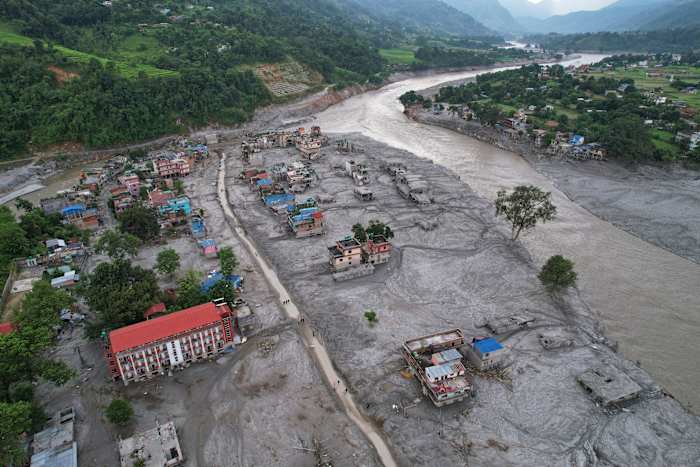
When an estimated mass of bedrock and glacial ice detaches from a four-thousand-foot vertical drop above the Langtang Lirung region, the resulting event is not a simple weather anomaly. It represents a systemic structural failure of high-altitude geological formations. On August 26, 2026, a catastrophic slope collapse in Nepal triggered a magnitude 5.2 seismic signature, generating a destructive debris avalanche that transformed river valleys in the Rasuwa district into high-velocity channels of mud, boulders, and water. While mainstream reporting attributes the disaster directly to general warming, a forensic evaluation of the underlying mechanics reveals a complex matrix of pre-conditioning factors, stress triggers, and compound hydraulic hazards.
Understanding why this disaster occurred requires shifting the analytical framework from isolated weather events to cumulative cryospheric destabilization.
The Pre-Conditioning Phase: Structural Fatigue and Subsurface Degradation
Mountain slopes at elevations exceeding four thousand meters maintain a delicate equilibrium dictated by thermal regimes and mechanical buttressing. This equilibrium relies on two primary variables: permafrost cementation and glacial lateral support.
Permafrost acts as a thermal glue. Frozen pore ice binds fractured bedrock together, providing shear strength across joint planes. When atmospheric temperatures systematically rise, this ice transitions from solid to liquid phase. The latent heat of fusion softens the bonding agent, increasing pore water pressure within the rock matrix. As internal pressures mount, the shear resistance of the joint planes drops precipitously.
Concurrently, regional glacial mass balance has turned persistently negative over the past three decades. As valley glaciers thin and retreat, they remove physical lateral pressure against adjacent steep rock walls. A glacier functions as an active counter-weight; when that mass recedes, the unsupported rock walls experience immediate gravitational stress redistribution.
Historical geological events compound this vulnerability. Major seismic events, such as the 2015 Nepal earthquake, introduced extensive micro-fracturing throughout the regional bedrock. While the mountain did not fail immediately in 2015, the earthquake established a baseline of structural fatigue. Over the intervening decade, thermal expansion and contraction driven by seasonal temperature fluctuations widened these micro-fractures, setting the stage for eventual structural failure.
The Trigger Matrix: Unprecedented Thermal Anomalies and Hydrological Surges
A pre-conditioned slope requires a distinct operational trigger to transition from static creep to dynamic failure. In late August 2026, the Hindu Kush Himalaya experienced temperature anomalies that pushed local thermal parameters past historical thresholds. July and August recorded the highest mean temperatures in instrumental observation history for those specific high-altitude zones.
This thermal spike accelerated two distinct fluid-driven mechanisms:
- Subglacial Meltwater Infiltration: Rapid surface melt generated unprecedented volumes of liquid water, which infiltrated deep into the newly opened bedrock fractures. This water acted as a hydraulic wedge, increasing hydrostatic pressure and reducing normal stress along potential slide planes.
- Anomalous Snowpack Dynamics: The preceding winter and late-season periods experienced atypical precipitation patterns, leaving residual snowpacks exposed to high summer ablation rates. The resulting influx of meltwater permeated the talus and rock-ice interfaces faster than subsurface drainage networks could evacuate it.
The convergence of thermal degradation and hydraulic pressure lowered the factor of safety for the slope below unity. Once gravitational shear stress exceeded the internal shear strength of the rock-ice composite, catastrophic detachment occurred within minutes.
The Hydrodynamic Cascade: Downstream Amplification and Secondary Failures
The initial rock and ice avalanche accounts for only the first stage of total destruction. The kinetic energy of the falling mass, combined with the dense fluid slurry generated upon impact, transformed the event into a high-density debris flow.
When this mass entered the narrow valley corridors, it created an instantaneous choking effect. The volume of debris temporarily choked the river channel, forming an unstable natural barrier dam. Water backing up behind this temporary earthen wall accumulated immense hydrostatic potential energy.
When the debris dam inevitably breached, the stored water released in an uncontrolled shock wave. This secondary mechanism—the barrier lake breakout flood—magnified the destructive radius far beyond the immediate impact zone of the initial landslide. Within forty-eight hours, a secondary barrier lake formed upstream in neighboring territory, creating a recurring threat profile that forced emergency evacuations across international borders.
The sequence demonstrates a fundamental principle of high-altitude risk analysis: damage is non-linear. A single mechanical failure at high elevation cascades through multiple physical subsystems, converting a localized geological collapse into a regional humanitarian crisis.
Operational Limitations in Early Warning Infrastructure
Current monitoring architectures remain structurally unequipped to predict failures of this specific magnitude. Traditional early warning systems rely primarily on hydrological sensors deployed in established river channels or remote cameras aimed at known glacial lakes. These networks operate downstream or at the surface, measuring symptoms rather than root causes.
Detecting deep-seated bedrock fatigue requires a different tier of instrumentation:
- Continuous high-precision GPS tracking of surface displacement vectors to measure micro-creep rates.
- Distributed arrays of seismic and acoustic monitoring units capable of listening to micro-fracturing within the rock mass weeks before macroscopic failure.
- High-frequency thermal imaging to track permafrost degradation depths across vertical faces.
Deploying such instrumentation across thousands of inaccessible high-altitude peaks presents severe logistical constraints and capital expenditure challenges. Consequently, hazard mitigation cannot rely entirely on real-time prediction. Risk management must transition toward vulnerability reduction, spatial planning restrictions in high-risk alluvial fans, and automated downstream evacuation triggers linked to regional seismic and mass-flow detection arrays.
Strategic Allocation of Cryospheric Defense Resources
Governments and multilateral development banks operating within High Mountain Asia must reallocate capital away from reactive disaster response and toward structural exposure reduction.
[Risk Mitigation Framework]
1. Baseline Spatial Mapping -> Identify high-risk valley corridors downstream of degrading permafrost.
2. Automated Early Detection -> Install seismic mass-flow sensors to gain seconds-to-minutes reaction windows.
3. Infrastructure Hardening -> Relocate critical energy and transport assets outside historical debris-flow zones.
Investment strategies should prioritize relocating vulnerable settlements away from alluvial fans and narrowing zones of habitation directly downstream of unstable moraine and rock complexes. Engineering interventions to drain dangerous glacial lakes can reduce specific hydrodynamic risks, but they offer zero mitigation against sudden bedrock avalanches. Stakeholders must accept that as regional thermal baselines continue to shift upward, mountain slopes will remain in an active state of transition. Long-term regional survival depends on engineering communities to adapt to structural instability rather than attempting to freeze an unyielding terrain in place.