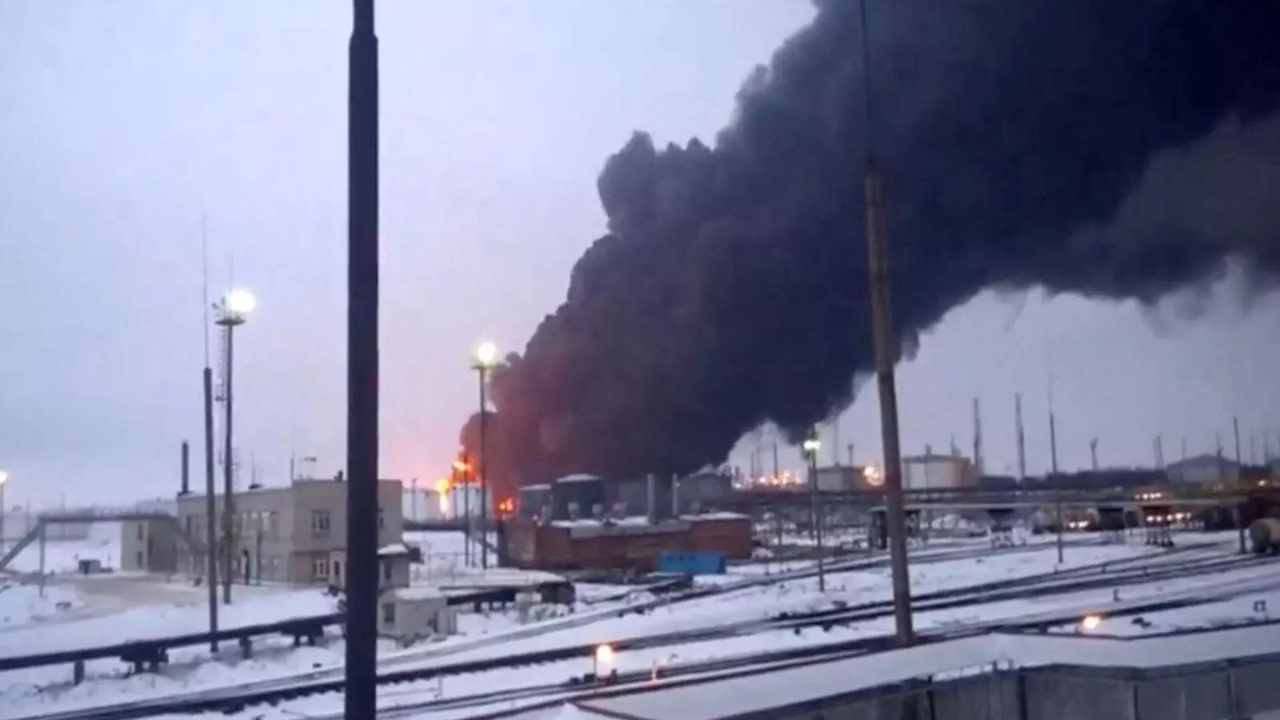
The strategic calculus of modern asymmetric warfare is dictated by a stark economic disparity: the cost of a long-range strike weapon versus the systemic cost of the disruption it inflicts. Recent Ukrainian drone strikes targeting Russian oil facilities, including operations that resulted in localized casualties and infrastructure damage, are not isolated tactical disruptions. They represent a deliberate, system-level campaign designed to exploit structural vulnerabilities in Russia's downstream energy supply chain. By analyzing these kinetic actions through the lens of industrial logistics and air defense saturation, we can isolate the precise operational mechanisms driving this campaign.
To understand the strategic utility of these strikes, one must move past the surface-level reporting of casualties and localized fires. The true impact lies in the compounding degradation of refining capacity, the diversion of military air defense assets from the front lines, and the structural friction introduced into the Russian domestic economy.
The Triad of Infrastructure Vulnerability
Targeting an energy network requires an understanding of industrial bottlenecks. Refining facilities are not uniform monoliths; they are highly integrated, fragile ecosystems. Ukrainian targeting methodology isolates three specific vulnerabilities within these complexes.
Primary Fractionation Towers
The core of any oil refinery is the atmospheric distillation unit, specifically the primary fractionation tower. These structures are highly visible, thermally distinct, and structurally delicate. If a drone strikes a storage tank, the result is a photogenic but economically manageable fire. If a drone penetrates a fractionation tower, the entire refining line halts. These towers require bespoke engineering and specialized metallurgy to replace—components that are heavily restricted under international sanctions regimes, creating a severe supply chain bottleneck for repairs.
Transshipment and Choke Points
Refineries rely on continuous input and output. Rail hubs, pumping stations, and port terminals connected to these facilities represent high-density targets. Disruption at a transshipment node forces upstream production halts because crude oil and refined products cannot be stored indefinitely on-site.
Power and Automation Substations
Modern petrochemical processing is entirely reliant on industrial control systems (ICS) and localized power grids. Specialized electrical substations feeding these facilities are frequently unarmored and positioned outside the primary containment walls, making them highly susceptible to fragmentation damage from low-cost loitering munitions.
The Cost Function of Asymmetric Air Defense
The operational friction imposed on Russian air defense networks exposes a structural imbalance in modern military doctrine. A state defending vast geographic expanses faces a mathematical impossibility when attempting to secure every critical infrastructure asset against low-altitude, low-radar-cross-section (RCS) threats.
The economic reality of this paradigm can be expressed through a simple resource allocation problem. A defending force possesses a finite number of advanced surface-to-air missile (SAM) systems, such as the S-400 or Pantsir-S1. Each engagement presents a specific cost profile:
Engagement Cost = (Cost of Interceptor Missile) - (Cost of Attacking Drone + Value of Protected Asset)
When Ukraine deploys a long-range drone costing roughly $20,000 to $50,000, the defending force faces a compounding dilemma:
- Interceptor Depletion: Utilizing a missile costing between $500,000 and $2 million to down a low-cost drone creates a negative economic attrition rate for the defender.
- Coverage Dilution: Moving a Pantsir-S1 unit to protect a domestic oil refinery in Krasnodar or Rostov directly removes tactical air defense capability from active combat zones in Ukraine, exposing front-line maneuvers to strike aircraft.
- Sensor Saturation: Low-altitude paths allow drones to exploit terrain masking, reducing the radar horizon of ground-based sensors and compressing the defender’s engagement window to seconds.
Kinetic Outcomes vs. Systemic Friction
Evaluating the efficacy of a strike based solely on immediate damage metrics misses the broader economic objective. The campaign operates on a dual-track mechanism of kinetic destruction and systemic friction.
The kinetic track achieves quantifiable reductions in refining throughput. Industry data indicates that sustained drone campaigns can successfully offline significant percentages of total Russian refining capacity for weeks or months at a time. This forces a cascade of macroeconomic adjustments. The state must choose between cutting lucrative refined product exports to preserve domestic supply, or allowing domestic fuel prices to escalate, risking internal economic stability.
The friction track is more insidious. It manifests as a sharp increase in insurance premiums for commercial shipping and energy transport within the strike zone. It demands the implementation of passive defense measures, such as steel netting around fractionation towers, which consumes industrial resources and slows down routine maintenance schedules. Furthermore, it introduces psychological friction, forcing operational staff to operate under continuous threat conditions, which degrades labor productivity and increases operational error rates.
Technical Adaptations in Long-Range Loitering Munitions
The evolution of Ukrainian strike capabilities reflects an accelerated hardware iterative cycle. Early operations relied on modified commercial reconnaissance platforms or Soviet-era jet drones. Current operations utilize purposefully designed, low-cost long-range strike platforms characterized by distinct architectural choices.
Composite Construction
The extensive use of carbon fiber, fiberglass, and molded plastics minimizes the radar cross-section, making detection by traditional early-warning radars exceedingly difficult until the platform is close to the target area.
Alternative Guidance Packages
To counter heavy Russian electronic warfare (EW) and GPS jamming, these drones have evolved past simple GNSS reliance. Modern variants employ visual navigation systems that map terrain features against pre-loaded satellite imagery, rendering localized GPS spoofing ineffective during the critical terminal phase of flight.
Commercial Component Integration
By leveraging mass-market internal combustion engines and consumer-grade electronics for non-critical systems, production can be scaled rapidly across decentralized civilian manufacturing nodes, bypassing traditional defense procurement bottlenecks.
Structural Constraints of the Campaign
While highly effective as an asymmetric lever, this strategic campaign faces distinct operational limits that prevent it from becoming a decisive, singular war-winning mechanism.
First, the payload capacity of a long-range loitering munition is structurally limited by the laws of aerodynamics and fuel consumption. A drone flying 800 kilometers typically carries a warhead weighing between 20 and 50 kilograms. This is sufficient to rupture pipes, ignite fuel vapor, and destroy sensitive electronics, but it lacks the kinetic energy required to collapse hardened concrete structures or deeply buried pipelines.
Second, the defender's adaptation curve is continuous. Russia has increasingly relied on localized electronic warfare umbrellas, physical barriers, and mobile air defense interception teams equipped with heavy machine guns and searchlights. This low-cost defensive response mirrors the offensive asymmetry, altering the success rate of deep-penetration missions over time.
Strategic Allocation Priority
For Ukraine to maximize the return on investment for long-range strike assets, targeting methodology must pivot from opportunism to strict economic sequencing. The priority must focus heavily on the destruction of specific components rather than generalized facility harassment.
Target Priority 1: Catalytic Cracking and Alkylation Units (Irreplaceable under current sanctions)
Target Priority 2: Rail Loading Racks and Export Terminal Infrastructure (Immediate export bottleneck)
Target Priority 3: Crude Distillation Units (High visibility, moderate repair time)
Target Priority 4: Finished Product Storage Tanks (Low strategic value, high visual impact only)
The optimal execution path requires the synchronization of multi-axis drone swarms designed to systematically overwhelm the localized air defense terminal batteries of a target facility. The initial wave must serve as an EW-decoy element, forcing the activation and subsequent ammunition depletion of active defense systems, while the secondary follow-on wave targets the primary fractionation infrastructure with precision terminal guidance. Only through this disciplined, component-level destruction can the asymmetric cost asymmetry be converted into a permanent structural deficit for the adversary’s war economy.