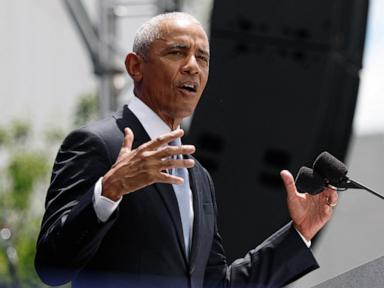
Late-cycle political fundraising does not operate as a linear purchase of votes; it functions as an insurance policy against statistical variance within the margin of error. In October 2026, former President Barack Obama told Democratic donors that key Senate and gubernatorial contests sit "on the razor's edge," warning that races showing a two- or three-point lead could all be lost by two points. Reported across outlets including CBS News and Political Wire alongside figures showing over $13.6 million raised by Obama for Democratic efforts, this warning highlights a structural vulnerability in modern American midterm elections: when races compress inside a three-point band, standard polling loses predictive certainty, and outcomes hinge entirely on marginal voter turnout and late-stage resource allocation.
Standard political journalism frames donor warnings as routine motivational rhetoric designed to prevent party complacency. A rigorous operational analysis reveals a different mechanism. When a former president raises $3.6 million in a single Democratic Senatorial Campaign Committee (DSCC) event in Virginia to push cumulative cycle fundraising past $13.6 million, the capital is not intended to alter fundamental voter ideology. Rather, it is deployed to solve a specific logistical problem: converting low-propensity, sympathetic voters into verified ballots within an electorate characterized by high polarization and narrow undecided pools.
The Statistical Mechanics of the Three-Point Band
To understand why a two- or three-point polling lead represents acute vulnerability rather than a comfortable buffer, analysts must separate systemic polling error from sampling error.
Public opinion polls typically report a margin of sampling error between plus or minus 3 and 4 percentage points at a 95 percent confidence interval. When a candidate holds a 2.5-point lead in a state such as Michigan, Ohio, or Georgia, the true underlying vote share overlaps entirely with a statistical tie or a narrow deficit.
Three structural variables compound this uncertainty in late-cycle midterm environments:
- Correlated Polling Error: State-level polling errors rarely distribute randomly across the electoral map. If a polling methodology undercounts a specific demographic—such as non-college-educated rural voters or disaffected urban youth—by two percentage points, that error replicates simultaneously across multiple battleground states. This explains Obama's explicit warning that Democrats could lose every single race currently showing a two-point advantage.
- Turnout Differential Volatility: Midterm electorates are significantly smaller and older than presidential electorates. A minor shift in enthusiasm between partisan bases alters the denominator of total votes cast, swinging final margins by three to five points without a single voter changing their mind.
- Late-Deciding Elastic Voters: The shrinking cohort of genuinely undecided voters tends to break disproportionately in the final 72 hours based on macroeconomic perception or immediate news cycles, introducing non-linear variance that early October polling cannot capture.
The Three Pillars of Late-Cycle Surrogate Deployment
High-profile political surrogates represent a finite, non-scalable asset. Deploying a former president across battleground states requires strict opportunity-cost calculations. Based on Obama's October 2026 campaign schedule—spanning fundraising in Virginia and ground rallies in Michigan, Ohio, and Georgia—the operational strategy relies on three distinct functional pillars.
1. Capital Aggregation and Downstream Liquidity
Early and mid-cycle fundraising builds campaign infrastructure, pays for staff, and reserves early television inventory. Late-cycle fundraising serves a distinct financial purpose: funding the high-cost, short-duration media buys and field operations of the final three weeks.
Television advertising rates spike in October due to lowest-unit-charge windows and inventory scarcity. Raising $3.6 million in a single Virginia DSCC event provides immediate liquidity to party committees, allowing them to reinforce vulnerable Senate seats or expand the map into unexpected battlegrounds—such as Texas, where Obama noted Democratic candidate James Talarico polling competitively against Ken Paxton—without cannibalizing funds reserved for core defensive states.
2. Coalition Bridging Across Ideological Factions
Midterm elections frequently expose fractures between a party's establishment wing and its progressive flank, particularly during periods of anti-incumbent sentiment. Left unresolved, these internal divisions depress turnout among younger and more ideological voters.
Obama's campaign appearances demonstrate a deliberate effort to neutralize ideological friction through direct endorsement and reframing. When campaigning in Michigan for Senate nominee Abdul El-Sayed and gubernatorial candidate Jocelyn Benson, Obama directly addressed criticisms that El-Sayed was "really left wing" by anchoring his platform—a higher minimum wage and universal healthcare—to the historical precedent of Franklin D. Roosevelt. Similarly, reporting from The Guardian notes that Obama openly acknowledged past progressive critiques of his own administration while campaigning alongside El-Sayed. This tactic functions as a coalition-repair mechanism: it grants establishment legitimacy to progressive candidates while signaling to skeptical progressive voters that party leadership validates their core policy priorities.
3. Earned Media Penetration in Fragmented Information Environments
Paid digital and broadcast advertisements suffer from declining marginal returns as voters experience message saturation in October. A major rally headlined by a former president bypasses paid media filters by generating localized earned media across regional television affiliates, local newspapers, and algorithmic social feeds.
By pairing targeted geographic stops—such as supporting former Senator Sherrod Brown and gubernatorial candidate Dr. Amy Acton in Cleveland, Ohio, or backing incumbent Senator Jon Ossoff and gubernatorial candidate Keisha Lance Bottoms in Georgia—the campaign forces local news cycles to center on the party's chosen framing, such as affordability and economic stability, rather than opposition narratives.
The Cost Function of Complacency in Fundraising
Obama's decision to emphasize vulnerability rather than momentum to high-dollar donors reflects an established behavioral principle in political finance: donor urgency correlates directly with perceived existential risk, not perceived inevitability.
In behavioral economics, loss aversion dictates that individuals expend significantly more resources to prevent a probable loss than to secure an equivalent gain. When polling headlines suggest a favorable national environment—including competitive numbers in traditionally difficult states like Alaska, Ohio, or Texas—major donors naturally redirect capital toward philanthropic initiatives, business investments, or long-term institutional projects, assuming their political investments are already secure.
By explicitly framing a two-point lead as a potential sweep of losses, the surrogate artificially reintroduces loss aversion into the donor room. This messaging strategy counteracts three specific operational failures that occur when a party believes it is ahead:
- Contribution Atrophy: Maxed-out individual donors stop bundling contributions from their professional networks during the final month, starving party committees of last-minute cash needed for get-out-the-vote (GOTV) field operations.
- Volunteer Defection: Grassroots canvassers and phone-bankers reduce their shift hours when they believe local races are safe, directly degrading the ground game required to turn out low-propensity voters.
- Strategic Overextension: Party committees prematurely divert funds from tight defensive races into long-shot offensive targets, leaving incumbents exposed to late opposition ad blitzes.
Structural Limitations of Surrogate-Driven Turnout
While high-profile surrogate deployment solves immediate fundraising and earned-media bottlenecks, treating it as a universal remedy misunderstands the mechanics of modern elections. Relying heavily on a national figure carries distinct operational constraints and diminishing returns.
First, national surrogates inherently nationalize local races. In states or districts where a Democratic candidate's viability depends on ticket-splitting voters or localized branding—such as distancing themselves from national party labels—an appearance by a former president reinforces partisan alignment. While this energizes the core Democratic base, it simultaneously triggers counter-mobilization among opposing partisan voters who might otherwise remain disengaged during a non-presidential cycle.
Second, surrogate rallies exhibit high efficiency for voter persuasion among engaged partisans but lower efficiency for reaching truly disconnected voters. Individuals who attend a political rally or consume political news coverage are already high-propensity voters. Converting the marginal voter who decides an election by 0.5 percentage points requires micro-targeted digital outreach, peer-to-peer relational organizing, and persistent door-to-door field contact—operations that require capital rather than speeches.
Third, late-cycle rhetoric cannot overcome structural macroeconomic headwinds. If voters attribute inflation, housing costs, or regional economic stagnation to the governing environment, campaign messaging around institutional norms or future policy risks faces steep resistance at the ballot box.
Capital Allocation Protocol for Final-Month Campaigns
Campaign managers and political committees operating within a three-point polling band must subordinate media optics to mathematical efficiency during the final 30 days. Rather than distributing late-cycle capital evenly across all competitive states, resource allocation should follow a strict triage protocol:
- Lock Defensive Floors Before Funding Offensive Expansion: Allocate the first tranche of late-cycle funds—such as the $13.6 million raised through surrogate events—exclusively to states where incumbent defense or realistic majority control sits within a three-point margin (e.g., Michigan, Georgia, and Ohio). Offensive investments in states like Texas or Alaska must remain strictly contingent on defensive metrics hitting 100 percent of their field-budget targets.
- Shift Budget Ratios Toward Direct Voter Contact: Once broadcast television markets reach saturation, redirect marginal dollars away from broad-reach television spots and toward paid field canvassers, ballot-cure operations, and targeted digital reminders aimed specifically at irregular voters who participated in 2022 or 2024 but have not yet requested or returned midterm ballots.
- Deploy National Surrogates Exclusively for Asymmetric Base Mobilization: Restrict physical appearances by national figures to high-density metropolitan areas and university hubs where the net gain in base turnout mathematically outweighs the risk of polarizing surrounding suburban or rural media markets.
Check out Both parties make a push before the midterm elections for broadcast coverage of the final-stretch messaging and campaign rallies ahead of the 2026 midterm elections.