The tech elite have abandoned the silicon valley uniform, and the watch media is completely misreading the signal.
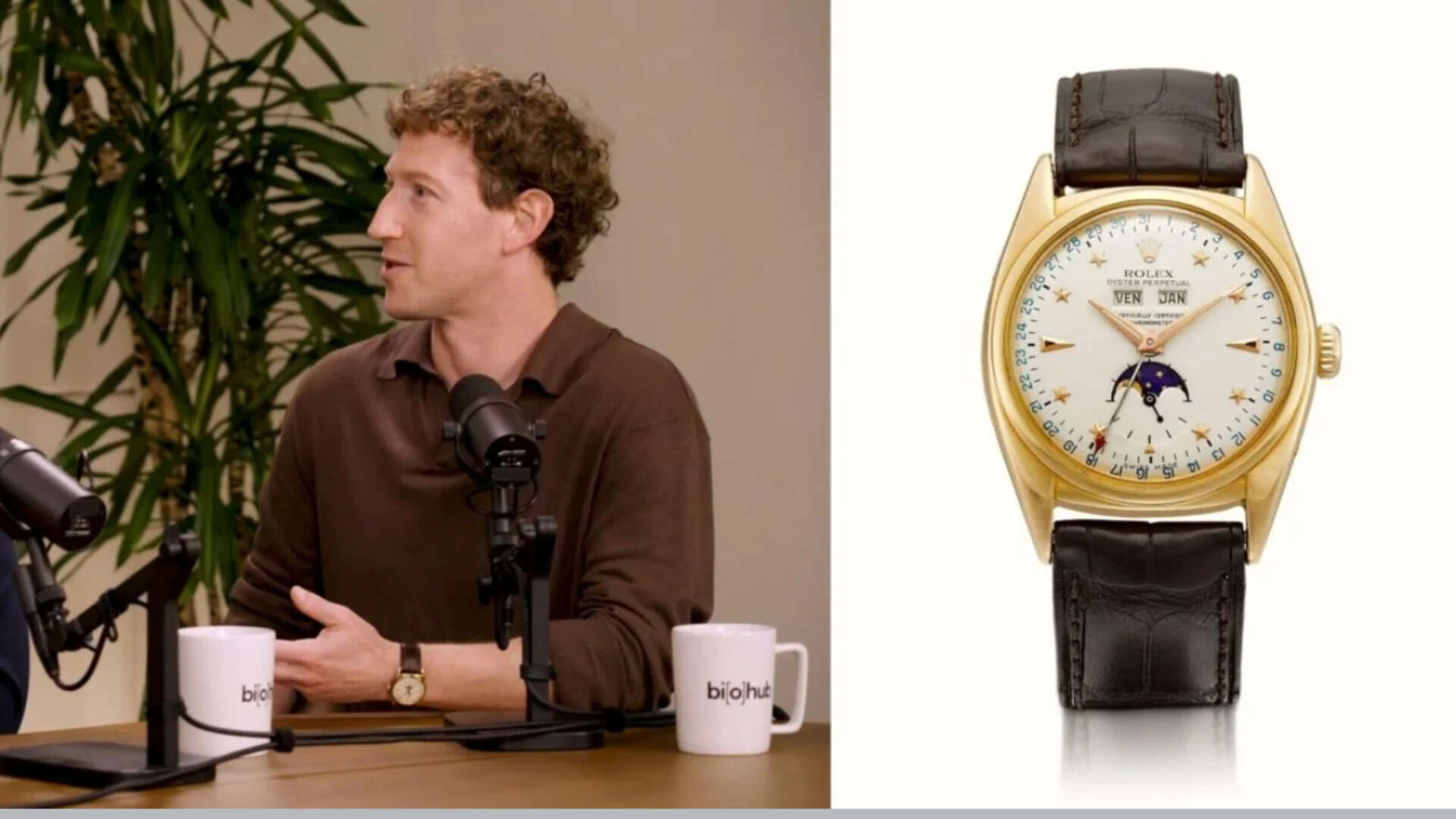
When Mark Zuckerberg was spotted wearing a vintage, mid-century Patek Philippe Ref. 2526 with a rare enamel dial and a moonphase complication—a watch valued north of $2 million—the collective internet regurgitated the same tired narrative. The consensus was immediate, lazy, and superficial: Billionaire discovers old luxury. Tech bro gets a taste for high horology. Silicon Valley embraces traditional craftsmanship.
This analysis misses the entire point of why the world’s most powerful tech executives are suddenly raiding the archives of Geneva’s holy trinity.
Zuckerberg is not having a midlife crisis, nor is he suddenly fascinated by the micro-mechanics of 1950s escapements. He is executing a calculated pivot. The pivot from utility to permanence.
For two decades, the Silicon Valley ethos was defined by the ephemeral. Code is rewritten daily. Hardware is obsolete in eighteen months. Servers are spun up and torn down in seconds. When you spend your entire life building digital empires out of thin air, you eventually develop a deep, psychological hunger for the unalterable.
The mainstream press wants you to look at a moonphase indicator and marvel at the romance of tracking lunar cycles. They want you to think about the heritage. Let's dismantle that illusion right now.
The Myth of the Reformed Tech Minimalist
Every profile tracking this sudden shift in executive style frames it as an evolution. They claim that as founders mature, their tastes refine. They move from the grey t-shirt to custom streetwear, and from the Apple Watch to the ultra-rare vintage Patek.
That is a fundamental misunderstanding of status signaling.
The Apple Watch stopped being a status symbol the moment it became a mass-market commodity. When every middle manager and barista is wearing the exact same aluminum rectangle on their wrist, the tool loses its ability to communicate power. Worse, the smartwatch is an explicit confession that your time belongs to someone else. It is a leash disguised as a luxury. It buzzes when you have an email. It vibrates when a meeting changes. It demands your attention.
A $2 million vintage Patek Philippe does absolutely nothing for your productivity. It does not sync with your calendar. It does not track your sleep. It barely keeps time to within a few seconds a day compared to an atomic clock.
That inefficiency is the entire point.
[The Status Signal Spectrum]
Mass Commodity -------------------> High Utility -------------------> Absolute Sovereignty
Apple Watch                         Rolex Submariner                  Vintage Patek Philippe
(Connected / Leashed)               (Durable / Standard)             (Autonomous / Untouchable)
Wearing a mechanical watch from the 1950s that requires manual intervention to stay accurate is the ultimate declaration of autonomy. It tells the world that you do not need to be reachable. You do not need to be optimized. You have reached a level of capital where the passage of time is something you observe, not something that dictates your actions.
Why the Watch Media Misunderstands the Enamel Dial
The specific watch in question—the Ref. 2526—is legendary among serious collectors not because it is flashy, but because of its dial. It features a twice-baked enamel face. Unlike standard metal dials that oxidize, tarnish, or fade over decades, enamel remains completely impervious to time. A 2526 dial looks exactly the same today as it did when it left the workshop in 1953.
The tech press looked at that dial and saw an aesthetic choice. They are blind to the structural irony.
Consider what Zuckerberg builds: the Metaverse, ephemeral feeds, social graphs that mutate by the hour. His core businesses exist entirely in the digital ether, prone to bit rot, platform shifts, and regulatory execution. By anchoring his physical identity to a twice-baked enamel dial, he is engaging in historical arbitrage. He is buying the one asset class that explicitly resists the corrosive, fast-moving nature of the software industry he helped create.
I have spent years advising founders on brand positioning, and I have watched them throw millions of dollars at modern luxury assets—hypercars, custom superyachts, mega-mansions. Those assets depreciate or require massive, active maintenance. They are liabilities masquerading as net worth.
Vintage horology is different. It is a finite, historical supply cap. Patek Philippe only made an estimated 600 total pieces of the Ref. 2526. Only a fraction of those featured specialized complications or specific dial configurations. You cannot manufacture more 1953 steel or enamel. You cannot spin up a new instance of mid-century Swiss craftsmanship.
The Flawed Premise of the "Investment" Narrative
Whenever a piece of this magnitude appears on a billionaire's wrist, the inevitable question surfaces across forums and financial columns: Is this a good investment?
This is the wrong question entirely. Even worse, it's a broke mindset applying retail logic to sovereign wealth.
To a man with a net worth hovering around $150 billion, a $2 million watch is not an investment asset. It is the financial equivalent of a rounding error on a rounding error. Calculating the compound annual growth rate (CAGR) of a vintage Patek for someone of that scale is an exercise in futility. They do not care if the watch appreciates by 8% or depreciates by 12% over the next decade.
The true value lies in institutional access and narrative control.
By entering the highest echelons of vintage collecting, you are not buying a piece of jewelry; you are entering an exclusive, unwritten network of global asset holders. The individuals who own these watches are the old-money gatekeepers of Europe, the sovereign wealth funds of the Middle East, and the silent titans of private equity. These are circles that do not care about daily active users or ad-retargeting algorithms. They care about lineage, permanence, and discretion.
The vintage watch is a passport. It bypasses the loud, tacky signaling of the nouveau riche and immediately establishes a shared vocabulary with the world's most protected capital.
The Downside of the Counter-Intuitive Pivot
Let’s be brutally honest about the risks of this strategy. While this shift from tech-minimalist to archival-collector creates a powerful aura of maturity and permanence, it carries an inherent vulnerability.
It risks alienating the very culture that built the empire.
Silicon Valley’s core mythos is rooted in the garage. It relies on the illusion that the founders are just like the engineers—grinding late nights, drinking bad coffee, focused entirely on the future. The moment an executive starts wearing a piece of history that costs more than their average employee will make in a lifetime, the illusion shatters permanently.
It marks the transition from the disruptor to the establishment.
[The Evolution of Executive Signaling]
Phase 1: The Disrupter (Hoodies, generic sneakers, total focus on product)
Phase 2: The Scale Exec (Tailored suits, high-end sportswear, curated lifestyle)
Phase 3: The Sovereign (Archival luxury, historic assets, detachment from the present)
This transition is dangerous if executed poorly. It can signal to your workforce that you are no longer looking forward; you are looking back. It implies that the most interesting things being made are no longer happening inside your own labs, but happened seventy years ago in a Swiss village.
Stop Misreading the Horizon
The world is changing, and the rules of executive presence are being completely rewritten. The era of the hyper-functional, hyper-optimized tech CEO is dead. The new meta is focused entirely on sovereignty, legacy, and historical anchoring.
Do not look at the wrist of the world's elite and think they are suddenly interested in the phases of the moon. They do not care about the moon. They care about building something that survives the digital meat grinder.
They are telling you exactly where the real power is moving. If you are still judging their influence by their software updates or their quarterly earnings calls, you are looking at the wrong dial.