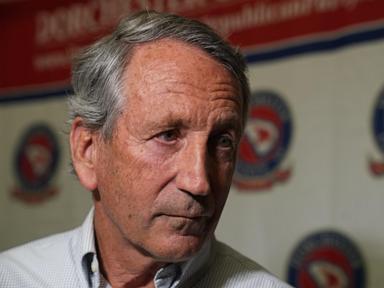
Mark Sanford is walking away from the ballot box, but he isn’t leaving the fight. After a lifetime spent navigating the jagged edges of South Carolina politics and the halls of Congress, the former governor has scrapped his latest bid for a House seat. This isn't just another politician retiring to a quiet life of consulting or corporate board memberships. Instead, Sanford is pivoting to the nonprofit sector, launching an organization dedicated to a singular, ignored obsession: the American national debt. It is a move that signals a profound shift in how fiscal conservatives view their own relevance in a Republican Party that has largely moved on from the "Tea Party" era of budget hawkishness.
The decision to withdraw wasn't fueled by a lack of name recognition or a sudden change of heart. It was a calculated realization that the current political apparatus no longer has an appetite for the brand of fiscal austerity Sanford has championed for decades. He is trading a voting card for a megaphone, betting that he can exert more influence on the country’s $34 trillion balance sheet from the outside than he can from the back benches of a fractured House GOP.
The Death of the Deficit Hawk
For years, the national debt was the cornerstone of Republican identity. We saw the rise of the Freedom Caucus and the 2010 wave that swept fiscal conservatives into power with the promise of "balancing the books." Those days are gone. The modern political climate prioritizes cultural warfare and populist trade policies over the dry, often painful math of entitlement reform and spending caps.
Sanford’s exit is the final nail in the coffin for that era. He recognizes that the party's center of gravity has shifted. When he looks at the current legislative agenda, he doesn't see a path toward the fiscal discipline he views as a moral imperative. By forming a nonprofit, he is essentially admitting that the legislative process is broken beyond repair for anyone seeking to address long-term insolvency.
The math is brutal. The United States is currently adding roughly $1 trillion to its debt every 100 days. Interest payments alone are beginning to eclipse the entire defense budget. In a functional system, this would be the only story on the front page. In our current system, it is a footnote. Sanford’s nonprofit aims to move that footnote back to the headline, but he faces an uphill battle against a public—and a political class—that has become addicted to deficit spending.
A Nonprofit Built on Accountability
The proposed organization isn't meant to be a simple "think tank" that churns out white papers destined to gather dust in Congressional offices. Sources close to Sanford’s camp suggest the goal is much more aggressive. It is about creating a "debt scorecard" that holds politicians’ feet to the fire in real-time.
Breaking the Cycle of Cheap Money
The core problem Sanford identifies is a fundamental misalignment of incentives. Politicians are rewarded for spending money today and punished for suggesting cuts that would protect the economy tomorrow. A nonprofit can operate outside the two-year election cycle. It can afford to be unpopular. It can tell the truth about Social Security and Medicare—the two largest drivers of future debt—without worrying about losing a primary in a geriatric-heavy district.
Sanford has long argued that the "magic money tree" philosophy adopted by both parties is a recipe for a sovereign debt crisis. His new venture will likely focus on three primary pillars:
- Transparency: Stripping away the accounting gimmicks used by the Congressional Budget Office to hide the true cost of legislation.
- Education: Connecting the dots for the average voter between federal debt and the "inflation tax" that erodes their purchasing power at the grocery store.
- Primary Pressure: Identifying and supporting candidates who are willing to take the "vow of fiscal poverty," refusing to vote for any budget that doesn't include a path to balance.
The Ghost of the Appalachian Trail
We cannot discuss Mark Sanford without acknowledging the baggage. His 2009 disappearance—famously explained as "hiking the Appalachian Trail" while he was actually in Argentina—remains one of the most bizarre chapters in American political history. It destroyed his national prospects at the time and turned him into a punchline.
Yet, Sanford’s political resurrection in 2013, winning back his old House seat, proved that voters in South Carolina were willing to separate personal failings from policy expertise. He remained one of the most consistent "no" votes in Washington, often standing alone against his own party on spending bills. His current departure from the race isn't a retreat caused by old scandals; it is a strategic repositioning. He has realized that his "scarlet letter" actually gives him a strange kind of freedom. He has already been through the fire. He has nothing left to lose, which makes him a dangerous critic for those in leadership who would rather ignore the looming fiscal cliff.
Why the Private Sector Fails Where Nonprofits Might Succeed
There is a reason Sanford isn't just joining a private equity firm or a lobbying shop. The private sector thrives on the stability provided by government spending. Defense contractors, healthcare giants, and infrastructure firms all have a vested interest in the continuation of the status quo. They want the taps to stay open.
A nonprofit model allows Sanford to bite the hand that feeds the rest of the Washington establishment. He isn't looking for a return on investment in the traditional sense. He is looking for a return on sanity. The challenge, however, will be funding. Most major donors to political causes are looking for immediate policy wins or regulatory relief. Funding a crusade against the national debt is a long-game play with very little immediate payoff. Sanford is banking on a small but dedicated group of "monetary patriots" who are terrified of what the 2030s look like if the current trajectory continues.
The Structural Trap of Entitlements
The real reason Sanford is quitting Congress to start this nonprofit is the "third pillar" of American politics: Entitlements. No one in Washington wants to touch them. They are the third rail. If you touch them, you die politically.
Sanford knows that the only way to address the debt is to reform Social Security and Medicare. But you cannot do that from inside a campaign. The moment a candidate mentions "adjusting the retirement age," their opponent runs ads featuring a grandmother being pushed off a cliff. By moving to a nonprofit, Sanford can advocate for these reforms from a distance, providing "air cover" for brave legislators who want to do the right thing but fear the electoral consequences.
He is essentially trying to build a lobby for the future. The debt is a burden placed on people who cannot yet vote—children and the unborn. Sanford’s nonprofit is, in theory, their representative in a system that only cares about the next fiscal quarter.
The Risks of Out-of-Office Activism
The danger for Sanford is irrelevance. Washington is a town that runs on power, and power is derived from the ability to trade favors and cast votes. Once you are no longer in the room, the room tends to forget you exist. We have seen many "principled" former members of Congress fade into the background, their newsletters unread and their warnings ignored.
However, Sanford isn't a typical former member. He has a history of being right about the math even when he was wrong about the politics. If he can leverage his media savvy and his genuine, almost obsessive, knowledge of the federal budget, he might create something more than just another 501(c)(3). He might create a movement.
The timing is certainly in his favor. As interest rates remain higher than they have been in decades, the cost of servicing the debt is becoming a tangible problem that even the most spendthrift politicians can no longer ignore. When the crisis eventually hits—and it will hit—people will look for the person who has been shouting about it for thirty years.
The Hard Truth About Sanford’s New Path
Let’s be clear: A nonprofit is not going to "fix" the national debt. The forces aligned in favor of spending are too powerful, the inertia of the federal bureaucracy is too great, and the American public’s desire for "free" services is too ingrained. Sanford knows this. He isn't a Wide-eyed optimist. He is a man who sees a ship heading for an iceberg and has decided that shouting from the deck wasn't working, so he’s jumped into a lifeboat to try and signal the rescue crews.
This isn't a career move; it's a desperate play for historical relevance. Sanford wants to be the man who can say "I told you so" when the currency devalues or the bond market revolts. But more than that, he wants to be the one holding the blueprint for the reconstruction when the current fiscal house of cards finally collapses.
He is betting that the truth about the debt will eventually become more powerful than the lies required to win an election. It is a massive gamble, and the odds are stacked heavily against him. But for a man who has already lost a governorship, a marriage, and a national reputation, it's a risk he is clearly willing to take.
The political machine has no use for Mark Sanford anymore, and frankly, he seems to have no use for it. The nonprofit isn't a consolation prize; it's a declaration of war on the status quo. Whether anyone will join him on the battlefield remains to be seen.
The era of the "polite" budget debate is over. If Sanford’s new venture succeeds, it will be because he embraced the role of the pariah, using his position outside the tent to set fire to the delusions keeping the inside comfortable. He has traded his seat at the table for the right to tell the people eating that the check is coming, and none of them can afford to pay it.