The brass nameplate on the third floor of the Pentagon didn't make a sound when it changed. It didn't need to. In the echoey, sterile corridors where decisions governing half the planet are made, the quietest adjustments often carry the heaviest weight.
For eight years, a specific phrase dominated briefings, budgets, and strategic doctrines: the Indo-Pacific. It was a massive, sprawling concept, an ambitious linguistic bridge thrown across two vast oceans to signal a new era of global focus. It felt modern. It felt expansive.
Then, the ink dried on a new directive. The name shifted back. The "Indo-" was gone, erased from the letterhead, restoring the historic moniker that had defined American presence in the region for generations: US Pacific Command.
To the casual observer scrolling through a newsfeed, this looks like bureaucratic trivia. It reads like political musical chairs or a pedantic exercise in military nomenclature. But geography is never just about dirt and water. It is about how we see the world, who we promise to protect, and where we expect the next great storm to break.
To understand why a deleted prefix matters, you have to leave the air-conditioned offices of Washington and look at the water through the eyes of the people who actually sail it.
The Weight of a Word
Consider a young officer standing watch on the bridge of a destroyer somewhere in the Philippine Sea. Around her, there is nothing but an obsidian expanse of water meeting a starless night sky. She isn't thinking about geopolitical chessboards or grand strategies crafted by think tanks. She is thinking about the radar screen, the rhythmic ping of navigation equipment, and the immense responsibility of keeping her crew safe in increasingly crowded waters.
For that officer, the name of her command dictates everything from her rules of engagement to the ports where her ship will pull in for fuel.
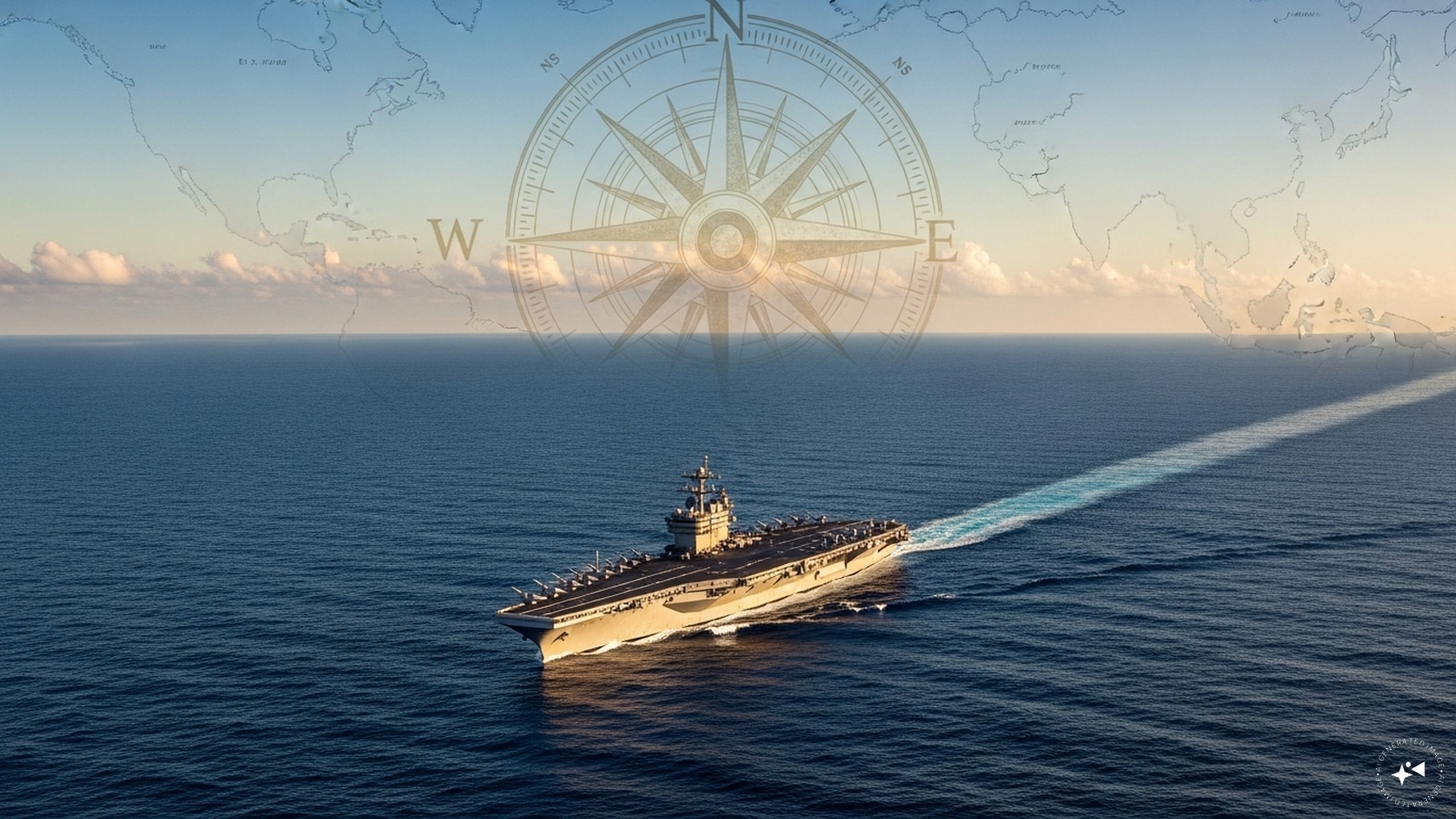
When the United States military rebranded its oldest and largest combatant command to "US Indo-Pacific Command" nearly a decade ago, it was a deliberate attempt to stretch the horizon. The goal was to loop India and the vast expanses of the Indian Ocean into a unified theater of operations. It was a grand architectural design meant to counter a rapidly rising superpower by aligning a democratic heavyweight on the other side of the Asian continent.
But grand designs on paper often collide with the brutal realities of distance, resources, and institutional memory.
The ocean is big. Mind-bogglingly big. The Pacific alone covers more of the Earth's surface than all the continents combined. Trying to manage both the Pacific and the Indian Oceans under a single operational mindset proved to be an administrative and strategic nightmare. It stretched focus thin. It blurred the lines of responsibility.
By dropping the title and reverting to the classic Pacific Command designation, the Pentagon did something rare in modern bureaucracy: it admitted the value of a sharper focus.
The View from the Waves
The old name carries a distinct ghost. Pacific Command—or PACOM, in the relentless acronym shorthand of the military—was forged in the crucible of World War II. It is a name etched into the black sands of Iwo Jima, the coral of Guadalcanal, and the deep waters of Midway. It represents a specific legacy of maritime dominance and a deeply ingrained network of traditional alliances with nations like Japan, South Korea, and Australia.
When you add "Indo" to that equation, the focus shifts westward, away from the immediate flashpoints of the Taiwan Strait and the East China Sea, and toward the subcontinent.
But India has always maintained a fiercely independent foreign policy, one deeply rooted in non-alignment. While Washington viewed the Indo-Pacific as a unified front, New Delhi viewed its priorities through its own lens, primarily focusing on its land borders and its immediate maritime neighborhood. The marriage of convenience on paper never quite translated into a seamless operational reality on the water.
The return to the legacy title signals a return to core business.
It is an acknowledgment that the primary friction points of the twenty-first century are concentrated heavily in the Western Pacific. The disputed reefs of the South China Sea, the fragile peace of the Taiwan Strait, and the defense of long-standing treaty allies require an undivided attention span. You cannot watch two oceans with equal intensity when the threat in one is growing exponentially louder by the day.
The Geography of the Mind
Human beings rely on maps to make sense of chaos, but the lines we draw on them are entirely imaginary. We group nations together under umbrella terms because our brains crave order. We talk about "The West" or "The Middle East" or "The Indo-Pacific" as if they are solid, unyielding realities rather than fragile political concepts.
When those concepts change, the friction is felt first by the people tasked with executing them.
Imagine the logistics coordinators who suddenly have to re-map supply chains, the diplomats who must explain to foreign ministries why a single word was dropped from a joint communique, and the analysts who have to recalibrate their software models. The transition isn't seamless. It is clunky, expensive, and deeply frustrating for the thousands of men and women caught in the middle of a bureaucratic pivot.
Yet, there is a quiet reassurance in the reversion. It strips away the jargon of the 2010s and replaces it with something grounded in historical permanence.
The Pacific Command title reflects a reality that has existed since 1947. It is an anchor. In an era defined by rapid technological shifts, hypersonic missiles, and gray-zone warfare that blurs the line between peace and conflict, anchoring a strategy in a known, historically proven framework provides a strange kind of stability.
A Return to the Center
This name change is not a retreat; it is a concentration of force.
By narrowing the linguistic and geographic scope, the command is signaling to adversaries and allies alike exactly where its eyes are fixed. The vast, blue spaces of the Pacific are no longer being shared conceptually with another ocean. The focus is back on the islands, the straits, and the ancient maritime routes where the global economy breathes.
Back on the destroyer in the Philippine Sea, the name on the official message traffic changes, but the mission remains identical. The crew still trains, the radar still spins, and the ocean remains as indifferent to human terminology as it has for millennia.
The mapmakers in Washington have simply adjusted their lenses, wiping away a decade of conceptual overreach to see the water exactly as it is: vast, dangerous, and demanding undivided attention.