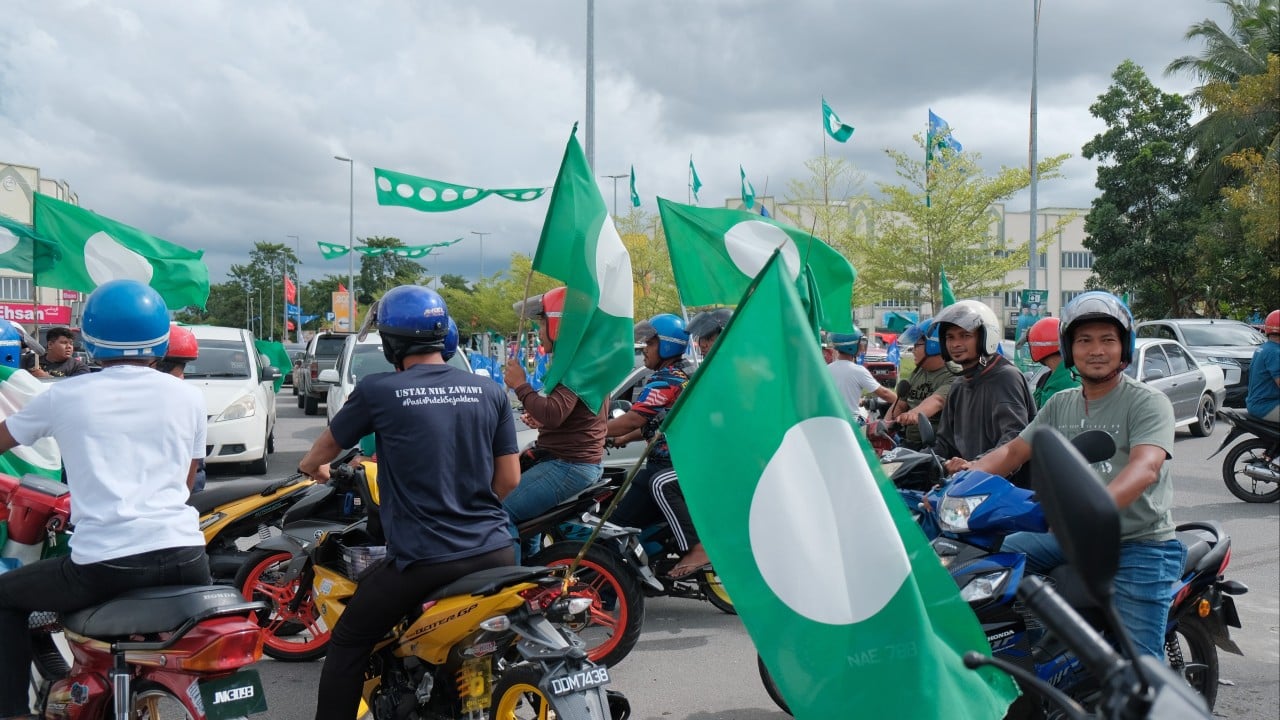
The morning air in Kuala Lumpur always smells of damp earth and exhaust fumes, a heavy blanket that settles over the asphalt before the sun can burn it away. Stand on a street corner in Kampung Baru, listen to the low hum of motorbikes weaving through gridlock, and you will feel the ordinary pulse of a nation built on a delicate bargain. For decades, that bargain kept religion in the mosques and politics in the parliament, distinct and parallel tracks.
Now, the tracks are converging. You might also find this related story insightful: The Straits of Hormuz and the Dangerous Myth of Total Control.
Consider a hypothetical voter named Amin. Amin sits in a plastic chair outside a kopitiam, stirring condensed milk into his morning coffee. He watches the headlines flicker across his phone screen. Another press conference. Another speech about moral governance. Another subtle shift in the tectonic plates of Malaysian power. Amin is not a political strategist. He is a mechanic with grease permanently lodged in the creases of his knuckles. Yet he feels the tremor.
Power in Malaysia has always been a mosaic. It is a country stitched together by ethnicity, language, and geography, spanning the bustling skyscrapers of the capital and the quiet, riverine kampungs of the northern coast. To govern this place requires holding contradictory truths in your hands without dropping them. As reported in latest coverage by The Guardian, the effects are worth noting.
Enter the Malaysian Islamic Party, known locally as PAS.
For years, PAS was viewed through a regional lens. Their stronghold was always the coast, places like Kelantan and Terengganu, where life moves to the rhythm of the monsoon and Friday prayers. They were the local authority, the party of the religious schoolteacher and the village elder. People whispered about their ultimate ambitions, but for a long time, those ambitions stayed anchored to the northeast.
Then came the shift.
To understand how a regional player set its sights on federal dominance, you have to look at the math of disillusionment. Trust in traditional coalitions fractured. Economic anxieties pressed down on young families trying to afford an apartment in the Klang Valley. In that vacuum of certainty, identity became a compass.
PAS did not build its federal ambition overnight. It was constructed brick by quiet brick, sermon by sermon, policy proposal by policy proposal. They positioned themselves not just as an alternative party, but as a moral harbor in a stormy sea. When people felt lost in a changing global economy, the party offered a return to absolutes.
Think of it like navigating a river at night. The water looks black and smooth, but beneath the surface, hidden snags wait to catch the unwary.
Political analysts call this strategy mainstreaming. They point to shifting vote shares and parliamentary seat counts. But numbers on a spreadsheet miss the human cost of polarization. They miss the way neighbors start looking at each other sideways, wondering if their version of the country is the one that will survive the next election cycle.
Federal power in Malaysia is not won by a landslide of hearts; it is won by the accumulation of margins. Every constituency won in the Malay heartland is a stepping stone toward Putrajaya. Every time a legal boundary is pushed—whether through state-level enactments or moral policing guidelines—the center of gravity shifts.
Amin puts down his glass of coffee. The ice has melted, diluting the dark sweetness. He does not know what a federal Islamist governance model looks like in practice for a pluralistic society made up of Malays, Chinese, Indians, and indigenous communities. Nobody does. That is the uncertainty that hangs over the kopitiam.
When a party with a specific religious ideology inches closer to total state control, the stakes transcend normal partisan rivalry. It redraws the boundaries of daily life. What can be taught in schools. What can be performed on stages. Who belongs to the inner circle and who stands outside in the rain.
The ambition is no longer regional. It is national. It is structural.
History teaches us that political movements driven by moral certainty rarely compromise easily. They view their mission through an eternal lens, which makes temporary political losses mere footnotes in a longer crusade. That persistence is formidable. It is also deeply unsettling for millions of citizens who value the secular foundations woven into the nation's independence.
The road ahead is not a straight line. It is a fog-covered mountain pass where every turn could reveal a sheer drop or a clear vista.
As the afternoon heat bakes the pavement, the motorbikes roar back to life, streaming down Jalan Ampang beneath the shadow of the Petronas Towers. Steel and glass pierce the clouds, symbols of modern ambition, while down below, flyers are being printed, microphones are being tested, and the quiet march toward the center of power continues step by deliberate step.