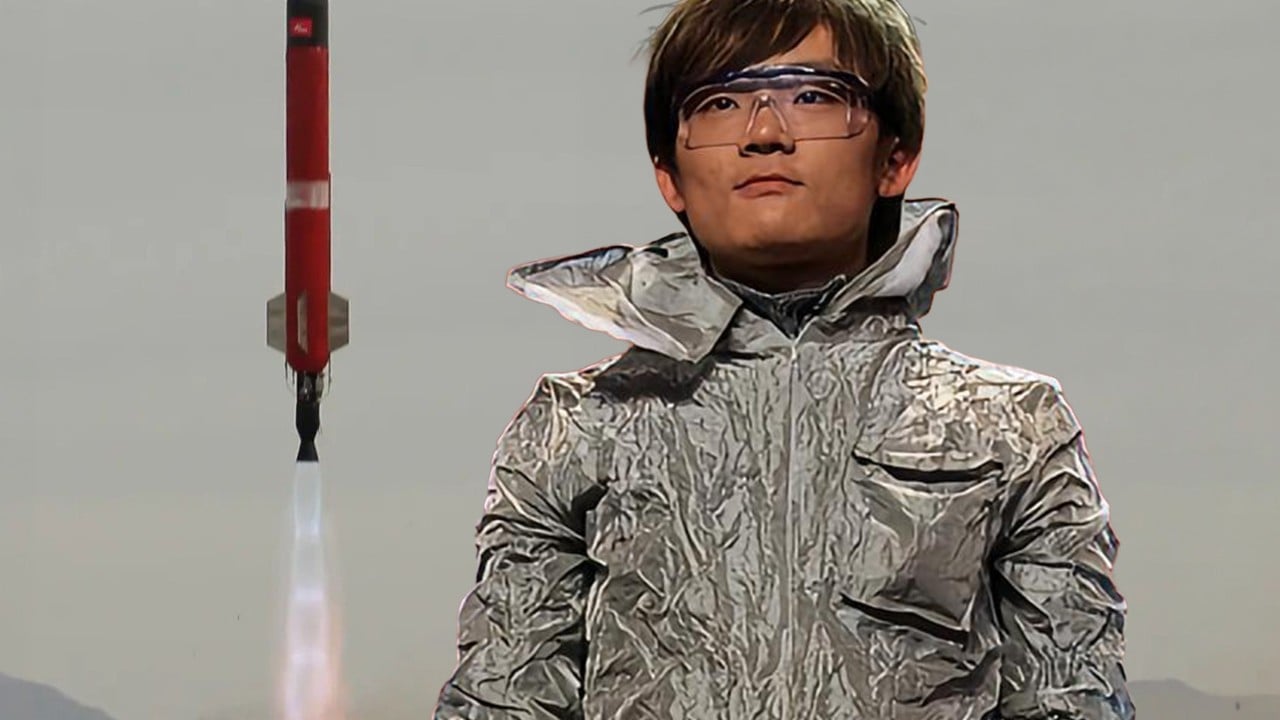
Wu Bing stands in the shadow of a metal cylinder that most Western aerospace giants would call a hobby project. To the traditional gatekeepers of the stratosphere, he is an interloper. Some call him a visionary; others use the word "madman" with a mixture of derision and dawning fear. But as the engines of his latest low-cost rocket flickered to life in the Chinese desert, the sound wasn't just a roar. It was the sound of a gate being kicked off its hinges.
For sixty years, space has been a luxury boutique. We treated the vacuum of the Great Silence like a high-end country club where the initiation fee was several billion dollars and a national flag. If you weren't a superpower or a billionaire with a penchant for PR stunts, the stars were something you looked at, not something you touched.
Wu wants to change the math. He isn't interested in the prestige of the moon or the ego of Mars. He wants to make the vacuum of space as accessible as a cross-country bus ticket.
The core of the problem has always been the "weight of the gold." Historically, putting a single kilogram of cargo into orbit cost roughly $20,000. Imagine paying that much just to mail a liter of water to a friend. At those prices, space is a playground for the elite. Wu Bing’s company, Deep Blue Aerospace, recently completed a high-altitude recovery test that suggests we are moving toward a reality where that price tag is slashed by 90%.
The Scarcity Myth
We have been conditioned to believe that rockets must be pristine, singular works of art. In the traditional model, a rocket is a sacrificial lamb. It burns bright, delivers its payload, and then plunges into the ocean as a charred, expensive piece of litter. It is the equivalent of flying a Boeing 747 from New York to London and then crashing it into the Atlantic because "that's just how flying works."
Wu watched this waste and saw an opening. He realized that the barrier to the stars wasn't physics; it was the business model. By focusing on liquid oxygen and kerosene—fuels that are cheap, stable, and relatively easy to handle—and perfecting the "vertical landing" that allows a rocket to return to its pad like a trained bird, he is stripping away the mysticism of spaceflight.
Think of a hypothetical engineer named Chen. In the old world, Chen has a brilliant idea for a satellite that could monitor crop yields in developing nations, potentially saving millions from famine. But Chen is broke. He has no path to orbit. He is locked out of the "realm" of possibility because he can't afford the ride. When Wu Bing talks about budget space travel, he isn't talking about tourism for the wealthy. He is talking about Chen. He is talking about the democratization of the overhead view.
The "madness" attributed to Wu stems from his refusal to accept the industry's inflated margins. While NASA and even some private competitors spend years in bureaucratic loops, the Chinese commercial space sector is iterating at a speed that feels reckless to the uninitiated. They are failing fast. They are blowing things up. And every explosion is a lesson paid for at a fraction of the cost of a Western setback.
The Invisible Stakes of the Low-Cost Race
There is a tension in the air at the launch sites in the Gobi Desert. It is a humid, electric feeling. It’s the realization that the first person to truly commoditize the sky wins more than just money. They win the infrastructure of the future.
If Wu succeeds, the sky becomes a logistics layer.
We often get caught up in the "how" of rocket science—the $T = \dot{m}v_e + (p_e - p_a)A_e$ of thrust equations—but the "why" is far more visceral. We are a species that has run out of room. Our terrestrial resources are finite, our bandwidth is capped, and our perspective is cramped. Space offers a release valve. But that valve is stuck.
Wu Bing is the guy with the WD-40 and a sledgehammer.
His recent successful launch and recovery tests aren't just technical milestones. They are psychological ones. They prove that you don't need a Silicon Valley pedigree or a Cold War budget to master the hardest thing humans have ever tried to do. You just need a relentless focus on the bottom line.
Critics argue that "cheap" and "rocket" are two words that should never occupy the same sentence. They point to the immense pressures of flight, the freezing temperatures, and the unforgiving nature of orbital mechanics. They aren't wrong. Space is a graveyard of "low-cost" dreams. One hairline fracture in a fuel line, one sensor calibration off by a fraction of a millimeter, and the whole dream turns into an expensive firework.
The Emotional Weight of a Desert Launch
Watching a rocket return to Earth is a surreal experience. Gravity, the one law we can never break, finally meets an equal match. As the engines reignite to slow the descent, there is a moment of pure, heart-stopping uncertainty. The machine hovers. It wobbles. It searches for its footing on a concrete pad that looks impossibly small from a few miles up.
In that moment, Wu Bing isn't just a CEO. He is a gambler holding a hand that could redefine human history.
If the rocket sticks the landing, the cost of the next mission drops significantly. The hardware is saved. The electronics stay intact. The only major cost for the next flight is the fuel—which, in the grand scheme of things, is cheaper than the coffee consumed by the ground crew.
This is the "reusability" dividend. It is the reason why the "madman" label is starting to peel away, revealing a shrewd architect of a new economy. We are seeing the birth of the "space-tethered economy," where the distance between a warehouse in Shanghai and a satellite in Low Earth Orbit is measured in minutes and thousands of dollars, rather than years and billions.
The Friction of Progress
But the path isn't smooth. The global community looks at the rise of Chinese private space firms with a mix of awe and geopolitical anxiety. There are questions about debris. There are questions about the "Kessler Syndrome," a theoretical scenario where the sky becomes so crowded with cheap satellites that they begin to collide, creating a cloud of shrapnel that locks us on Earth forever.
Wu has to navigate these fears while keeping his investors happy and his engineers focused. It is a precarious balance. He is operating in a culture that prizes results above all else, in an industry where one mistake is a national embarrassment.
The human element here is the sheer audacity of the attempt. It takes a specific kind of ego to look at the vast, cold expanse of the universe and think, "I can build a bridge there for the price of a used car."
Consider the implications for global internet. Or for climate monitoring. Or for the manufacturing of medicines that can only be grown in zero gravity. When the cost of entry drops, the variety of players increases. We move from a world of "Big Space" to "Your Space."
A Shift in the Winds
The air in the desert is cooling now. The dust kicked up by the latest test has settled, coating the recovery vehicles in a fine, grey powder. Wu Bing is likely already looking at the data from the next iteration. He knows that his lead is temporary. Every successful landing invites a dozen more competitors.
The "Madman of Science" might actually be the only sane person in the room. He realized that we have been treating the most important frontier in human history like a museum—beautiful to look at, but far too expensive to touch.
He is turning the museum into a marketplace.
The stakes aren't just about rockets or satellites or even the billionaire space race. They are about whether we remain a planet-bound species, limited by the dirt beneath our feet, or whether we finally take our place in the vacuum.
The next time you look up at a clear night sky, don't just see the stars. Look for the tiny, moving lights of the satellites already there. And then imagine a thousand more. Imagine a sky that belongs to the dreamers, the tinkerers, and the "madmen" who refused to believe that the price of admission was too high.
The gate is open. The engines are cooling. The price of the stars just went down.