Silence is heavy when you are waiting for a wall to break.
Not a brick wall. Not a barrier of wood or iron. An invisible wall. A ceiling made of compressed air, molecular friction, and atmospheric resistance that fights back with the force of a hurricane the moment you approach the speed of sound. For decades, common wisdom dictated that humanity did not belong up there, screaming past seven hundred and sixty miles per hour on four wheels. The air would catch the chassis. The car would lift. It would become an airplane, and then it would become a tragedy.
Andy Green knew this. He also chose to ignore it.
The Weight of the Desert
Stepping onto the salt flats of Black Rock or the hard-baked crust of Hakskeenpan is an exercise in ego death. The earth stretches out in every direction, a blinding, bleached canvas under a merciless sun. There are no trees. There are no reference points. Horizon blurs into sky until you lose all sense of up, down, and forward.
Imagine standing inside a metal tube smaller than a fighter jet, strapped so tightly into a harness that your ribs ache, knowing that twenty feet beneath your seat is a engine capable of generating thousands of pounds of thrust. The noise is not a sound you hear with your ears. It is a physical weight. It sits on your chest. It rattles your teeth in your skull.
Andy Green is not a stuntman in the traditional sense. He is a mathematician with a death wish, or perhaps a pilot who simply traded the sky for the ground because the ground felt more dangerous. As a Royal Air Force fighter pilot, he spent his professional life calculating vectors and G-forces. When he first climbed into ThrustSSC in 1997, he wasn't just driving; he was negotiating a truce between physics and human ambition. He broke the sound barrier then, pushing a car past Mach 1 for the first time in history.
That was yesterday. Yesterday is a ghost.
The Agony of the Second-Guess
Speed is an addiction with a terrible withdrawal. Once you have torn a hole in the sky and listened to the violent crack of a sonic boom echoing across the empty desert behind you, normal life loses its grain. But returning to the line is harder than the first time.
Consider what happens to a man who has already conquered the impossible. The second time around, nobody is cheering for the sheer novelty of the miracle. They expect it. The fear changes shape. It morphs from the terror of the unknown into the quiet, nagging dread of repetition. What if the math fails? What if the tire delaminates at seven hundred miles per hour? At that speed, a pebble on the track is not a pebble. It is a bullet. A twitch of the steering wheel is not a correction. It is a signature on a death certificate.
When Andy Green returned to set a new benchmark, he wasn't racing against other men. He was racing against his own ghost.
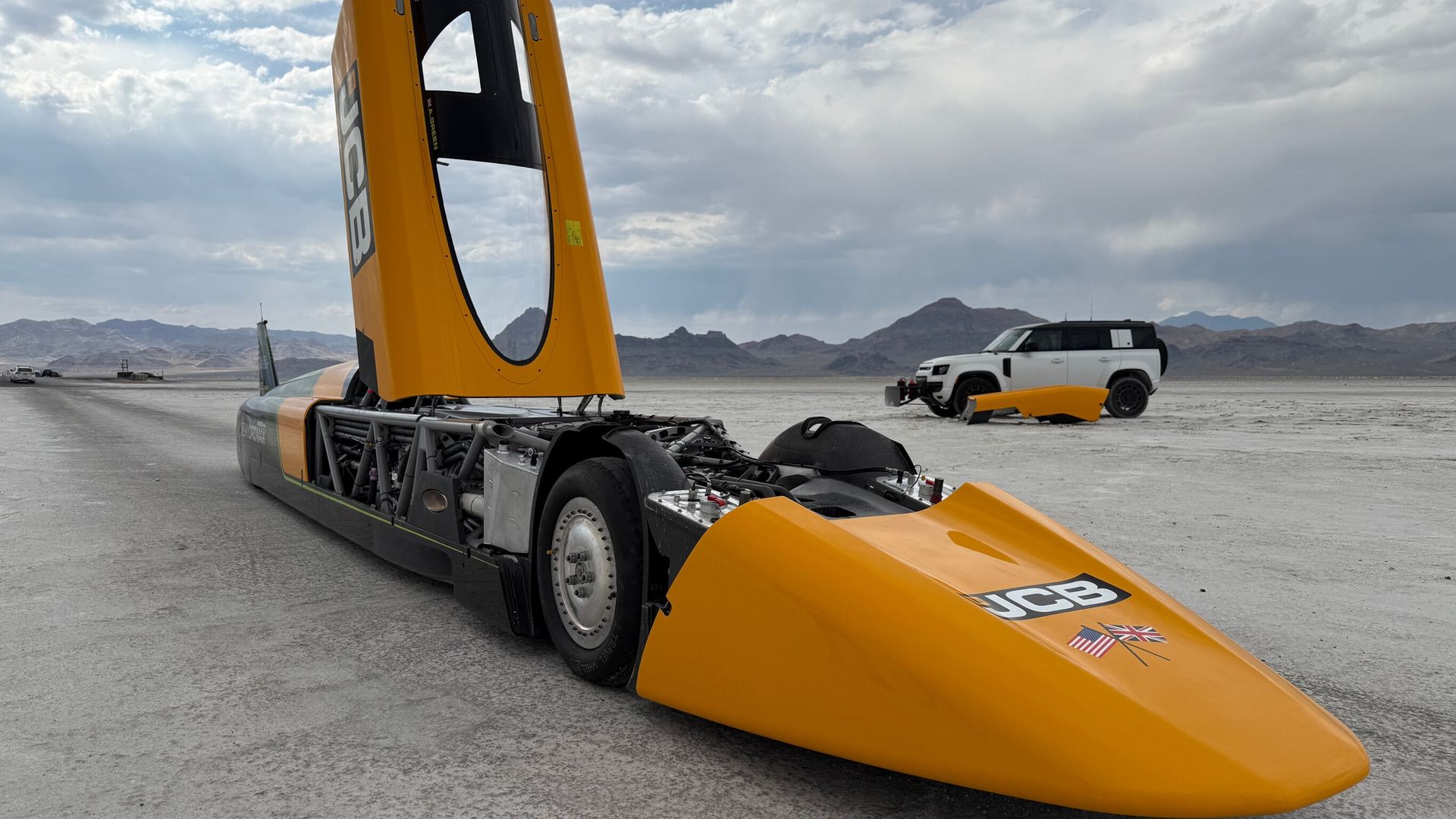
The machine had changed. Bloodhound LSR, the successor to his earlier chariot, was a beast forged from titanium and aerospace engineering. It was designed to run on a cocktail of jet engines and rocket power. To understand the scale of it, think of strapping yourself to the underside of a commercial airliner, removing the wings, and pointing the nose down a narrow dirt track carved into the middle of nowhere.
The cockpit smells of hot wiring, sweat, and burning kerosene. There is no radio chatter that matters once the burners ignite. You are entirely alone.
The Ignition
Three. Two. One.
The world ceases to exist.
The acceleration is an assault. It hits you like a physical hand pressed flat against your face, shoving your head back into the headrest so hard your vision greys at the edges. Blood pools in your lower limbs. Your internal organs shift backward. The desert outside the small, thick polycarbonate window stops being a landscape and turns into a grey streak of motion.
Seven hundred miles per hour.
At this velocity, aerodynamics stop behaving like air. The atmosphere turns into a viscous syrup. The nose of the car wants to lift, to dance, to find the sky. Green’s hands on the controls must be micro-surgical. A millimeter too far to the left, and the car skips across the hardpan like a flat stone thrown across a glassy lake.
Seven hundred and fifty.
The instrumentation is a chaotic symphony of blinking amber and green lights. The temperature gauges are climbing. The roar of the jet engine is deafening, a monstrous howl that eats the air and spits out fire. And then, the transition.
The shockwave detaches. The air parts with a violent, concussive snap that shatters the silence of the desert miles away.
He is through.
The Aftermath
When the parachutes deploy, they catch the air with a brutal deceleration that throws Green forward against his harness, bruising his shoulders. The sudden quiet is uncanny. The screaming engine dies down to a hot, ticking ping of cooling metal.
He sits there for a long moment, breathing heavily, tasting copper and dust. The salt flats are still around him, indifferent, ancient, and completely silent once more.
He did it again. Another record secured. Another invisible line crossed.
The car rolls to a stop, surrounded by a swarm of engineers and mechanics who look like tiny ants against the vast white expanse of the desert. They run toward him, shouting, waving their arms, shedding the tension of months of sleepless nights and calculations scribbled on whiteboards.
Green pops the canopy. The dry desert wind rushes in, warm and smelling of baked earth. He unbuckles his helmet, his hair plastered to his forehead with sweat, and squints against the glaring light.
He has rewritten the limits of what a human being can do on the surface of this planet. Yet, as he climbs down onto the cracked earth, his legs shaking slightly from the sudden release of adrenaline, he doesn't look like a conqueror. He looks like a man who has just returned from a very long, very lonely journey to the edge of the world, wondering simply what is left out there to chase.