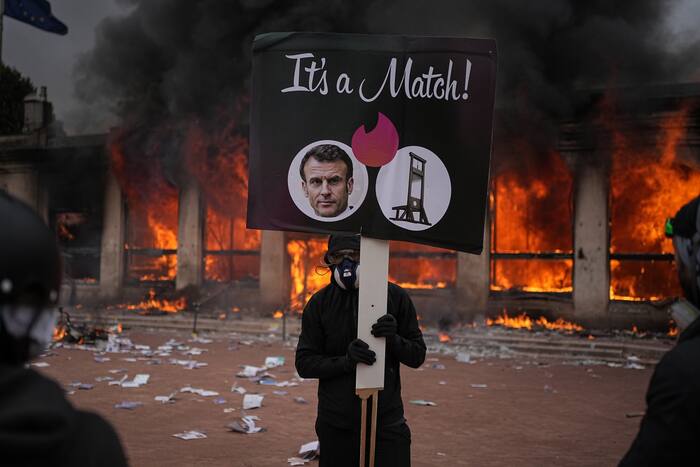
Every six months, foreign correspondents pack their bags for Paris, check into a hotel near the Place de la Republique, and write the exact same obituary for the Fifth Republic. The headline writes itself. Riots are burning trash cans, unions are striking, and pundits are treating Emmanuel Macron like a monarch trapped in Versailles while the peasants sharpen their pitchforks. The lazy consensus says this is the end of an era, a terminal crisis of governance, and proof that French democracy is terminally broken.
It is absolute nonsense.
If you treat every Parisian street protest as an existential threat to the French state, you do not understand France. You are falling for the oldest theatrical trick in Western politics. The French do not riot because their democracy is failing; they riot because it is working precisely as designed. The street is simply the upper chamber of the French legislative process. When parliament stalls or a president tries to push through pension reform, the citizens take to the asphalt to renegotiate the social contract with tear gas and overturned barricades. It is loud, messy, and economically inefficient. It is also Tuesday.
Let us look past the smoke and the burning tires to examine the structural reality of what is happening in France right now.
Emmanuel Macron is serving his final constitutional term. Under the rules of the Fifth Republic, he cannot run again. That single constraint changes the entire political physics of Paris. In American politics, a lame-duck president loses legislative gravity because everyone is looking toward the next administration. In France, a lame-duck president becomes a lightning rod for every political ambition in the country. The presidential hopefuls are not merely jockeying to succeed him; they are auditioning to tear down his legacy before the ink is even dry.
The media loves to frame this as an uprising against Macron’s autocracy. Remember the narrative that he bypassed parliament to raise the retirement age? It made for great television. But strip away the drama and look at the actual math. France spent decades avoiding structural fiscal adjustments while its neighbors raised their retirement ages years ago. Macron inherited a pension system heading off a demographic cliff. Did he handle it with political grace? Hardly. He approached the state budget like an investment banker trying to balance a spreadsheet on the back of a napkin while lecturing the workers about responsibility. That tactical arrogance invited the backlash.
Yet, notice what did not happen. The Fifth Republic did not collapse. The constitution held. The courts did not suspend operations. The machinery of the state continued to function despite millions of people deciding that public transport was optional for a fortnight.
The real story of the post-Macron scramble is not that the system is collapsing. It is that the political class on both the far left and the far right has figured out how to weaponize the inherent fatigue of the electorate.
On the right, Marine Le Pen and her protegé Jordan Bardella are sitting back and watching the chaos with terrifying discipline. They do not need to burn cars. They just need to look reasonable while everyone else sets the furniture on fire. They have rebranded nationalism into a populist grievance machine that appeals not just to the traditional working class, but to professionals who are tired of paying fifty percent of their income in taxes only to watch public services crumble. The mainstream right has spent a decade trying to out-maneuver Le Pen by copying her talking points, which only serves to make the original version more attractive.
On the left, Jean-Luc Melenchon and his coalition treat institutional norms like suggestions written in invisible ink. They have mastered the art of perpetual agitation, treating every municipal dispute as a dry run for a general insurrection. They promise a fantasy economy where everyone retires at sixty, taxes pay for infinite public goods, and the laws of global trade simply stop applying because the people voted otherwise.
Neither side is offering a solution to the demographic and economic gravity pulling down the European continent. Both sides are selling nostalgia for an era of welfare states funded by demographic booms that are never coming back.
When presidential hopefuls position themselves to inherit the Élysée Palace, they are playing a game of musical chairs where the music stopped ten years ago. France is caught between an unreformed statist economy that suffocates innovation and an electorate that refuses to accept any reduction in state-guaranteed benefits. Macron tried to bridge that gap by telling the French they needed to become a startup nation. It was tone-deaf. You cannot turn a country whose national identity is rooted in the social solidarity of the resistance into Silicon Valley over a long weekend.
So what happens when Macron finally hands over the keys?
The people cheering his departure will discover that the next president faces the exact same balance sheet. The debt-to-GDP ratio will not care who is sitting in the presidential chair. The European Union fiscal rules will not bend just because a populist won an election on a wave of anger. The trash will still need to be collected, and someone will still have to pay for the healthcare system.
The French understand this deep down. That is why they protest with such cheerful cynicism. They know that governments come and go, but the bureaucratic state of Paris remains eternal, stubborn, and completely indifferent to whoever happens to be giving speeches on television.
Stop looking at the smoke in the streets as a sign of a dying republic. It is just the steam escaping a pressure cooker that has been bolted shut by history. If you want to know who will win the next election, stop asking who has the best plan for France. Ask who is best at surviving the fire.