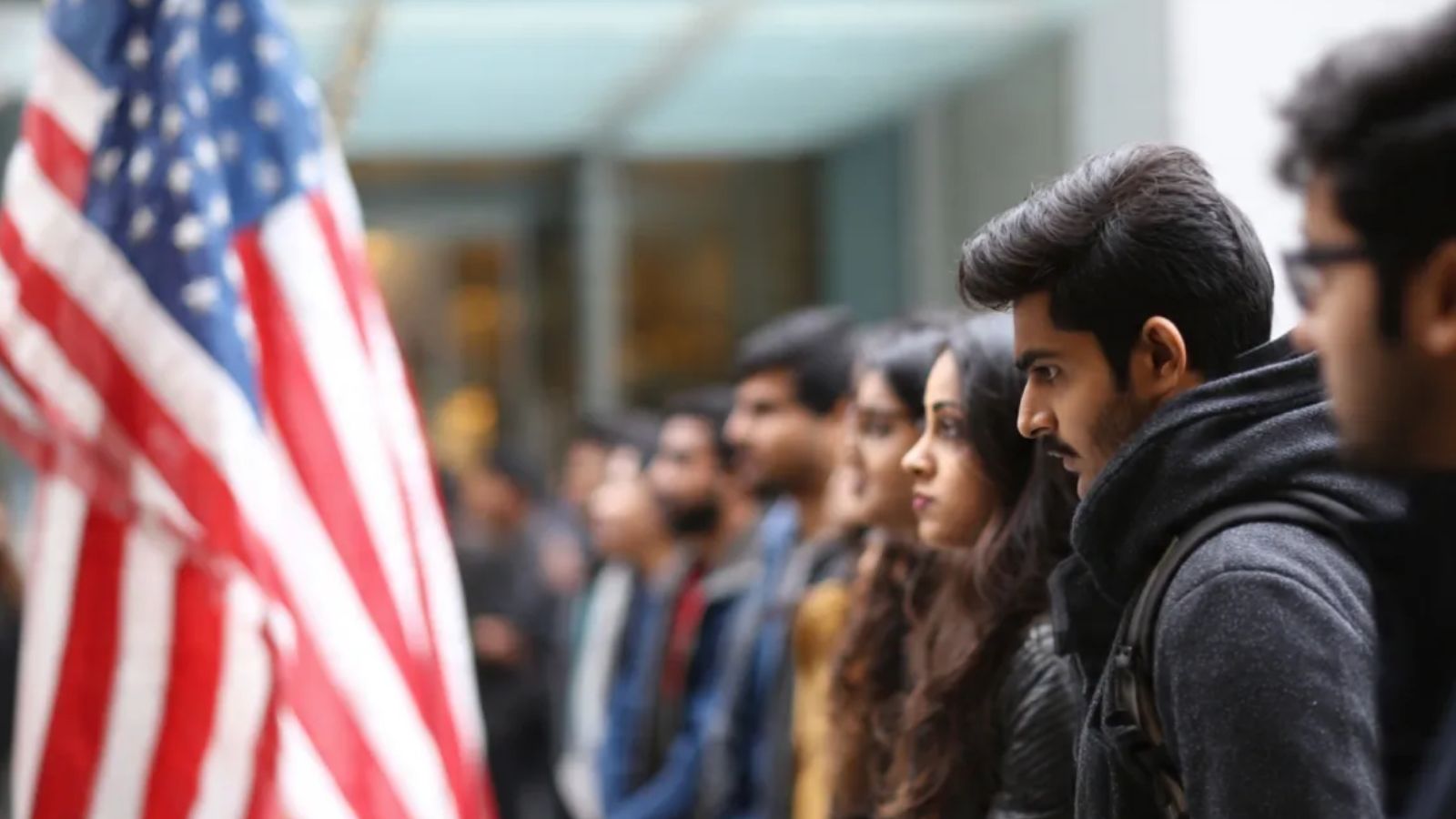
The global arbitrage of highly skilled human capital relies on institutional predictability. For half a century, the United States maintained an structural advantage in this market through a regulatory mechanism known as Duration of Status (D/S). By allowing international students to remain in the country indefinitely so long as they maintained compliance and full-time enrollment, the federal government effectively outsourced visa maintenance to accredited universities.
The finalization of the Department of Homeland Security (DHS) rule on July 16, 2026, which replaces D/S with a fixed four-year admission ceiling effective September 15, 2026, dismantles this equilibrium. This policy shift alters the financial and operational risk models for global talent, specifically targeting the pipeline originating from India—the largest source of international students in the United States.
The Mismatch Function: Academic Timelines vs. Bureaucratic Caps
The core flaw of a rigid 48-month visa ceiling lies in its divergence from actual higher education completion functions. The regulation operates on the assumption that an academic cycle is a uniform, four-year block. Data from the National Center for Education Statistics reveals that the median time to complete a standard bachelor’s degree in the United States is 52 months. For a Doctor of Philosophy (PhD) program, the timeline extends to a median of 5.7 years.
This structural deficit introduces an artificial friction point. Under the new framework, any student whose program exceeds the 48-month threshold must file a Form I-539 for an Extension of Stay with US Citizenship and Immigration Services (USCIS). The downstream effects of this requirement follow a predictable chain of friction:
[48-Month Admission Cap Reached]
               │
               ▼
[Mandatory Form I-539 Filing + Fees + Biometrics]
               │
               ▼
[USCIS Backlog Processing Delay (~12 Months)]
               │
               ▼
[Accrual Risk of Unlawful Presence / Loss of Academic Status]
The operational risk shifts entirely to the student and the host laboratory. Because USCIS handles a net backlog exceeding 11 million cases, standard processing times for non-immigrant applications frequently hover near 12 months. A doctoral candidate entering their fifth year of research must navigate a protracted period of administrative limbo. If the extension is delayed or denied, the student faces immediate termination of legal status, forcing an abrupt exit mid-research and disrupting long-term laboratory objectives.
Capital Degradation in the Higher Education Sector
International higher education functions as a major export sector for the United States economy, generating approximately $55 billion annually and supporting over 450,000 jobs. The fixed-term visa rule acts as a demand shock within this ecosystem. Preliminary metrics captured by the Foundation for India and Indian Diaspora Studies (FIIDS) during the lead-up to the final rule show a 17% decline in new international student enrollments for the autumn 2025 cycle, with 96% of surveyed institutions citing visa policy uncertainty as the primary driver.
The financial model of major American research universities depends heavily on the full-tuition premiums paid by international student populations. This revenue cross-subsidizes domestic financial aid, institutional infrastructure, and low-yield departmental budgets.
The National Association of Foreign Student Affairs (NAFSA) quantified the immediate financial fallout of the 17% enrollment reduction at $1.1 billion in lost top-line revenue and a contraction of nearly 23,000 sector-adjacent jobs. The elimination of the D/S mechanism creates an ongoing fiscal headwind, forcing universities to either scale back research output or raise domestic tuition to cover the structural deficit.
Asymmetric Attrition of the STEM Pipeline
The policy introduces specific microeconomic distortions for Indian nationals, who hold a disproportionate share of F-1 graduate visas and subsequent STEM Optional Practical Training (OPT) authorizations. The standard Indian academic trajectory in the United States follows a compounding pattern: a two-year master’s degree, followed by up to 36 months of STEM OPT employment. Under the previous D/S framework, this continuous five-year sequence required no structural intervention from federal immigration agencies.
By enforcing a four-year cap inclusive of practical training, the new regulation forces a collision between the degree completion timeline and the post-graduation work period. F-1 holders must now petition for extensions mid-way through their post-graduate employment. This structural change increases the total cost of ownership for American employers hiring international graduates, as companies must navigate biometric fees, legal overhead, and the risk of unexpected visa denials for critical personnel.
Compounding this friction is the compression of the post-completion grace period from 60 days down to 30 days. This change severely limits the transition window for individuals attempting to move from student status to employment-based visas like the H-1B. The second limitation comes from new restrictions on academic flexibility: undergraduate and graduate students face strict prohibitions against changing majors, altering fields of study, or pursuing a second degree at the same or a lower educational level while remaining in F-1 status. The rule enforces a strict upward-only educational path, destroying the multi-disciplinary flexibility that made the American university model attractive.
Geopolitical Realignment of High-Skill Migration
Talent migration is a zero-sum game played across competing regulatory jurisdictions. The introduction of systematic friction into the United States immigration architecture functions as a regulatory subsidy for secondary markets.
Countries such as Canada, the United Kingdom, Germany, and Australia maintain immigration frameworks engineered to capture the mobile talent being displaced by these policy changes. Canada’s Express Entry system and the UK’s High Potential Individual visa offer clear pathways to permanent residency, contrasting sharply with the long green card backlogs and new fixed-term constraints of the American system.
The long-term threat is not merely a loss of tuition capital, but the degradation of the domestic innovation ecosystem. Silicon Valley and the broader domestic tech landscape rely heavily on advanced degree holders from American universities to fill technical roles. When international talent diverts to other markets, the corporate research and development centers often follow, shifting intellectual property creation outside United States borders.
Strategic Responses for Institutional Survival
To limit the impact of the September 15, 2026 rule, academic institutions and corporate partners must shift from reactive lobbying to structural adaptation.
Universities must restructure doctoral and advanced graduate curricula to compress the initial, on-campus coursework phase into tighter timelines, maximizing the portion of the degree that can be classified under distinct curricular practical training or curricular phases that qualify for specialized administrative handling.
Simultaneously, university legal counsel must establish internal immigration management offices dedicated exclusively to handling proactive Form I-539 filings at least 180 days prior to the 48-month expiration mark. This approach is necessary to ensure that students maintain a continuous legal right to study and work while applications languish in the USCIS backlog.
On the corporate side, technology firms must build talent pipelines that assume lower H-1B conversion rates and higher international student attrition. This involves expanding global capability centers (GCCs) in markets like Bengaluru, Hyderabad, and Toronto, allowing firms to transition high-performing Indian graduates to international offices if their US student visa extensions face administrative denial. The organizations that survive this policy shift will be those that treat immigration policy not as a temporary disruption, but as a permanent variable in their global operations model.