The air in Beijing has a way of tasting like cold metal and ancient dust when the winter winds whip down from the Gobi. Inside the Great Hall of the People, the air is different. It is heavy. It carries the scent of expensive tea and the suffocating weight of history. When Donald Trump sat across from Xi Jinping this week, the cameras captured the staged smiles and the rhythmic nodding of translators, but the real story wasn't in the press releases. It was in the silence between the sentences.
This wasn't just a meeting. It was a collision of two different ways of seeing the future. On one side, an American president driven by the immediate, loud demands of trade deficits and industrial revival. On the other, a Chinese leader playing a game of decades, viewing every concession through the lens of a "rejuvenation" that stretches far beyond the next election cycle. Also making news recently: The Iron Dome Fallacy and Why Kyiv is a Warning to the West.
The stakes were higher than the usual tariff squabbles. The world was watching to see if these two men could prevent a regional spark in the Middle East from becoming a global wildfire.
The Ghost of 1979
To understand why the talks over Iran felt so jagged, you have to look at the map through Beijing's eyes. For the United States, Iran is a geopolitical puzzle to be solved, a regime to be contained. For China, Iran is a gas station and a gateway. Further details on this are explored by The Washington Post.
Consider a hypothetical factory owner in Zhejiang province. Let’s call him Mr. Chen. His machines run on energy that flows through the Strait of Hormuz. When the U.S. talks about tightening the screws on Tehran, Mr. Chen doesn't think about nuclear non-proliferation. He thinks about the lights flickering out in his workshop. He thinks about the cost of shipping containers.
China is currently the world’s largest importer of crude oil. They aren't just buying fuel; they are buying stability. When Trump pressed Xi to use his leverage to pull Iran back from the brink of open conflict, he was asking Xi to gamble with China’s own economic circulatory system.
The tension in the room was palpable. The U.S. delegation arrived with data points on Iranian drone capabilities and regional instability. The Chinese countered with the cold logic of energy security. It is a fundamental disagreement on the definition of "order." Washington sees order as the enforcement of international norms. Beijing sees order as the uninterrupted flow of commerce.
The Mathematics of the American Heartland
While the geopolitical maneuvering dominated the closed-door sessions, the trade discussions were where the human cost of this relationship became visible. Trump didn't come to Beijing to talk about abstract economic theory. He came to talk about soybeans, steel, and the survival of the American middle class.
The numbers are staggering, but they often obscure the people behind them. A 500-billion-dollar trade deficit is a statistic. A closed furniture plant in North Carolina is a tragedy.
Trump’s approach has always been transactional, a series of "wins" designed to be signaled back home. He pushed for more market access, for the removal of barriers that have long frustrated American tech giants and farmers. But the Chinese side knows that every time they open a door, they lose a measure of control.
Xi Jinping is navigating his own domestic pressures. China’s growth is slowing. The era of double-digit expansion is a memory. If he gives too much to the Americans, he looks weak to a domestic audience that has been fed a steady diet of nationalist pride. If he gives too little, he risks a full-scale trade war that could derail his plans for 2030.
The negotiations were a choreographed dance of "give and take" where nobody wanted to be the first to move. Trump spoke of the "great chemistry" he shares with Xi, a phrase he uses to humanize a relationship that is increasingly defined by systemic rivalry. It is a classic sales tactic: build the rapport, then squeeze for the deal.
The Invisible War for the Future
Beyond the oil and the soybeans lies the real battlefield: technology. This is the part of the conversation that rarely makes the headlines because it is difficult to summarize in a soundbite. It is the battle over who will own the "brains" of the 21st century.
When the two leaders discussed intellectual property, they weren't just talking about fake handbags on a street corner in Shenzhen. They were talking about the algorithms that will drive autonomous cars, the code that will manage power grids, and the semiconductors that are the lifeblood of modern existence.
The U.S. views China’s rapid tech advancement as a result of forced technology transfers and state-sponsored theft. China views its rise as a natural return to its historical status as the world’s leading civilization.
Imagine a young software engineer in Silicon Valley and her counterpart in Beijing. They are both working on the same problems, fueled by the same ambition. But the political structures above them are building walls where there used to be bridges. The talk of "decoupling" isn't just about supply chains; it’s about the fracturing of the global scientific community.
The Long Walk Back
As the motorcade wound its way out of the Forbidden City, the results of the visit remained shrouded in the typical diplomatic fog. There were "agreements to continue talking" and "productive exchanges of views."
But the reality is that the friction between these two superpowers is now the permanent weather of our world. It isn't something to be "solved" in a single trip or a single summit. It is a tension to be managed.
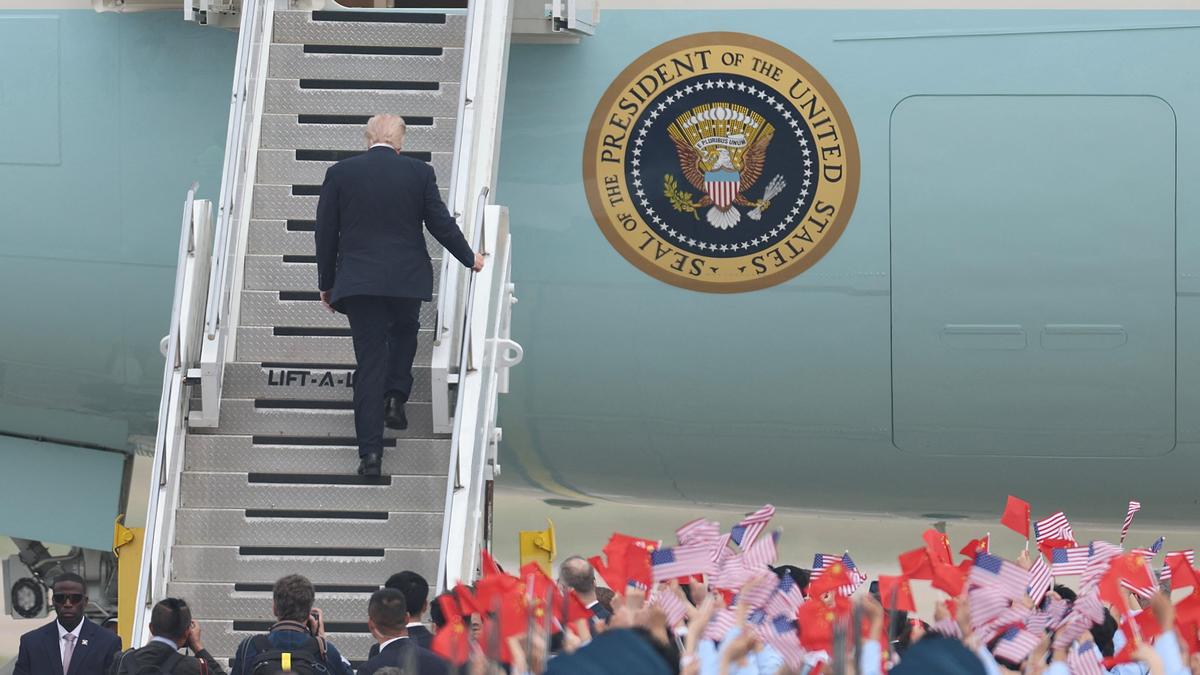
Trump left Beijing with a handful of promises and a reinforced sense of his own negotiating prowess. Xi remained behind, a leader who thinks in centuries, watching the American president's plane disappear into the grey horizon.
The world breathes a small sigh of relief when these meetings end without a blowup. But the fundamental questions remain unanswered. Can two empires, one rising and one seeking to maintain its zenith, share the same narrow peak?
The answer isn't in the signed documents. It’s in the way a farmer in Iowa decides whether to plant more corn this spring, and in the way a clerk in a Tehran ministry watches the price of brent crude. It’s in the quiet anxiety of the global markets, waiting for the next tweet or the next decree from the Great Hall.
The lights in the Forbidden City go out eventually, but the shadows they cast reach across every ocean, touching every life, reminding us that in the high-stakes game of empires, there are no spectators. Only participants who haven't yet realized they are on the board.