Smoke does not merely fill a room. It claims it.
It rolls in low, a dense and suffocating tide that swallows the floorboards, paints the walls in shades of bruised charcoal, and chews greedily at the oxygen. By the time it reaches the eleventh floor, it has lost all gentleness. It is hot. It is heavy. It smells of melted plastic, scorched plaster, and the terrifying finality of a trap snapping shut.
Gravity is an unthinking thing. For most of our lives, we treat it as an invisible servant, keeping our coffee cups anchored to desks and our feet firmly planted on the pavement. We forget its violence. We forget that the space between an eleventh-story window and the hard, indifferent concrete below is not merely empty air. It is a drop of roughly one hundred feet—a distance that turns air into stone and steel.
When Berlin firefighters arrived at the burning apartment building, the street below was a chaotic theater of sirens, flashing red light, and frantic shouts. They moved with the grim, practiced efficiency of people who have stared down catastrophe before. Hoses uncoiled like sleeping serpents. Ladders cranked upward, groaning against the strain.
They looked up.
There she was.
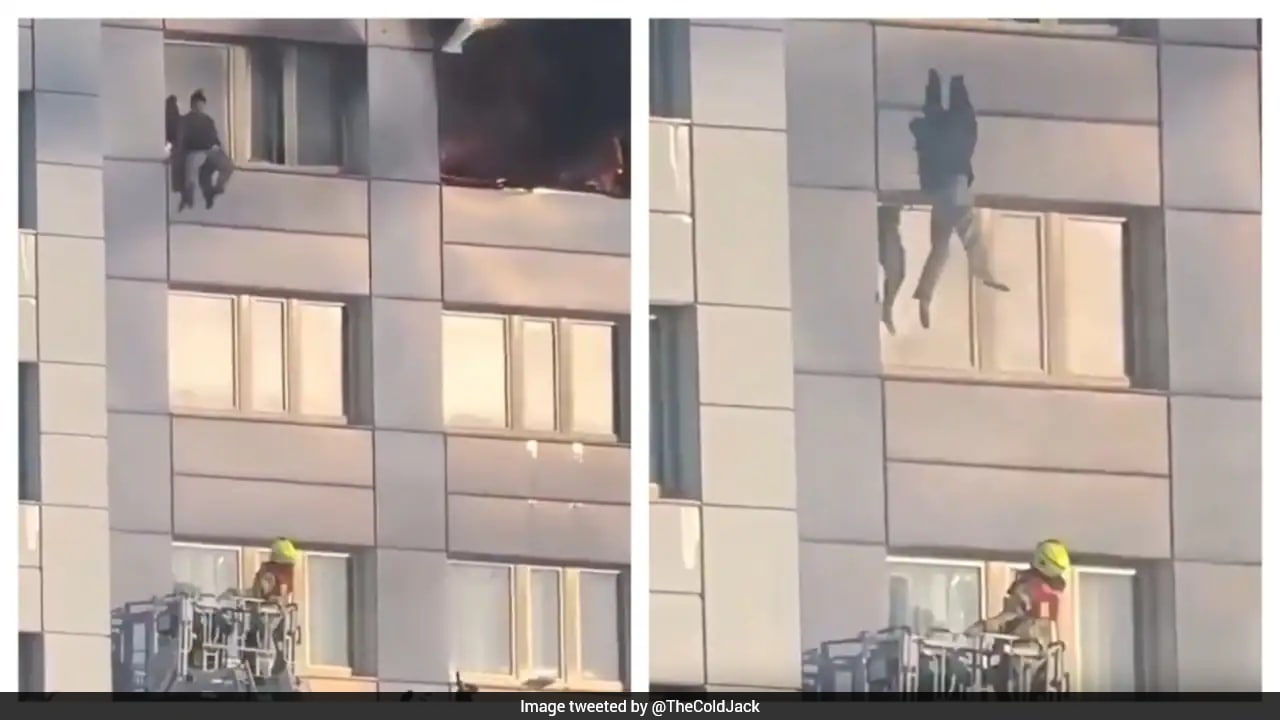
Framed by the jagged geometry of an eleventh-floor window, pressed against the glass for a desperate breath of clean air, a woman stood at the edge of existence. Behind her, the apartment was an oven. In front of her was the void.
Time fractured.
In crises like these, we often speak of split-second decisions as if they are calculated equations solved by cold computers. They are not. They are animal impulses wrapped in absolute terror. Every instinct in the human body screams to stay inside, to fight the fire, to cling to the familiar walls even as they burn. To step out into nothingness requires an act of supreme, agonizing betrayal of every survival mechanism we possess.
The rescue ladder could not reach her. Not in time. The mechanics of metal and hydraulics have limits; the spread of fire does not.
Below, the ground crew did something remarkable. They did not wait for the impossible. They improvised with what they had: a jump cushion, a desperate hope, and raw, unflinching nerve.
Consider the physics of what happened next. A human body falling from that height accelerates at a terrifying rate. By the time she hit the net, she would have been traveling at a speed that makes an impact feel less like a landing and more like a collision with a moving vehicle. The margin for error was measured in inches. If she drifted too far to the left, she would miss the cushion entirely. If she hit it awkwardly, the momentum could shatter bone.
She looked down at the street. She looked back at the smoke billowing past her shoulders.
She let go.
For a heartbeat, there was only flight. Not the graceful, soaring flight of birds, but the vertiginous plummet of a falling stone. The wind roared in her ears. The flashing lights below blurred into a spinning wheel of red and white.
Then came the impact.
The safety cushion gave way with a violent, pneumatic hiss, absorbing the kinetic debt of her fall in one breathless, crushing shock. Hands reached in—hands belonging to strangers who had transformed themselves into a safety net—and pulled her from the wreckage of her momentum.
She survived. Bruised, shaken, and forever altered by the geography of that single minute, she stepped out of the shadow of death and back into the ordinary noise of the world.
We walk past buildings every day without looking up. We count on the floors beneath our feet to hold, the walls around us to protect, and the air in our lungs to sustain us. But life is thin. The boundary between routine and ruin is often no wider than a window frame.
Yet, when the worst arrives, something else shows up, too. It is the stubborn refusal to let go of one another. It is the sound of heavy boots running toward the heat. It is the desperate, beautiful leap into the dark, trusting that someone, somewhere, is standing below with their arms wide open.