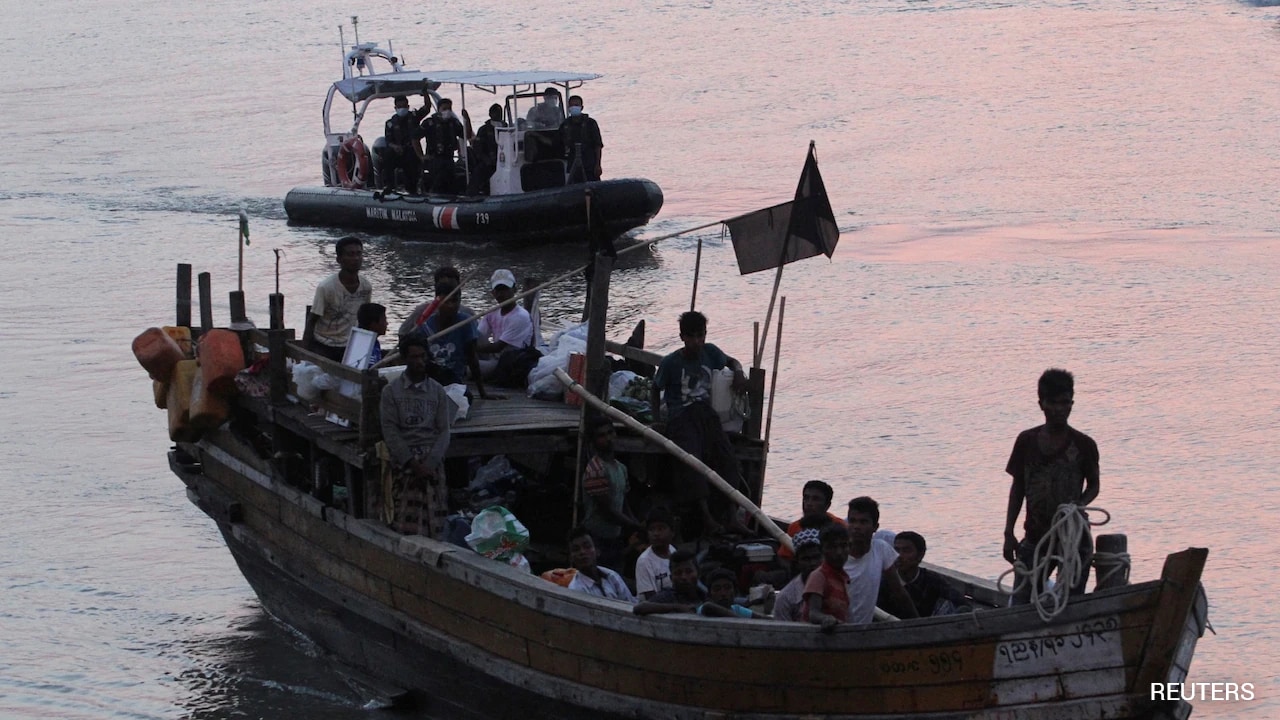
The maritime tragedy off the coast of Myanmar, where two vessels carrying over 500 Rohingya refugees sank, is not an isolated maritime accident. It is the predictable output of a closed socio-economic and geopolitical system. When human beings are systematically stripped of legal identity, restricted from domestic movement, and denied formal economic participation, their survival strategy shifts from local adaptation to high-risk migration.
To understand why hundreds of individuals board structurally unsound, overloaded fishing trawlers to cross the Andaman Sea, one must look beyond the immediate catalyst of a sinking vessel. The phenomenon is governed by a brutal cost-benefit equation where the perceived utility of flight, despite a high probability of death, outweighs the certainty of slow attrition under a regime of systemic confinement.
The Triple-Constraint Framework of Rohingya Vulnerability
The decision to embark on a lethal sea crossing is structured by three compounding containment vectors. These vectors eliminate alternative survival strategies, funneling population segments toward maritime smuggling networks.
+---------------------------------------------------------------+
|                  SYSTEMIC CONFINEMENT VECTORS                 |
+---------------------------------------------------------------+
|  1. LEGAL EXCLUSION                                           |
|     - 1982 Citizenship Law denies de jure status.             |
|     - Statelessness prevents legal domestic/int'l travel.     |
+---------------------------------------------------------------+
|  2. GEOGRAPHIC ENCLOSURE                                      |
|     - Internally Displaced Person (IDP) camps act as prisons. |
|     - Militarized checkpoints prevent overland exit.          |
+---------------------------------------------------------------+
|  3. ECONOMIC STRANGULATION                                    |
|     - Prohibition on formal employment and land ownership.     |
|     - Absolute reliance on diminishing international aid.     |
+---------------------------------------------------------------+
1. Legal De-incentivization and Statelessness
The primary driver is the institutionalized denial of legal personhood. Under Myanmar’s 1982 Citizenship Law, the Rohingya are excluded from the recognized national races, rendering them de jure stateless. This status removes basic protections, leaving the population without recourse to state justice systems, property rights, or civil documentation. Without a passport, identity card, or travel authorization, the physical movement of a Rohingya individual across any formal border is impossible. Thus, irregular maritime routes are not a preference; they are the sole physical channel available.
2. Geographic Enclosure (The IDP Camp Bottleneck)
Since the communal violence of 2012 and the military clearance operations of 2016 and 2017, hundreds of thousands of Rohingya have been concentrated into camp networks in central Rakhine State and Cox's Bazar in Bangladesh. In Rakhine, these camps function as open-air containment zones. Security checkpoints restrict movement between villages and townships. This geographic isolation prevents access to regional markets, higher education, and specialized healthcare, transforming the camps from temporary humanitarian shelters into permanent holding facilities.
3. Economic Strangulation and Aid Dependency
Confinement prevents participation in the formal economy. Denied access to agricultural land, fisheries, and urban labor markets, the interned population relies almost entirely on international humanitarian aid. As global donor priorities shift, funding for these humanitarian operations consistently declines. The reduction in food rations, healthcare services, and basic infrastructure inside the camps creates a compounding deficit in daily caloric intake and safety. This economic baseline makes the payment of high fees to human smugglers—often funded by remittances from the diaspora—a rational, capital-allocating decision aimed at securing long-term survival.
The Microeconomics of Maritime Smuggling Networks
The maritime route across the Andaman Sea to Malaysia or Indonesia operates as an unregulated, high-yield market. Understanding the mechanics of this market requires analyzing the supply chain, the asset-risk profile of the operators, and the pricing structures imposed on refugees.
Asset Degradation and Overloading Economics
The vessels utilized in these crossings are typically wooden fishing trawlers designed for coastal operations, not deep-sea navigation. Smuggling syndicates operate on a low-capex, high-depreciation model. The vessel is treated as a single-use, disposable asset.
Smuggler Revenue Equation:
Total Revenue = (Number of Passengers) x (Ticket Price)
Net Profit = Total Revenue - (Cost of Vessel + Bribes + Fuel)
Because the vessel is expected to be abandoned, seized, or destroyed at the destination, the operator has a powerful incentive to maximize the cargo density of each voyage. If a boat with a safe capacity of 75 passengers is loaded with 250, the marginal cost of adding the 176th passenger is near zero, while the marginal revenue is equal to the full ticket price. This economic incentive structure guarantees extreme overloading, directly compromising the vessel’s metacentric height and making it highly susceptible to capsizing in moderate swells.
The Financial Transaction Pipeline
The capital required for a transit attempt is substantial, often ranging from $2,000 to $5,000 per person. Given the lack of formal banking access in refugee camps, transactions rely on informal value transfer systems, primarily hawala or hundi.
- The Down Payment: An initial deposit is paid to local recruiters to secure a place on a feeder boat.
- The Escrow Stage: The bulk of the fee is held by a trusted third-party intermediary in a transit country (e.g., Thailand or Bangladesh).
- The Release Trigger: The funds are released to the smuggling syndicate only upon proof of safe arrival at the destination, or, in more predatory scenarios, upon physical delivery of the passenger to a secondary transit camp where extortion is used to extract additional payments from relatives abroad.
This financial structure shifts the immediate risk of loss onto the migrant’s family network, which often liquidates ancestral land, takes on high-interest debt, or commits future labor to secure the necessary capital.
The Hydrographic and Meteorological Hazards of the Andaman Passage
The physical geography of the Andaman Sea and the Bay of Bengal presents severe navigational challenges that are compounded by the technical inadequacy of the smuggling vessels.
                 ANDAMAN SEA TRANSIT HAZARDS

      [ October - May ]                  [ June - September ]
      Northeast Monsoon                  Southwest Monsoon

   - Relatively calmer seas           - Extreme wind shear
   - High volume of departures        - Torrential rainfall
   - Elevated risk of interception    - Severe swell heights
                                      - High rate of capsizing
The Southwest Monsoon (June to September) brings high wind shear, torrential rainfall, and severe swell heights. During this period, the probability of structural failure for an overloaded wooden vessel increases exponentially. Smugglers frequently attempt crossings at the beginning or end of the monsoon transitions to exploit gaps in naval patrols. However, unexpected meteorological shifts quickly overwhelm these underpowered, unnavigated craft.
Without basic maritime safety equipment—such as life vests, functioning bilge pumps, GPS navigation, or marine radios—any mechanical failure of the engine transforms the vessel into a drifting hazard. Once the engine fails, the vessel loses steerage, aligns beam-to-seas, and is easily capsized by breaking waves.
Regional Policy Failures and the Deterrence Fallacy
The high mortality rate of the Andaman Sea corridor is exacerbated by a regional security architecture that prioritizes deterrence over search-and-rescue (SAR) obligations.
The "Push-Back" Doctrine
States bordering the Andaman Sea and the Malacca Strait have historically employed a strategy of maritime deterrence, colloquially known as "pushing back" or "helping on." When refugee vessels enter a state's territorial waters or Exclusive Economic Zone (EEZ), naval or coast guard assets are deployed to intercept the vessels, provide minimal food and water, repair the engine if disabled, and escort them back into international waters.
This policy operates on the flawed assumption that regional deterrence reduces the overall volume of departures. In practice, it merely extends the time vessels spend at sea, increasing the probability of structural breakdown, starvation, dehydration, and eventual sinking.
The Regulatory Void of ASEAN
The Association of Southeast Asian Nations (ASEAN) operates under the core principle of non-interference in the internal affairs of member states. This principle prevents collective diplomatic action against the structural conditions inside Myanmar that generate the refugee flow. Furthermore, key transit and destination states in the region—including Malaysia, Thailand, and Indonesia—are not signatories to the 1951 Refugee Convention. Consequently, they lack formal domestic legal frameworks for processing asylum seekers, treating arrivals instead as illegal immigrants subject to detention, deportation, or exploitation.
A Data-Driven Projection of the Crisis
The structural drivers of the Rohingya maritime exodus show no signs of self-correction. To project the trajectory of this humanitarian crisis, we must evaluate three primary variables: the stability of the security situation in Rakhine State, the level of international humanitarian funding, and the policy posture of destination countries.
+------------------+------------------+------------------+
|     VARIABLE     | CURRENT trend    | SYSTEMIC IMPACT  |
+------------------+------------------+------------------+
| Rakhine State    | Intensifying     | Increased displacement,|
| Conflict         | Civil War        | higher pressure to flee|
+------------------+------------------+------------------+
| Humanitarian Aid | Declining        | Lower caloric intake,  |
| Budgets          | Globally         | greater desperation    |
+------------------+------------------+------------------+
| Destination      | Hardening        | Longer voyages,        |
| Policies         | Border Controls  | higher mortality rates |
+------------------+------------------+------------------+
As the civil war in Myanmar intensifies, the physical security of the remaining Rohingya population in Rakhine State is increasingly compromised. Compulsory conscription laws, targeted shelling, and the cutting of supply lines by competing military factions have made the region uninhabitable. With traditional overland routes through Bangladesh heavily militarized and restricted, the maritime corridor remains the only viable escape hatch.
Simultaneously, the global contraction of humanitarian budgets ensures that conditions within the refugee camps of Cox's Bazar will continue to deteriorate. As rations fall below survival thresholds, the demographic profile of those attempting the sea crossing will shift from single young men seeking work to entire family units fleeing starvation.
The convergence of these trends indicates that despite the high probability of maritime disaster, departure volumes will increase. Without a coordinated, region-wide search-and-rescue framework and a fundamental shift in the legal status of refugees in transit countries, the Andaman Sea will continue to function as a highly predictable, systemic sink for human life.