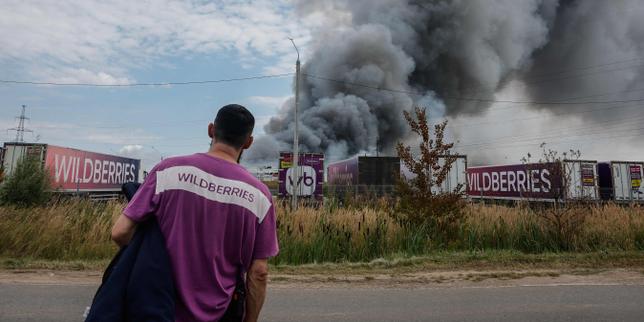
Structural Vulnerability in Distributed Retail Infrastructure
Modern supply chain economics treats geographic dispersion as a hedge against catastrophic failure. When a retailer builds a network of distributed hubs across a continent-sized domestic market, the underlying assumption is that localized disruptions will attenuate before threatening aggregate throughput. Wildberries, the dominant e-commerce platform in the Russian Federation, inverted this economic principle. By concentrating high-capacity sorting and fulfillment infrastructure into a small number of critical nodes, the enterprise substituted spatial resilience for localized efficiency.
Recent operational assessments from Ukrainian intelligence agencies indicate that kinetic strikes have targeted and disabled seven of the ten primary fulfillment centers underpinning the Wildberries logistics architecture. This event presents a distinct case study in asymmetric supply chain disruption. Instead of targeting point-to-point transport links or last-mile delivery vectors, the disruption targeted high-density consolidation nodes. The operational consequence is not a linear reduction in delivery speeds, but a complete structural bifurcation between inventory positioning and consumer demand fulfillment.
To understand why this failure mode propagates across the entire enterprise, we must examine the economics of hyper-scale retail distribution. A fulfillment center of the scale operated by Wildberries is not merely a warehouse; it is an automated sorting machine, a data aggregation point, and a regional liquidity anchor for third-party merchants. When seven of these massive nodes drop offline simultaneously, the downstream effects cascade through inventory holding costs, merchant cash flow velocity, and regional pricing stability.
The Mechanics of Node Concentration
The geography of Russian retail logistics is dictated by population density gradients and arterial rail networks. Wildberries historically optimized its network capital expenditure by clustering fulfillment capacity around major metropolitan agglomerations, particularly the Moscow oblast, Saint Petersburg, and key southern transit hubs. This topology minimizes the cost per parcel-kilometer during normal operating conditions.
However, high node concentration creates a steep cost function cliff during abnormal shocks. The infrastructure deficit cannot be absorbed by secondary or tertiary facilities because those smaller locations lack the automated high-speed cross-docking systems required to process millions of stock-keeping units daily.
Normal Operation:
[Distributed Merchants] -> [Primary Nodes (Top 10)] -> [Automated Sorting] -> [Last Mile]

Disrupted State:
[Distributed Merchants] -> [Compromised Nodes (7/10 Down)] -> [System Bottleneck / Deadlock]
                                                        -> [Unaligned Secondary Nodes]
When primary sorting capacity vanishes, the inventory destined for those hubs hits an immediate dead-end. Merchants who relied on the platform's just-in-time intake schedules find their working capital trapped in transit vehicles or regional holding yards. The logistical network shifts from a high-velocity flow state to a static storage problem, where warehouse space becomes scarcer and more expensive by the hour.
The Merchant Liquidity Crunch
Retail platforms operating marketplace models do not merely move boxes; they intermediate financial risk. Wildberries functions as a financial clearinghouse for thousands of small and medium-sized enterprises. These merchants manufacture or import goods, ship them to Wildberries fulfillment centers, and receive payouts only after final consumer delivery is logged in the platform's ledger.
When fulfillment nodes go offline, the transaction cycle breaks at the final stage. Goods sitting in a compromised sorting facility are categorized neither as delivered nor as returnable inventory. This creates an accounting limbo that starves merchants of operating cash flow.
- Inventory Immobilization: Stock is physically present within the regional theater but inaccessible to the digital order management system.
- Payout Suspension: Revenue recognition is delayed indefinitely pending physical inventory audits that cannot occur in active conflict zones or structurally damaged facilities.
- Credit Contraction: Working capital loans secured against platform receivables immediately trigger risk reassessments from commercial lenders.
The secondary effect of this liquidity crunch is supply contraction. Merchants unable to monetize existing inventory stop placing purchase orders with upstream manufacturers. The disruption thus spreads from the logistics provider's physical assets to the broader manufacturing and import ecosystem that feeds the platform.
Information Asymmetry and Operational Fog
Quantifying the exact operational capacity loss of a retail giant during wartime conditions requires navigating severe information asymmetry. Official statements from military intelligence agencies often employ aggregated metrics designed to signal strategic impact, while corporate entities under financial and regulatory pressure favor continuity messaging.
To bridge this analytical gap, we must evaluate the structural indicators that reveal true operational health:
- App-Based Fulfillment Timelines: Delivery latency metrics observed by end-users provide an immediate proxy for sorting backlog. When delivery windows expand from days to weeks across multiple federal districts, the failure is centralized, not localized.
- Geographic Redistribution Costs: Rerouting freight from undamaged eastern hubs to western population centers incurs exponential transport cost penalties. Diesel consumption, driver availability, and rail car turnaround times become acute bottlenecks.
- Third-Party Merchant Migration: The rate at which marketplace sellers diversify their catalog presence toward competing platforms (such as Ozon or Yandex Market) indicates their confidence in the operator's recovery timeline.
The loss of seven primary centers means that the remaining three hubs, alongside minor regional depots, must absorb a throughput volume they were never engineered to handle. This creates a classic queuing theory failure: as arrival rates exceed service rates, queue lengths approach infinity, and system latency spikes non-linearly.
The Cost Function of Network Reconstruction
Rebuilding centralized fulfillment capacity under conditions of ongoing geopolitical risk presents an intractable economic problem for private enterprise. Traditional logistics strategy assumes a stable legal and physical security environment where capital expenditure depreciates over a predictable multi-decade horizon. When physical infrastructure is subject to kinetic targeting, the risk-adjusted return on fixed capital investment drops below zero.
Consequently, Wildberries cannot simply rebuild identical hyper-scale facilities in the same geographic corridors. Doing so would expose the enterprise to repeated asset destruction without altering the underlying vulnerability profile.
Instead, the strategic imperative shifts toward forced decentralization. However, decentralization carries its own economic penalties:
- Capital Intensity: Replacing one mega-hub with twenty micro-depots increases real estate acquisition costs, lease complexity, and administrative overhead.
- Inventory Fragmentation: Splitting stock across dozens of smaller locations reduces inventory visibility and increases the probability of stockouts for high-velocity items.
- Technological Overhead: Managing a hyper-fragmented network requires sophisticated predictive routing algorithms and localized inventory optimization software that may be difficult to scale rapidly under technology import restrictions.
The friction between the physical vulnerability of centralized hubs and the economic inefficiency of decentralized micro-fulfillment defines the strategic ceiling for the enterprise.
Strategic Trajectory and Market Reconfiguration
The systemic shock to Wildberries alters the competitive equilibrium of the Russian e-commerce sector. Market share in online retail is sticky during periods of operational stability due to network effects: consumers gravitate toward the platform with the widest catalog, and merchants gravitate toward the platform with the highest buyer traffic.
However, severe fulfillment failures break these feedback loops. When delivery reliability collapses, consumer loyalty erodes instantly in favor of alternative platforms with uncompromised logistics networks.
The structural burden now borne by the market leader creates an opening for competitors to capture high-value urban segments. Yet, no single competitor possesses the surplus capacity to absorb the displaced volume of a nationwide giant overnight. The entire domestic e-commerce sector faces a capacity ceiling dictated by physical infrastructure limits and the prohibitive cost of capital in a constrained macroeconomic environment.
Management response under these conditions cannot rely on operational tweaks or public relations messaging. The path forward requires a fundamental renegotiation of service level agreements with merchants, the rationing of high-density delivery zones, and the acceptance of permanently higher unit logistics costs in exchange for network survival. The era of frictionless, ultra-fast hyper-scale delivery across the entire Russian landmass has collided with the hard physical limits of concentrated infrastructure under stress.