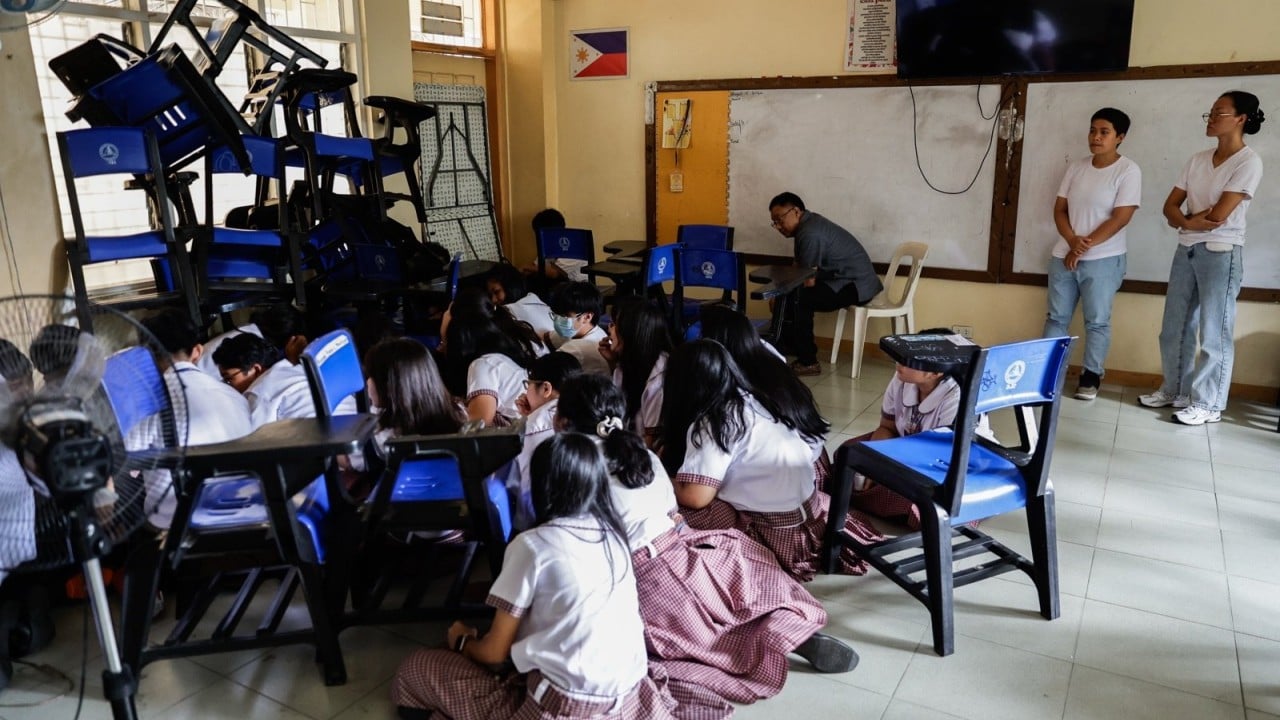
The heavy iron gate of a Manila public high school does not just keep the outside world away. It keeps the anxiety in.
At seven in the morning, the air smells of diesel exhaust, toasted pandesal from a street cart, and the sharp, distinct scent of damp concrete after a tropical downpour. Thousands of students stream past armed guards, through metal detectors, and past perimeter walls topped with coils of rusted barbed wire. To an outsider, it looks like a maximum-security compound. To the teachers, parents, and children who live inside its shadow for eight hours a day, it is simply Tuesday.
We have built fortresses and called them places of learning.
Behind this architectural paranoia lies a quiet panic. For years, policymakers across the Philippines have wrestled with how to protect the nation's youth. The response has been heavy-handed, reactive, and dangerously narrow. More locks. Tighter gates. Armed personnel stationed at entry points like checkpoint guards on a border. It is a philosophy born from fear, operating on a simple, flawed premise: safety is something you construct out of steel and concrete.
Consider what happens next. When a school turns inward, transforming its perimeter into a barrier against hypothetical threats, the psychological climate shifts. Children stop seeing a sanctuary. They see a cage. The message whispered by every iron bar and pat-down search is unambiguous. Danger is everywhere. You are not safe.
(Note: The following hypothetical scenario illustrates a pattern observed by education advocates and child psychologists in congested urban campuses.)
Imagine Maria, a fourteen-year-old eighth grader in Quezon City. Every morning, she stands in a queue that snakes outside the school gate for twenty minutes. The sun beats down. Her heavy canvas backpack, stuffed with notebooks and a bento box, digs into her shoulders. A security guard presses a cold plastic wand along her spine, checking for contraband. By the time she reaches her homeroom, her heart is racing, not with the excitement of algebra or literature, but with a low-grade, persistent adrenaline spike. Her body is preparing for conflict before she has even opened a textbook.
This is the hidden toll of our current approach. We harden the exterior while eroding the interior.
Educational experts and child welfare advocates have begun pushing back against this fortress mentality, labeling it a profound miscalculation. The critique is straightforward. By pouring resources into physical deterrence—hardening gates, adding surveillance cameras, and militarizing the threshold—schools neglect the invisible vulnerabilities that truly endanger students. Bullying, chronic mental health crises, deteriorating infrastructure, fire hazards, and disaster unpreparedness do not care about a metal detector. A locked gate will not stop an earthquake, nor will it heal a child drowning in silent despair.
The numbers tell a sobering story of misplaced priorities. Across the archipelago, thousands of public schools struggle with basic infrastructure deficits. Classrooms routinely hold double or triple their intended capacity, turning concrete boxes into stifling heat traps. Evacuation routes are often blocked by illegal expansions or narrow corridors. Yet, budgets frequently prioritize perimeter security over structural resilience, counseling services, or emergency medical response training.
We are guarding the front door while the roof leaks and the foundation cracks.
To understand why this happens, we have to look at how modern bureaucracies process fear. Fear is loud. A single dramatic incident on the evening news demands an immediate, visible reaction. Politicians need to show action. Nothing looks more proactive than a fresh coat of paint on a security wall or a new batch of handheld scanners. It is tangible. It is countable. It can be photographed for a press release.
Nuance, conversely, is invisible. Funding a full-time guidance counselor for a student body of two thousand doesn't make the morning papers. Upgrading electrical wiring to prevent fires lacks cinematic flair. Cultivating an environment of psychological safety—where students trust their peers and faculty enough to report brewing conflicts—takes years of patient, unglamorous labor.
So we choose the gate. It is easier to lock a child in than it is to open a path for them.
Step inside a typical faculty room during the mid-morning lull. The teachers are exhausted. They are not just educators anymore; they are part-time security coordinators, crowd controllers, administrative clerks, and frontline emotional triage nurses. They watch forty students in a room designed for twenty, trying to spot the quiet kid in the back who stopped speaking three weeks ago. They know that safety isn't about whether a security guard has a radio. It is about whether a student has someone to turn to when the world feels like it is collapsing.
When critics urge the Philippines to rethink its school safety approach, they are arguing for a fundamental inversion of values. True security is relational, not structural. It lives in the ratio of students to counselors. It lives in the structural integrity of a gymnasium roof during a typhoon. It lives in transparent, well-practiced evacuation protocols rather than panic-induced lockdowns behind bolted doors.
The shift requires courage. It means dismantling the illusion of protection that high walls provide and replacing it with the messy, vital work of community care. It means acknowledging that a child learns best not when they are watched by a guard, but when they are seen by an adult who cares.
The iron gates of Manila will not vanish tomorrow. The guards will remain at their posts, checking bags under the morning sun. But the conversation is beginning to crack open. Parents are asking harder questions. Teachers are demanding better tools.
We are slowly realizing that the most dangerous thing we can do to our children is teach them to live behind bars in the name of keeping them safe. The real work of protection is not about keeping the world out. It is about building a world inside the classroom that is worth stepping into.
The bell rings. The courtyard fills with noise, laughter, and the chaotic energy of youth. For a fleeting moment, the iron fades into the background, and all that remains is the sound of potential, waiting to be set free.