The studio lights in Tehran are unforgiving. They bounce off polished mahogany desks and high-definition lenses, creating an environment of sterile, controlled perfection. But on a Tuesday that felt like any other, that control evaporated. It happened when a news anchor, a man whose career was built on the steady delivery of state-sanctioned scripts, reached beneath his desk and pulled out an AK-47.
He didn't just hold it. He didn't treat it like a historical artifact or a prop in a play. He gripped the handguard, checked the magazine, and, with the camera tracking his every move, leveled the barrel toward the edge of the frame. Then he squeezed the trigger.
The sound in a small, enclosed television studio is different than it is on a battlefield. It is sharper. It is a physical intrusion. The rhythmic crack-crack-crack of the rifle didn't just fill the room; it shattered the invisible wall between the viewer’s living room and the grim reality of a nation preparing for something dark. This wasn't a movie set. This was live television in Iran, and the message was unmistakable: the line between the civilian and the soldier has been erased.
The Weaponization of the Everyday
Imagine a father named Reza. He lives in a modest apartment in Mashhad. He spends his days worrying about the price of eggs and the slow speed of his internet connection. He is not a revolutionary. He is not a soldier. But lately, his evening news looks less like a report on the weather and more like a tactical briefing.
When the state media broadcasts an anchor firing a fully automatic weapon into a sandbagged corner of a studio, they are talking directly to Reza. They are telling him that his hands, which currently hold a briefcase or a steering wheel, must soon learn the weight of cold steel. This is the "Basij" model taken to its most extreme logical conclusion. The Basij, a paramilitary volunteer force, has long been a fixture of Iranian life, but the recent push to "democratize" the use of assault rifles suggests a shift from ideological policing to total societal mobilization.
The statistics back up this atmospheric shift. Iranian officials have ramped up "defense readiness" programs in schools and community centers. It is a calculated move to turn every street corner into a potential front line. By showing a polished, suit-clad newsman operating a weapon of war, the government is trying to normalize the presence of high-caliber violence in the middle of a Tuesday afternoon.
The Mechanics of Fear
To understand why this matters, you have to understand the rifle itself. The AK-47 is not a precision instrument. It is a rugged, reliable tool designed for mass production and ease of use. It is the most recognizable silhouette in the history of modern conflict. When an anchor fires one on air, he isn't demonstrating marksmanship; he is demonstrating accessibility.
The message is simple: If he can do it, you can do it.
But there is a hidden cost to this kind of propaganda. When a society begins to view its civilian population as a reserve armory, the social contract begins to fray. In a healthy state, the monopoly on violence is held by professional institutions—the police, the military—who are (theoretically) bound by international law and domestic oversight. When you bypass those institutions to train the general public in the middle of a news broadcast, you aren't just preparing for a foreign invasion. You are admitting that the domestic environment is no longer safe.
Consider the psychological toll on the viewer. Seeing a weapon fired in a space meant for information—a space that is supposed to be "safe"—triggers a primitive response. It’s a sensory hijack. The smell of cordite in a carpeted studio is a sensory dissonance that tells the brain the rules have changed. The anchor’s smile after the recoil settles is the most chilling part of the footage. It is the smile of someone who has accepted that peace is a temporary luxury.
The Invisible Stakes of Technical Training
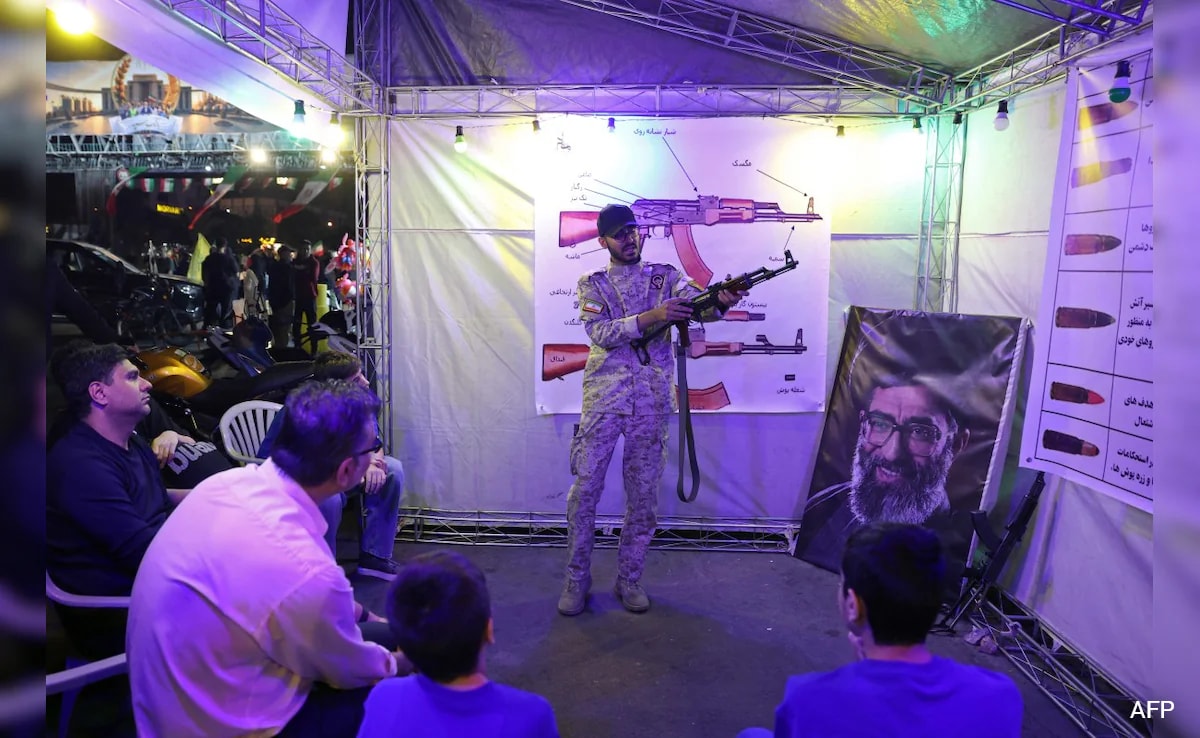
The broadcast wasn't just a stunt; it was a tutorial. The anchor walked through the basic operation of the weapon, turning a tool of destruction into a household appliance. This "educational" framing is a classic psychological tactic. If you can teach someone the mechanics of a thing, you strip away the taboo of using it.
We see this pattern in history. During the height of the Cold War, "duck and cover" drills in American schools served a similar purpose. They didn't actually save anyone from a nuclear blast, but they kept the population in a state of constant, low-level mobilization. They ensured that the "enemy" was always at the front of the mind.
In Iran, the stakes are more immediate. The regional tensions involving Israel, the United States, and various proxy groups are no longer abstract geopolitical chess moves discussed in smoky backrooms. They are being literalized. When the government provides "weapon training" to civilians via the television, they are prepping the collective psyche for a reality where the war doesn't stay at the border. It comes to the doorstep.
The Sound of a Broken Taboo
The most haunting element of the footage isn't the rifle itself. It’s the silence that follows the gunfire. The echo dies down, the smoke drifts toward the studio vents, and the anchor returns to his calm, modulated tone. He adjusts his tie. He looks back into the lens.
This is the "new normal" being manufactured in real-time.
For the international community, this broadcast serves as a flare. It signals a regime that is no longer interested in the optics of diplomacy. For the Iranian citizen, it is a heavy-handed reminder of their obligation to the state. The rifle is presented as a gift, a means of empowerment, but it is actually a burden. It is the weight of a conflict they didn't choose, handed to them by a man in a suit who just finished reading the sports scores.
The human element here isn't found in the bravado of the anchor. It’s found in the millions of people watching from the other side of the glass. It’s in the grandmother wondering if her grandson’s school will be the next "training ground." It’s in the young professional wondering if their resume will soon be replaced by a conscription notice.
When the safety catch is flipped off on live television, it stays off. You can’t un-see the muzzle flash. You can’t un-hear the mechanical slap of the bolt carrier returning to battery. The studio might be bright, the anchor might be composed, but the shadow being cast across the nation is long, jagged, and shaped exactly like a barrel.
The broadcast ends. The screen fades to black. But the vibration of those shots remains in the floorboards of every home that was tuned in.
Violence, once invited into the living room, rarely agrees to leave.