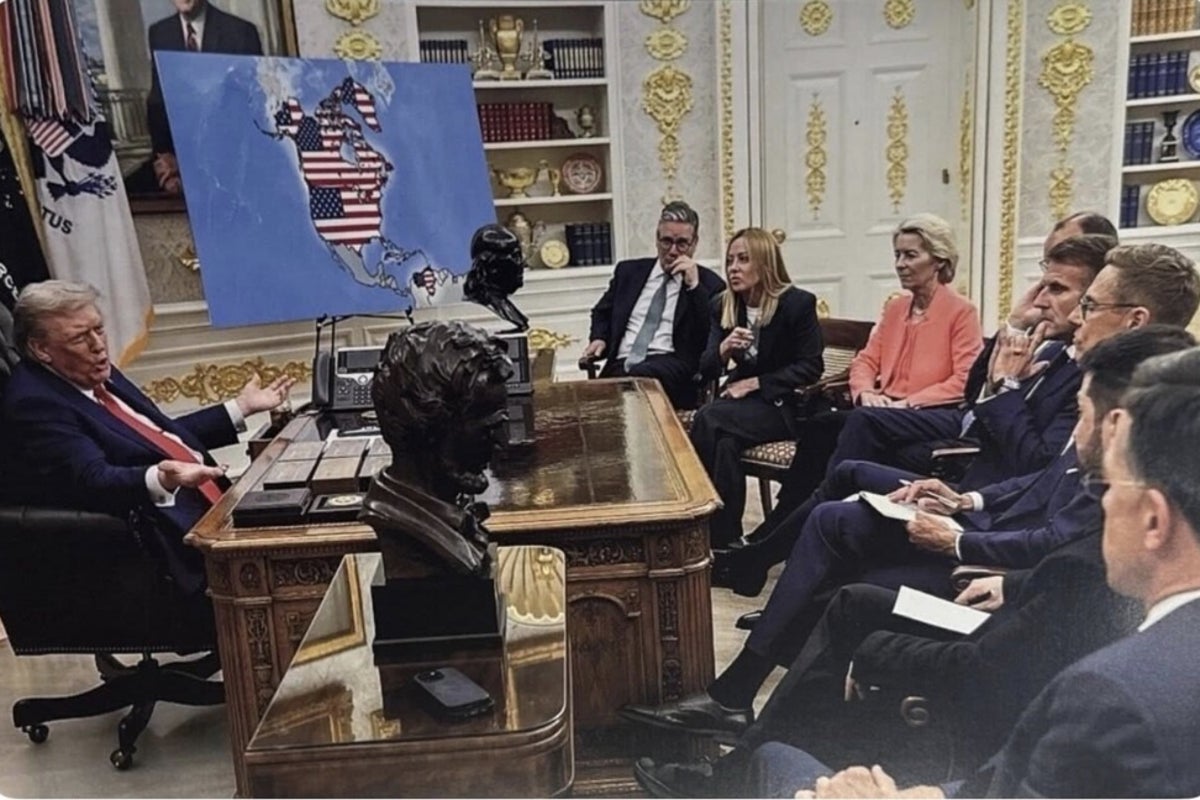
A screen glows bright blue in the dark of a Ottawa living room. It is late, the kind of quiet hour where the rest of the neighborhood has surrendered to sleep, but the woman sitting at her kitchen table cannot close her eyes. On her phone, a single image flashes across social media: a map, modified with crude digital lines, laying claim to lands that do not belong to the person posting it. To a political strategist in Washington, it is just content—a provocative jab meant to trigger outrage, dominate a twenty-four-hour news cycle, and signal dominance to a fiercely loyal audience.
To the woman at the table, whose family has run a transport business across the Ontario-Michigan border for three generations, it feels like a tremor beneath the floorboards.
Politics in the digital age has flattened geography into a series of punchlines and threat vectors. When former President Donald Trump posts a photoshopped map depicting Canada and Greenland as annexed territories of the United States, news outlets rush to break the story with familiar, mechanical headlines. They detail the platform used, the reaction of political pundits, and the swift, measured diplomatic responses from foreign capitals.
They tell you what was posted. They rarely tell you what it feels like to live inside the fallout.
The Geography of Anxiety
Geopolitics used to move at the speed of signed parchment and secret ambassadors. Today, it moves at the speed of a thumb flicking across a glass screen. A single upload can erase decades of quiet, institutional trust in a matter of seconds.
Consider Greenland. Most people view the vast, icy territory through the lens of abstract strategy—a strategic wedge of rock and ice sitting atop the Arctic, rich in untapped minerals and positioned along trade routes that are opening as polar ice recedes. When American political figures casually talk about buying or absorbing it, the commentary usually centers on military bases or economic leverage.
The people who actually inhabit those fjord-carved coastlines experience a very different reality. For centuries, native communities have managed a delicate balance with one of the most unforgiving environments on Earth. Their sovereignty is not a theoretical concept debated in think tanks; it is tied to their identity, their language, and their right to govern their own harsh, beautiful home.
When a social media post turns an entire nation into a casual trophy, it sends a cold shiver through small communities. It tells them that in the eyes of the world's most powerful empire, their history is merely real estate waiting for a developer.
The Invisible Stakes Behind the Screen
Border towns understand something that capital cities often forget: borders are not just lines on a map. They are living, breathing ecosystems.
In places like Windsor or Niagara, the boundary between nations is defined by daily commutes, shared power grids, intermarried families, and supply chains so tightly woven that a bumper made in Ontario might cross the Detroit River four times before it is bolted onto a finished truck.
Sovereignty is not merely a legal status; it is the silent agreement that your neighbor respects your right to exist on your own terms.
When social media rhetoric turns aggressive, the economic damage does not wait for actual policy changes. It begins immediately in the minds of investors and business owners.
- Capital freezes: Small logistics firms delay buying new fleets because they cannot predict if trade routes will remain open.
- Tourism stutters: Travelers hesitate, spooked by shifting cultural friction and potential border delays.
- Diplomatic energy drains: Civil servants spend thousands of hours managing artificial crises instead of solving real issues like climate adaptation or infrastructure repair.
A post designed to generate outrage costs the creator nothing. It costs the people on the ground their sense of stability.
The Architecture of Distraction
It is easy to dismiss these digital provocations as political theater, a performance meant for domestic voters who crave a show of raw power. But theater has consequences when the stage is the global arena.
Every time a major political figure tests the boundaries of international decorum, they lower the baseline of what is acceptable. What begins as a joke or a troll slowly morphs into a policy option through sheer repetition. The unthinkable becomes the talked-about; the talked-about becomes the plausible.
The true danger is not that American troops will suddenly march across the 49th parallel or land on the shores of Nuuk tomorrow. The danger is the slow erosion of trust among allies who have spent over a century building the quietest, most successful peaceful partnership in human history.
Trust takes generations to construct out of trade treaties, shared sacrifices in global wars, and mutual respect. It takes a second to fracture with a careless graphic.
The Quiet Strength of the Far North
Back in Ottawa, the woman puts her phone face down on the table. The screen goes black, but the impression remains.
Outside her window, the night air is thick and cold. Across the border, millions of ordinary citizens go to sleep with no desire to conquer their neighbors, oblivious to the political games played in their name. The human tragedy of modern political theater is that it creates enemies out of friends who share the same values, the same economy, and the same quiet hopes for their children.
In Greenland, the northern lights stretch across an endless sky, completely unbothered by digital maps or sovereign claims. The ice remains, the people remain, and the quiet dignity of a culture that has survived centuries of isolation stands firm against the noise of a distant feed.
The lines drawn in pixels will eventually be forgotten, washed away by the next wave of breaking news. But the people who live along those borders will remember who treated their home as a sovereign nation, and who treated it as a punchline.