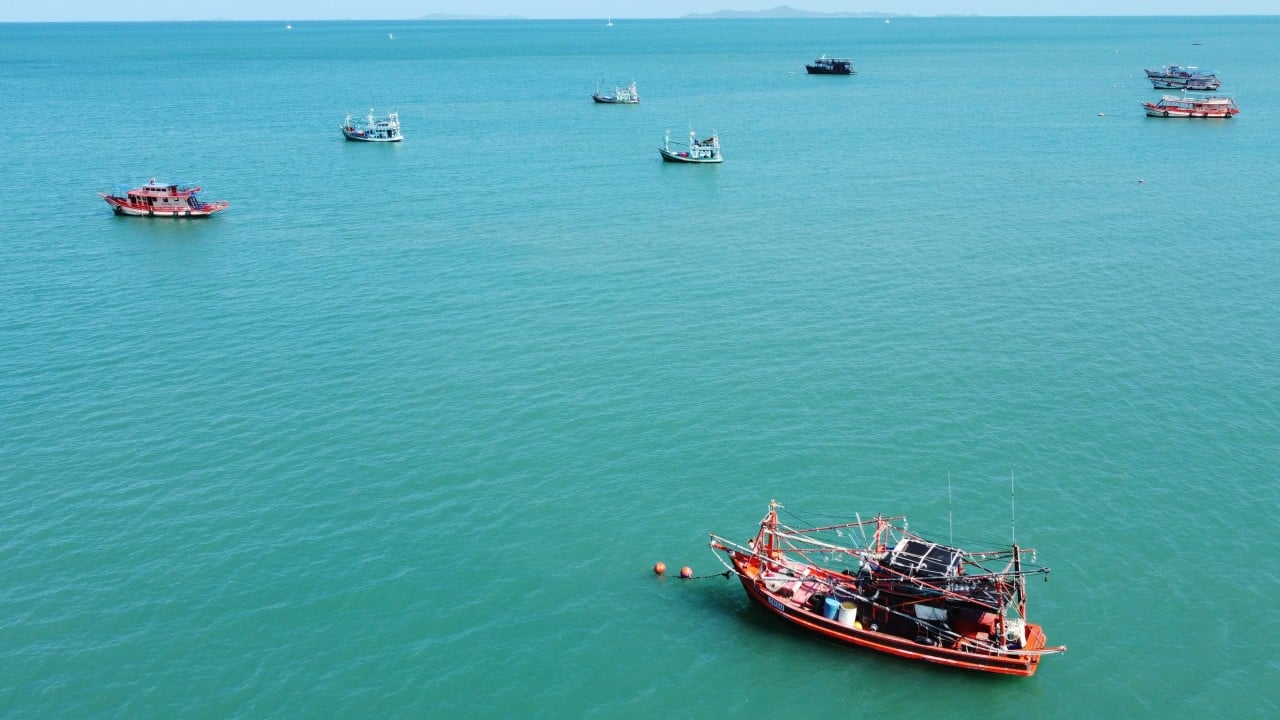
Salt air hangs heavy over the docks of Trat long before dawn. Engine oil mixes with the smell of diesel, crushed ice, and wet timber. You feel the Gulf of Siam in your boots before you ever see it—a low, rhythmic thrum carried through wooden planks from boats idling against pilings.
Out there, past the familiar fishing grounds where generations of families have read the tides by cloud formations and water color, the ocean looks unbroken. Flat. Blue-gray. Endless. Yet beneath roughly 26,000 square kilometers of that water sits one of Southeast Asia's most stubborn geopolitical puzzles: the Overlapping Claims Area, a triangular patch of seabed claimed by both Thailand and Cambodia. You might also find this similar coverage insightful: Why Slovakia Matters So Much for European Ammunition Production Right Now.
Estimated to hold trillions of cubic feet of natural gas and sizable pockets of oil, the zone has long been framed in diplomatic cables and energy briefs as a prize worth an estimated US$300 billion. Numbers like that sound clean on a spreadsheet. They look tidy inside a ministry briefing book.
Out on the water, nothing is tidy. As extensively documented in detailed coverage by BBC News, the effects are significant.
Diplomatic tensions between Bangkok and Phnom Penh over this offshore territory have flared and cooled for more than half a century. Whenever domestic politics shift, energy prices spike, or nationalist sentiment rises on either side of the border, the seabed returns to center stage. Sometimes leaders talk of joint development and shared prosperity. Other times, rhetoric hardens, old grievances surface, and the silence between capitals grows cold.
To understand why a patch of empty ocean can stir such fierce emotion—and why calm negotiations matter so urgently—you have to look past the dollar figures. You have to look at the people standing on the shore, the families heating pots over gas stoves in Bangkok apartments and Phnom Penh shophouses, and the diplomats sitting across from one another trying not to let history drown the present.
Lines Drawn on Water
Water does not hold a boundary marker. You cannot drive a wooden stake into a swell or plant a flag on a wave.
When colonial mapmakers and postwar governments drew lines across mainland Southeast Asia in the twentieth century, maritime borders proved far trickier than riverbanks or mountain ridges. In the early 1970s, Cambodia and Thailand sketched competing claims over the continental shelf in the Gulf of Siam. Their lines crossed. The triangle formed where those claims overlap became the Overlapping Claims Area—known in policy shorthand as the OCA.
For decades, the dispute has lived in a strange limbo. Neither side has fully surrendered its claim, yet unilateral drilling in contested waters risks confrontation, legal standoffs, and political backlash. In 2001, the two governments signed a memorandum of understanding aimed at creating a framework for joint development and border demarcation. Progress stalled, restarted, and stalled again. Political transitions in both countries—including changing coalitions, shifting royalist and populist dynamics, and leadership changes—repeatedly pulled attention away or turned compromise into a political liability.
It helps to pause here and use a metaphor. Imagine two neighbors sharing a narrow strip of land between their backyards where neither has a clear deed, and both suspect there is gold buried six feet down. One neighbor wants to measure the yard first and put up a fence before anyone digs. The other wants to dig together right away and split whatever turns up, worrying that waiting decades to draw a line means leaving wealth in the dirt while both households pay high utility bills.
That tension sits right at the heart of the Thailand–Cambodia seabed standoff. One side emphasizes sovereignty and clear demarcation first; the other emphasizes joint resource exploration and shared economic benefit. Both arguments have logic. Both carry political risk.
A Hypothetical Morning in Two Kitchens
To feel how an abstract maritime dispute reaches into everyday life, consider a hypothetical scenario—a morning routine that plays out in countless homes across both nations, even if the specific characters below are invented to illustrate real pressures.
In a cramped fifth-floor walk-up in central Bangkok, Somchai, a hypothetical delivery rider, flicks the igniter on a small gas stove to heat water for instant coffee before his 6:00 a.m. shift. The blue flame sputters slightly, then catches. Like much of Thailand, his country relies heavily on natural gas for electricity generation and cooking. Domestic gas fields in the Gulf of Siam have matured over the years, forcing Thailand to import more liquefied natural gas—often at volatile global prices—to keep the grid steady and household costs manageable.
Across the border and down toward the coast, in a hypothetical concrete shopfront outside Sihanoukville, Sokha wipes down counter space before opening her small noodle stall. Electricity reliability and fuel costs shape every margin in a growing economy. Cambodia has long sought stronger domestic energy security and new revenue streams to fund roads, schools, hospitals, and grid expansion without leaning excessively on costly imported power.
Neither Somchai nor Sokha wakes up thinking about continental shelf coordinates or hydrocarbon reserve estimates. Yet the price of keeping the lights on, the stability of national budgets, and the health of bilateral trade between Thailand and Cambodia are braided together. When tensions flare over contested waters, trade corridors, border crossings, and diplomatic goodwill can all feel the chill.
Why US$300 Billion Feels So Heavy
Three hundred billion dollars. Say it out loud and your brain tries to picture a mountain of cash, when in reality it is a long-term projection based on estimated recoverable reserves, assumed commodity prices, extraction costs, and decades of production.
Energy economics is rarely a straight line. Offshore oil and gas projects in Southeast Asia take years of seismic surveying, engineering, rig mobilization, pipeline construction, and regulatory approvals before the first cubic foot of gas reaches a turbine. Prices swing. Global demand shifts as renewables expand and economies electrify. An estimate of US$300 billion is not a check sitting in a vault waiting to be cashed tomorrow morning; it is a multi-decade horizon.
Still, numbers like that carry enormous psychological weight. In politics, potential wealth often feels immediate. Opponents can accuse negotiators of giving away national heritage for pennies on the dollar if a deal looks too generous to the other side. Supporters can argue that walking away from potential revenue is reckless when citizens are feeling the pinch of living costs.
That is what makes maritime disputes so delicate. A compromise can look like weakness in a headline even when it is pragmatism in practice.
Have you ever tried to split something valuable when everyone around you is shouting that you are getting cheated? The pressure distorts judgment. Even reasonable people start hedging every word.
History Has a Long Memory
Diplomats never sit in a soundproof room. Behind every chair in Bangkok and Phnom Penh stands history—not as a dusty textbook, but as a living set of sensitivities.
Thailand and Cambodia share deep cultural ties, intertwined histories, and bustling cross-border commerce. Millions of people move between the two countries for work, trade, family, and travel. At the same time, border disputes—most famously around the Preah Vihear temple area years ago—have shown how quickly historical pride and territorial anxiety can flare into crisis.
When leaders in either capital try to calm tensions over the seabed, they have to walk a narrow ridge. Move too slowly, and energy needs go unmet while mistrust lingers. Move too fast without public trust or clear guardrails, and domestic critics may frame the effort as a surrender of sovereignty.
In international relations, this is a recognizable pattern: disputes over resources rarely stay purely about resources. They absorb national identity. A patch of seabed stops being just geology and becomes a mirror of how a nation sees its strength, its fairness, and its future.
I will be candid here: maritime law, joint development zones, and offshore reserve math can feel dizzying even to people who follow regional news closely. Terms like "overlapping claims" and "memorandum of understanding" sound polite, almost sleepy, right up until the moment a diplomatic row threatens regional stability. If you have ever felt your eyes glaze over when reading about border negotiations, you are not alone. The jargon hides high stakes behind calm nouns.
What Calm Actually Requires
So what does it take for Thailand and Cambodia to keep a US$300 billion seabed dispute from boiling over?
First, it takes lower temperatures in public rhetoric. Calm is not the absence of disagreement; it is the habit of disagreeing without turning a neighbor into an existential enemy. When officials speak carefully—acknowledging legitimate national interests on both sides while keeping channels open—room opens up for technical experts to do quiet work.
Second, it takes separating immediate political theater from long-term practicality. A joint development arrangement, if structured carefully, does not have to mean abandoning core legal positions overnight. Historically, states around the world have used joint zones or phased frameworks to unlock resources or prevent clashes while keeping sovereignty questions ring-fenced—though doing so requires ironclad trust, transparent revenue-sharing rules, and clear dispute mechanisms.
Third, it takes remembering who pays the price if talks collapse. It is not the think-tank analysts writing papers about geopolitics. It is the small business owner watching energy costs eat into profits. It is the worker whose livelihood depends on steady cross-border trade. It is the young person entering a job market shaped by whether Southeast Asia looks stable and cooperative or fractured and tense.
Consider what happens next: if capitals treat every flare-up as a zero-sum battle, every future negotiation becomes harder. If they treat calm as a shared investment, both countries gain breathing room to plan their energy futures—whether that means responsibly tapping offshore gas, building cleaner power grids, or strengthening regional trade.
The Quiet Test Beneath the Waves
There is no dramatic explosion out in the Gulf of Siam when talks stall. No sirens wail over the Overlapping Claims Area. Just wind crossing open water, waves rolling toward shallow beaches, and boats heading out before sunrise while capitals weigh risk against reward.
Sometimes the hardest battles in statecraft are fought not with weapons, but with patience—resisting the easy outrage, sitting through long meetings, and refusing to let an old line on a map decide the fate of people living today.
Down in the dark beneath those shifting waves, the seabed waits in silence. Above it, two neighboring nations face a choice that echoes far beyond the water: let a fortune in the deep pull them apart, or find enough steady ground between them to keep the peace.