Dust sticks to the lens when the wind comes off the escarpment. It is a fine, red grit that gets into the gears, scratches the glass, and coats the tongue like dry flour. Anyone who has spent twenty-four hours waiting in a canvas blind knows this taste. You sit knee-to-knee with your own breath, listening to the dry rattle of acacia pods outside, wondering if the pride moved on an hour ago or if they are sitting ten feet behind your canvas wall, watching the cloth move in the heat.
Most television about the wild tries to sell you an aquarium. It puts glass between you and the teeth, turning predators into actors and landscapes into wallpaper. We have grown accustomed to watching the earth as though it were streaming past a train window—clean, distant, and safe.
Then comes a project that decides to break the glass.
National Geographic’s Africa: Earth's Wild Home does not look like a nature documentary. It looks like a confession. Across its sweeping episodes, the production team—armed with thermal imaging, ultra-high-definition macro lenses, and stabilization rigs that float like ghosts over the Maasai Mara and the Namib dunes—manages something rare. It stops narrating the continent and starts recording its pulse.
Consider what it takes to film a nocturnal desert lion navigating the salt pans under a quarter-moon. You do not just turn on a camera. You sit in the dark for three weeks. You watch the temperature plunge from forty degrees Celsius to freezing. You wait. And when the pride finally moves, the camera does not catch a generic stock shot of majestic beasts pacing against a sunset. It catches the individual scar across a matriarch’s nose, the ragged tear in an ear earned during a territorial dispute three rains ago, and the exhausted slump of a cub whose belly has stayed flat for two days.
This is where the magic lives. Not in the grand aerial shots that make the continent look like a postcard, but in the grit under the fingernails.
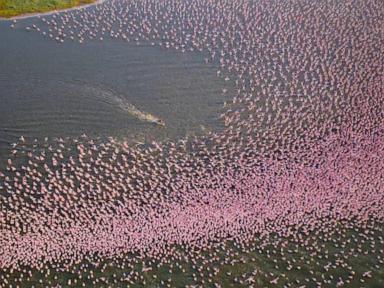
The series splits its gaze across radically different worlds. One moment you are swimming through the murky, nutrient-rich channels of the Okavango Delta, where a leopard stalks lechwe through water so still it mirrors the clouds. The next, you are dropped onto the scorching salt crust of Makgadikgadi, where millions of flamingos gather in a surreal, pink-feathered metropolis that feels less like Earth and more like a foreign moon.
To bring these contrasting biomes to life, the cinematographers abandoned traditional long-lens observation. They moved inside the micro-habitats. Using specialized macro probes, they filmed the frantic, high-stakes architecture of termite mounds from the perspective of the insects, making the subterranean tunnels look like subterranean gothic cathedrals. They tracked the invisible highway of water that transforms parched earth into a roaring flood within hours—not through computer-generated graphics, but by positioning remote cameras in dry riverbeds months before the first drop fell, waiting for the wall of water to smash through the dust.
We talk about biodiversity as if it were a spreadsheet entry. We quote the shrinking square mileage of the Serengeti or the dwindling numbers of desert-adapted elephants in Mali. But numbers are cowards. They let us care without feeling.
A statistic cannot show you the heavy, sagging stride of an old bull elephant whose tusks drag in the dust because the wells have dried up three miles further than they did when he was young. It cannot capture the desperate, silent coordination of wild dogs boxing out hyenas to protect their pups in the scrub.
Africa: Earth's Wild Home forces you to look at those eyes. There is a terrifying intelligence behind the amber stare of a cheetah scanning the horizon for competition. It is an intelligence forged in an environment where hesitation means starvation and a single miscalculated leap into a warthog burrow can break a leg and end a bloodline.
Technology has finally caught up with the wilderness, but only because the people behind the cameras were willing to slow down. The gear used for this series—the specialized gimbals, the low-light sensors that can pull color and clarity out of a moonless night, the drones that slip through a canopy without startling a nesting hornbill—did not distance the crew from nature. It forced them closer. They had to understand the animal's schedule, its fears, its geography, better than the locals who share the grazing lands.
There is a moment in the second episode where a young baboon troop encounters a flash flood in a rocky gorge. The water arrives with the sound of a freight train, tumbling boulders the size of cars down a dry wash. You watch the frantic scramble up the cliffs. You see the hesitation of a mother carrying an infant that cannot yet climb on its own.
Your heart accelerates. You know how physics works. You know gravity does not negotiate.
When they make the ledge—just barely, claws scrabbling for purchase in the wet shale—you exhale. You realize you have been holding your breath for two full minutes. That is the triumph of this work. It does not teach you about Africa. It makes you a temporary resident of its margins, sharing the same thin air, the same sudden terror, and the same desperate, beautiful will to endure.
The screen fades to black eventually. The credits roll over the sound of wind rustling through dry grass and the distant, haunting call of a spotted hyena fading into the gray dawn.
You turn off the television. The room is quiet. But outside your window, the streetlights hum, and somewhere out there, beneath the same indifferent stars, the earth is still turning, still breathing, still waiting for the rain.


