The sun does not rise differently over the border in South Lebanon. It hits the olive groves with the same impartial heat, the same golden indifference that it shows to the stone houses and the cratered roads. But for the people who walk these hills, the light means something else. It means exposure. It means visibility. For a journalist, that light is the only tool that matters. You wake up, you check your gear, you look at the map, and you ask yourself the question that defined Amal Khalil’s life: Who is watching?
Amal understood the calculus of war. She knew that every shot fired in the dark, every explosion that leveled a home, and every life extinguished in the mud of the borderlands was a story screaming to be told. She also knew that in the architecture of this conflict, the witness is often the first casualty. To report on the truth is to stand directly in the line of fire. It is not a job for the faint of heart. It is a slow, methodical accumulation of moments where you choose between staying safe and standing firm.
She chose to stand firm.
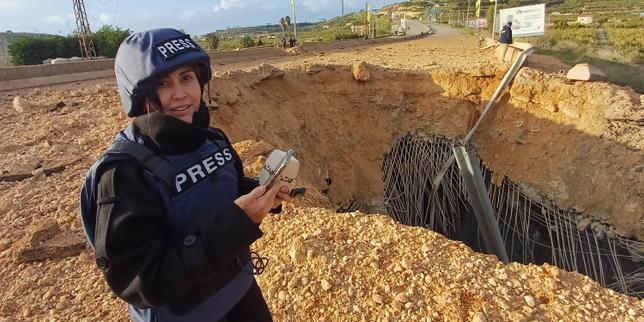
Her mornings began with the smell of strong coffee and the heavy silence of anticipation. There was the equipment to check—the lenses, the batteries, the vest that offered little protection against the realities of modern artillery, yet remained a uniform of purpose. She was not a soldier. She carried no weapon. Her hands were calibrated for focus, not for violence. But in a conflict where the lines of engagement are fluid and often nonexistent, the distinction between combatant and chronicler is frequently ignored by those who press the buttons that release the fire.
Consider the geography of the incident. This was not a chaotic battlefield of moving infantry. This was a place of fixed points and established roles. The cameras were set up. The insignia was visible. The world knew who was there. When the strike came, it did not arrive as an accident of war. It arrived with the cold, deliberate precision of a choice.
The blast was instantaneous.
In that fraction of a second, the story she was building—the narrative of a village under pressure, of the people clinging to their ancestral soil—was interrupted. The silence that followed was not peaceful. It was the heavy, suffocating silence of a story cut short. When a journalist is killed, the world loses more than just a person. It loses a window. It loses the eyes that were seeing what we refused to look at.
We often talk about the death of a reporter in terms of statistics. We count the numbers. We measure the loss against the backdrop of total casualties. But that approach misses the gravity of the void. When Amal Khalil died, she took with her the specific cadence of the questions she would have asked tomorrow. She took the perspective she had spent years cultivating, the nuanced understanding of the people she lived among. You cannot replace that. You cannot substitute a voice with a press release. The erasure of her voice is an act of silencing that reverberates far beyond the border.
The danger of this moment is not just the violence itself. It is the normalization of the silence that follows. When journalists are systematically removed from the equation of war, the conflict becomes abstract. It becomes a map of lines and dots, a series of strategic maneuvers devoid of human consequence. We start to see the world through the lens of a satellite, high above the clouds, where we can no longer see the faces of the people on the ground. We lose the grit. We lose the dust. We lose the humanity.
Amal’s death is a mirror. It forces us to ask why we are comfortable with the quiet. Why do we accept the absence of information as a byproduct of conflict? It is easy to look away. It is easy to consume the sanitized versions of events that come through official channels, stripped of the messy, painful reality that local reporters provide at the risk of their own lives. But the truth is not sanitized. It is loud. It is angry. It is desperate. And it requires someone to be there to record it.
There is a concept in ethics regarding the bystander effect, where the presence of others inhibits our urge to intervene. In the context of war, we are all bystanders. We sit in our offices, our homes, our safe, quiet rooms, watching the feed. We see the smoke rise from the hills of Lebanon, and we swipe past. We do not feel the heat. We do not hear the whistle of the projectile. We do not know the names of the people who were drinking tea on their porch when the sky fell.
Amal bridged that distance. She turned the abstract struggle into a personal experience. She made it impossible to ignore the stakes. When she went to the field, she was not looking for glory. She was looking for the truth in the rubble. She was looking for the dignity of the people whose lives had been turned into pawns in a geopolitical game.
The state of affairs today is grim. The risk for those on the ground has escalated beyond any reasonable measure. It is no longer just about the unpredictability of the battlefield; it is about the targeting of the very mechanism that makes information possible. When the people holding the cameras are marked as threats, the war has entered a new, darker phase. It is an attempt to impose a blackout. It is an attempt to break the link between the event and the observer.
We have to understand that this is not just about a specific incident in Lebanon. This is about the integrity of the record. If we allow the witnesses to be removed, we allow the narrative to be written by those with the power to enforce their own versions of reality. We surrender our right to know. We surrender our right to judge. We become passive recipients of a story designed to suit the powerful, not the truth.
Think of the equipment she left behind. The camera, still capable of recording. The recorder, still sensitive to sound. They are inanimate objects, yet they carry the weight of her intent. They are waiting for someone to pick them up, to continue the work, to walk back into the danger and say, "I am here. I am watching. I will tell the story."
But who will take her place?
The tragedy is not just that she died. The tragedy is that the incentive structure of this war is designed to make her work impossible. It is designed to scare the next person away. It is designed to ensure that the silence becomes permanent.
We are entering a time where the truth is becoming an endangered commodity. The walls are closing in on those who dare to document the reality of the front lines. The pressures are not just physical; they are psychological, emotional, and systemic. You are constantly told to step back. You are constantly told that your presence is unwanted, that your perspective is biased, that your safety is your own responsibility.
Yet, the hunger for the truth remains. It is a primal instinct. We want to know. We need to know. We need the people who go to the edges of the map to tell us what is happening there. Without them, we are sleepwalking. We are navigating a fog of our own making, unable to see the precipice until we are already falling.
The death of a journalist is a fundamental disruption of our collective consciousness. It is a tear in the fabric of our shared understanding. When the person who brings us the news of the world is killed, the world itself becomes smaller, darker, and more hostile. We lose a piece of ourselves.
There is a persistent myth that the truth will set us free. It will not. The truth will only provide the data we need to make a choice. It will only give us the ammunition we need to argue for a different path. It is up to us to do the rest. It is up to us to recognize the value of the sacrifice. It is up to us to demand accountability.
If we let this moment pass without reflection, if we treat the loss of Amal Khalil as just another headline, just another statistic in a long, brutal sequence of events, then we are complicit in her silencing. We are helping to build the wall of indifference that makes her death inevitable. We are agreeing that the truth is worth less than the status quo.
But we have a choice. We can look at the map and see only lines. Or we can look at the faces. We can choose to amplify the stories that were meant to be extinguished. We can choose to acknowledge the risk that is being taken on our behalf every single day. We can choose to see the human being behind the byline.
The field is empty now, or perhaps it is filled with people waiting for the dust to settle, waiting for the permission to speak. The hills of South Lebanon remain, standing silent watch over the events that have unfolded upon them. They do not judge. They do not take sides. They only witness.
We must be the ones who translate that witness into action. We must ensure that the questions she was asking—the hard, uncomfortable, necessary questions—are not buried with her. We must ensure that the narrative of her life is not replaced by the narrative of her death. She was a reporter. She was a witness. She was a storyteller.
And her story did not end when the strike hit. It continues in every person who decides to pick up the camera, who decides to step forward into the light, who decides that the truth is worth the cost. The silence is loud, but it is not absolute. As long as there is someone left to listen, as long as there is someone left to care, the voice of the witness will never be truly extinguished.
There is a finality in the way the world moves on. The cycle of news continues, the headlines shift, the attention drifts to the next crisis, the next tragedy, the next breaking story. It is the nature of the beast. But underneath that movement, there is a bedrock of memory. There is the persistent, stubborn insistence of the facts. There is the residue of the lives that have been lived in the service of something greater than themselves.
In the end, that is all we have. We have the memories we choose to keep. We have the stories we choose to tell. We have the legacy of the people who dared to look into the darkness and hold up a light.
Amal Khalil looked into that darkness. She did not blink. She did not turn away. She stood her ground, camera in hand, and she bore witness to the reality of her time. That is her legacy. That is her final report. It is written not on the page, but in the consciousness of everyone who understands the profound, terrible, and necessary cost of telling the truth.
The sun is setting now over the border. The light is fading, casting long, sharp shadows over the land. It is quiet. But if you listen closely, you can still hear the echo of a voice that refused to be silenced. You can still see the image of a life that refused to be hidden. You can still feel the weight of a story that is waiting for someone, anyone, to finish it.
The camera is still there. The memory is still there. The truth is still waiting.
It is time to look.