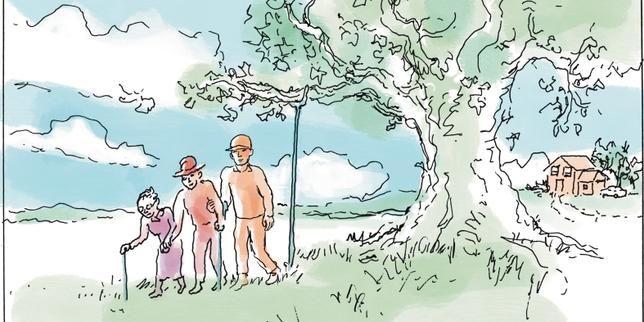
Acquiring functional literacy in your eighties is not a miracle of late-blooming genius; it is a high-friction cognitive engineering problem governed by neuroplasticity, visual acuity constraints, and opportunity cost. Most personal narratives treating late-life reading as an inspirational awakening miss the underlying system mechanics: how an octogenarian brain decodes orthography when working memory capacity is tighter, how sensory degradation alters visual input bottlenecks, and how time allocation changes when career and child-rearing obligations no longer compete for bandwidth. This analysis establishes a structural model of late-life reading acquisition, maps the causal chains behind successful skill transfer, and details an operational framework for learners and instructors working with older adults.
The Structural Model of Late-Life Literacy
Popular accounts of learning to read in advanced age usually frame the process around emotional triumph. That framing leaves out the operational architecture required to move from phonological awareness and letter-sound correspondence to independent text comprehension. Reading is not a single innate faculty; it is a multi-stage processing pipeline where a failure at one stage starves downstream stages of usable information. Don't forget to check out our recent coverage on this related article.
In an octogenarian learner, the pipeline operates under distinct physical and cognitive parameters compared to a child or a young adult:
- Input Channel Integrity: Visual acuity, contrast sensitivity, crowding effects, and ocular motor control determine how cleanly graphemes enter the visual system. Presbyopia, cataracts, macular changes, or uncorrected refractive error degrade character boundaries before any linguistic rule is applied.
- Phonological and Orthographic Mapping: The brain must link visual symbols (graphemes) to speech sounds (phonemes) and recurring letter patterns (morphemes and rimes). In late-life learners who speak a language fluently, oral vocabulary and syntactic intuition are already mature, which is an advantage for guessing meaning from context, yet a potential hazard if top-down guessing masks weak decoding accuracy.
- Working Memory and Executive Control: Holding phonemes in mind while blending them into a word, then holding words in sequence to parse a clause, taxes working memory. Age-related shifts in processing speed and attentional control make inefficient decoding feel exhausting far faster than it does for a fluent reader.
- Long-Term Semantic Networks: Unlike children building a world model from scratch, an eighty-year-old possesses decades of episodic memory, domain schemas, and idiomatic knowledge. When a decoded word hits an existing semantic node, retention is rapid; when it hits an unfamiliar concept, consolidation requires deliberate repetition.
- Affective and Identity Regulation: Shame around non-literacy, fear of public error, and shifts in self-concept directly govern practice frequency. High anxiety narrows attentional bandwidth and triggers avoidance, whereas autonomy and low-stakes mastery sustain daily repetition.
The causal relationship between these components is sequential and asymmetric. Fixing motivation without fixing font size, lighting, or glare creates frustration rather than progress. Conversely, providing crisp visual materials without addressing fear of judgment leads to sporadic practice that fails to build automaticity. To read more about the background of this, Everyday Health offers an informative breakdown.
Consider a learner who spent eighty years navigating life through oral networks, physical labor, or trade skills. When they attempt to read a standard newspaper or prescription label, their oral comprehension of the underlying concepts may be high, while their sub-lexical decoding speed is slow. By the time they sound out the final words of a sentence, the opening words have decayed in working memory. The bottleneck is not intelligence or life experience; it is decoding latency relative to working memory decay rate.
Why Conventional Literacy Assumptions Break Down at Eighty
Standard adult literacy instruction was largely designed for working-age adults seeking employment credentials, GED completion, or workplace advancement. Applying those assumptions directly to an eighty-year-old produces predictable failure modes.
Time Horizons and Return on Effort
Economic models of human capital typically assume a multi-decade payoff window for skill acquisition. At age eighty, the expected horizon for career or financial return on literacy is near zero, which changes the incentive structure. If instruction relies on abstract future utility ("this will help you advance" or "you will need this for job forms"), engagement drops.
The actual payoff functions in late life are immediate and concrete: reading a grandchild's text or card, verifying medication instructions without asking someone else, navigating public signage independently, or reading scripture or local news on one's own schedule. A framework that ignores immediate functional utility misallocates instructional hours toward low-relevance drills.
Cognitive Fatigue and Session Economics
Younger learners can often absorb sixty- to ninety-minute study blocks through sheer stamina. For many octogenarians, sustained visual attention and phonemic decoding produce sharp cognitive fatigue within twenty to thirty minutes.
A second limitation of long sessions is diminishing marginal return on practice time. Pushing past mental exhaustion increases decoding errors, reinforces inaccurate guessing habits, and associates reading with physical or mental strain. Shorter, high-frequency sessions—such as fifteen to twenty-five minutes once or twice daily—protect attention quality and support sleep-dependent memory consolidation.
Prior Knowledge as Both Scaffold and Interference
A common hypothesis in adult education is that rich life experience universally accelerates learning. In practice, prior knowledge cuts both ways.
- Scaffold Effect: Familiar topics reduce cognitive load during comprehension. A learner who knows how gardening, cooking, carpentry, or community organizing works can predict vocabulary and verify whether a decoded word makes sense in context.
- Interference Effect: Decades of reliance on oral memory and compensatory strategies (asking family members, memorizing routes, recognizing logos rather than spelling) can encourage holistic guessing based on initial letters or word shape. While guessing works occasionally in casual conversation, it breaks down on unfamiliar names, medical terms, or subtle grammatical distinctions.
Distinguishing between known empirical patterns and educated hypotheses matters here. Large-scale clinical trials specifically testing structured phonics versus whole-language methods exclusively in eighty-year-old first-time readers are scarce compared to pediatric literacy research. However, cognitive psychology findings on orthographic processing, working memory limits, and spaced retrieval provide strong mechanistic grounds for why explicit decoding and spaced practice outperform unstructured immersion. Treating those mechanisms as working hypotheses to test with each individual learner—rather than rigid dogma—keeps instruction honest.
Causal Chains Behind Life Change in Late Adulthood
When someone reports that learning to read in their eighties transformed their life, the change rarely comes from a single moment of decoding a sentence. It emerges from cascading shifts across autonomy, social standing, and daily friction reduction.
The first causal link is friction reduction in high-stakes micro-tasks. Everyday life contains dozens of small literacy checkpoints: street signs, bus or clinic notices, bills, labels, menus, and digital messages. Before literacy, each checkpoint requires either a workaround, a delay, or social dependence. Eliminating even a fraction of those dependencies lowers baseline daily stress and restores a sense of agency.
The second link is rebalancing intergenerational and social dynamics. Dependence on adult children, spouses, or neighbors for reading tasks often carries an unspoken asymmetry, even when helpers are kind. Becoming able to read private correspondence or personal documents shifts the relationship from one-way assistance toward mutual respect and privacy.
The third link is identity expansion. Someone who has carried a quiet stigma of "not being a reader" or "missing out on school" often internalizes a fixed limit on what they can learn. Mastering a foundational skill late in life falsifies that limit. That shift in self-efficacy can spill over into other domains—such as basic smartphone use, financial tracking, or voice-assisted tools paired with text verification.
The causal chain is not automatic, though. Learning to decode basic text does not guarantee emotional relief if the learner faces severe social isolation, untreated health decline, or materials that are too small or complex to read comfortably. Literacy is an enabling capability, not a cure-all.
An Operational Playbook for Late-Life Literacy
Turning late-life reading from an aspiration into a repeatable outcome requires treating instruction and self-study like a controlled system. The steps below outline a practical sequence for a learner working with a tutor, family member, or structured program.
- Audit Sensory and Environmental Inputs First: Before introducing drills, test reading under realistic home lighting. Use high-contrast print, larger type (often 14-point to 18-point or larger depending on acuity), matte paper to avoid glare, and verified eyeglasses. Rule out uncorrected vision issues before attributing struggles to memory or effort.
- Anchor on High-Value Personal Goals: Identify three to five specific texts the learner wants to read within the next month—such as family messages, hymns or community bulletins, recipes, or simple news summaries. Use these as north-star targets so practice stays connected to lived priorities.
- Build Explicit Sound-Symbol and Pattern Accuracy: Start with clear letter-sound correspondences, common consonant blends, and high-utility word families rather than relying on memorization of whole words by shape. Keep spoken vocabulary rich while keeping early decoding texts phonetically predictable and short.
- Engineer Short, Spaced Practice Loops: Schedule brief sessions—fifteen to twenty-five minutes—four to six days a week rather than marathon weekly cramming. End each session on a solvable win so the learner leaves with competence rather than depletion.
- Pair Decoding with Oral Comprehension and Meaning Checks: Have the learner read aloud at a comfortable pace without rushing, then summarize what the sentence or short paragraph means in their own words. This links visual decoding directly to their strong existing oral reasoning.
- Introduce Assisted Technology as a Bridge, Not a Crutch: Once basic decoding is underway, tools like screen magnifiers, high-contrast e-readers, or read-along audio can help learners check their own decoding against spoken words. The goal is to build independent recognition while reducing strain.
Real-World Scenarios and Trade-Offs
To see how these mechanics play out in practice, consider two contrasting situations.
In one scenario, an eighty-two-year-old retired mechanic who speaks fluent English wants to read maintenance notes and grandkids' texts. Because he knows mechanical terms orally and has sharp spatial reasoning, he grasps multi-syllable concepts quickly once decoded, yet he tends to guess words from the first two letters. A structured approach slows him down just enough to inspect the full letter sequence, using short, concrete sentences tied to tools, vehicles, and family life. Progress is steady because his prior domain knowledge validates what he decodes.
In a second scenario, an eighty-five-year-old woman begins learning to read in a second language she speaks only conversationally. Here, two bottlenecks compound at once: unfamiliar orthographic rules and a smaller spoken vocabulary in that language. Expecting rapid reading speed in this case sets unrealistic expectations. Progress requires starting with words she already knows orally in that language, keeping texts brief, and measuring wins in accurate decoding of familiar phrases rather than paragraph fluency.
Every instructional choice involves trade-offs. Focusing heavily on strict phonics builds reliable decoding skills, yet overly mechanical word lists can feel childish or tedious to an eighty-year-old adult. Conversely, focusing purely on meaningful whole texts feels dignified and engaging, yet can leave gaps when the learner encounters unfamiliar words. Effective instruction balances dignified, adult-appropriate material with systematic attention to how words are built.
Limits, Risks, and Strategic Next Moves
No literacy framework can override severe neurological decline, advanced dementia, or untreated sensory loss, and setting expectations around cognitive variability protects learners from self-blame. Energy levels fluctuate from day to day in late adulthood; a slow or foggy day is a normal data point in a long-term process, not evidence of regression. Privacy and emotional safety also remain critical: pushing someone to read aloud in front of a crowd or correcting them harshly can shut down willingness to try.
For anyone designing programs, supporting an older relative, or pursuing late-life reading themselves, the highest-leverage move is to replace inspiration with a two-week diagnostic sprint. Spend fourteen days optimizing lighting and print clarity, running twenty-minute low-stress sessions anchored to one real-life reading goal, and tracking what actually slows decoding down—eye strain, unfamiliar spelling patterns, or fatigue—so every subsequent week targets the true bottleneck rather than guesswork.