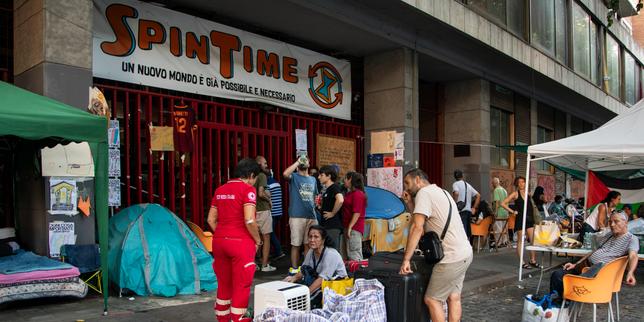
The marble of Rome forgets nothing. It absorbs the sun, bakes through the endless Italian afternoons, and holds onto the heat long after the tourists have traded the Spanish Steps for plates of cacio e pepe. But walk away from the postcard monuments, past the endless roar of the ring road, and you will find a different kind of stone. Cold. Empty. Forgotten.
For years, an abandoned former social security headquarters on Via di Santa Croce in Gerusalemme sat like a concrete monolith to bureaucratic failure. Six floors of glass, steel, and dust, rotting away while the city faced a housing crisis that felt less like a temporary dip and more like a permanent eviction notice for the working class.
Then came the people.
They did not ask for permission. They brought brooms. They brought electrical wire, hammers, mattresses, and children. They turned a dead office building into Spin Time Labs, a bustling vertical village where more four hundred people—migrants, artists, single mothers, and the chronically displaced—carved out a fragile, defiant sanctuary.
Now, the government wants the keys back.
Prime Minister Giorgia Meloni’s administration has set its sights on the occupied social center, framing the eviction not as a political crackdown, but as a routine restoration of legality. The rhetoric sounds clean on television. Law and order. Restoring public property. Equal enforcement of the rules.
Order.
It is a comforting word if you have a key to your own front door.
To understand what is happening inside Spin Time, you have to look past the political posturing and talk to someone like Marco, a hypothetical resident whose daily life mirrors the reality of dozens who sleep beneath its roof. Marco is not a radical bomb-thrower. He is a fifty-two-year-old cook who spent twenty years working hotel kitchens until a layoff and a soaring rental market conspired to push him onto a friend's couch, and then, eventually, into the lobby of the occupied building.
When Marco speaks about Spin Time, he does not talk about Marxist philosophy. He talks about the smell of espresso in the morning courtyards. He talks about the improvised daycare on the ground floor where mothers who clean houses for cash can leave their toddlers without paying half a day's wages. He talks about the concert hall built in an old parking garage, where punk bands and classical violinists share the same backstage dust.
This is what terrifies the architects of the current crackdown. Spin Time is not merely a squatter camp; it is a working model of an alternative society that proves the state's official safety net has rotted away. When an abandoned corporate tomb transforms into a vibrant cultural hub, complete with workshops, libraries, and legal clinics, it exposes a glaring, uncomfortable truth. The government did not want that building. They just did not want anyone else to live in it either.
Rome is drowning in empty square footage. While luxury apartments sit as sterile investment portfolios for foreign billionaires, families wait years for public housing allocations that never arrive. The municipal housing lists are longer than the lines for the Vatican museums. When the system fails to house its own, people build makeshift solutions.
And then the state remembers its laws.
The tension surrounding Spin Time is part of a broader legislative push by the right-wing coalition to criminalize occupation and dissent. Decree laws targeting social centers have multiplied, backed by police unions and nationalist politicians who paint every squatter as a dangerous criminal. They point to illegal connections, safety hazards, and the erosion of private property rights.
They rarely mention the alternative.
Where do four hundred people go when the riot shields advance and the heavy steel doors are welded shut? Back to the damp underpasses of Termini station? Back to the invisible margins where human beings vanish into statistical noise? The government has offered no viable relocation plan, no comprehensive housing voucher, and no empathy. Just a date on a calendar and a battalion of batons.
History teaches us that you can evict people from a building, but you cannot evict the desperation that put them there in the first place. Every time a social center is cleared in Italy, a dozen more underground networks form in the shadows, driven deeper into precarity.
Standing outside Spin Time on a humid evening, the contrast is stark. Through the tall glass windows of the ground-floor library, you can see teenagers hunched over textbooks under flickering fluorescent lights. Across the street, a police patrol car idles, its headlights cutting amber slashes through the Roman twilight. The officers inside stare straight ahead, waiting for the order to move. Inside, someone is playing an accordion. The notes drift out through a cracked window, mixing with the exhaust fumes of passing motorbikes, a fragile, stubborn melody echoing against the ancient, indifferent stone of the eternal city.



