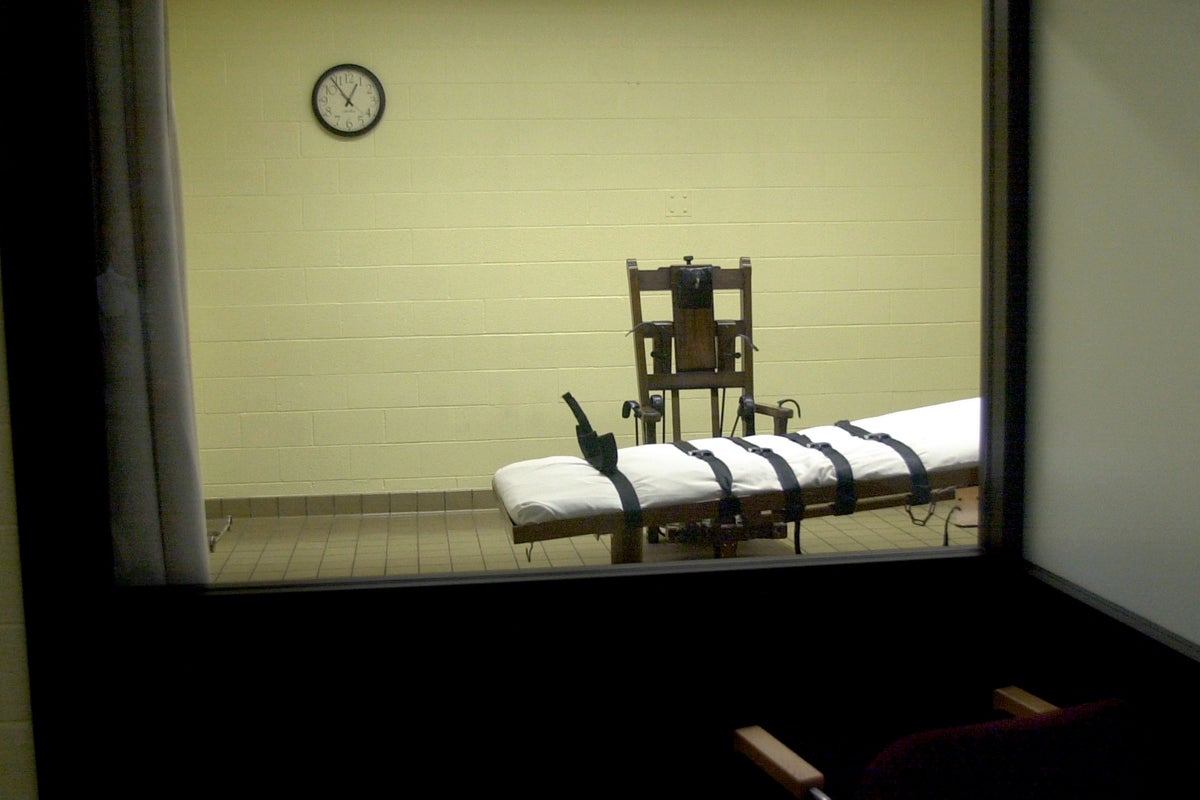
The air in a death chamber doesn’t move. It sits heavy, sterilized, and unnervingly cool, thick with the scent of industrial floor wax and the static of a dozen silent prayers. At the center of the room is the gurney. It is not just a piece of medical equipment; it is the final destination of a legal machine that has been grinding forward for decades.
Michael Smith sat on that gurney. He wasn't a statistic or a case file anymore. He was a man with a pulse, a history, and a wife watching through a pane of glass that felt like it was miles thick.
The state of Oklahoma calls this justice. The law books call it the final resolution for the families of Janet Moore and Sharath Pulluru, two lives extinguished in separate acts of violence in 2002. But as the clock ticked toward the hour of execution, the abstract concepts of "justice" and "retribution" dissolved. They were replaced by the raw, jagged reality of a man breathing his last and a woman refusing to let him go quietly.
Vivian Smith’s voice broke the silence. It wasn't a whisper. It wasn't a polite mourning. It was a jagged, desperate cry that clawed at the sterile environment.
"I love you!"
She shouted it as if her words could act as a physical barrier against the chemicals prepared to surge through his veins. She shouted it until the very moment his consciousness slipped away. Love is a strange thing to find in a room designed for the cessation of life. It felt out of place. It felt defiant.
The Weight of Two Decades
To understand why a woman would scream at a glass partition while the state executes a man, you have to look at the twenty-two years that led to this moment. Michael Smith was convicted of killing Moore and Pulluru during a drug-fueled spree. The details of the crimes were harrowing. They were the kind of facts that make the public nod when a death sentence is handed down.
Yet, Smith spent those twenty-two years claiming he didn't remember the killings. His lawyers didn't argue that he was a saint. They argued that he was a man with intellectual disabilities, a man whose brain didn't function like yours or mine. They pointed to his history of substance abuse and a life marked by chaos.
They were asking for mercy based on a broken mind.
The Board of Pardons and Paroles listened. Then they voted. 4 to 1 against clemency. The legal system is built on a series of binary choices: guilty or innocent, life or death, sane or insane. There is very little room for the gray areas of human psychology or the slow, agonizing process of personal change.
Consider the perspective of the Moore and Pulluru families. For them, this wasn't a narrative about Michael Smith’s mental state. It was a twenty-two-year wait for a period at the end of a very long, very painful sentence. Every appeal, every stay of execution, and every clemency hearing was a fresh wound. For them, the sterile room wasn't a place of tragedy; it was a place of accountability.
The Mechanics of the End
The process of lethal injection is often described as "peaceful." This is a carefully curated image. We want to believe that the state can take a life with the same clinical precision used to remove an appendix. But the reality is far more visceral.
The three-drug cocktail begins with midazolam, a sedative intended to render the prisoner unconscious. Then comes vecuronium bromide to paralyze the muscles, and finally, potassium chloride to stop the heart. It is a choreographed sequence.
As the drugs began their work, Smith’s breathing changed. It became shallow. His eyes, which had been locked on his wife, began to glaze. The "I love yous" from the other side of the glass continued, rhythmic and frantic, a heartbeat in verbal form.
This is the invisible stake of the death penalty. We often debate the ethics in classrooms or on social media, using words like "deterrence" and "constitutionality." But in that room, the debate ends. It is replaced by the sound of a woman’s grief and the silence of a man’s lungs.
The question isn't just whether Smith deserved to die for what he did in 2002. The question is what it does to a society to maintain a room where we systematically turn a person into a corpse while their loved ones watch.
A Legacy of Silence
When the doctor finally called the time of death, the room didn't feel more just. It just felt emptier.
The victims’ families issued statements. They spoke of relief. They spoke of moving forward. Their pain is a permanent fixture of this story, a foundation of grief that nothing—not even an execution—can fully erode. They lost their loved ones in flashes of senseless violence, and they have lived in the shadow of those losses for a generation.
But Vivian Smith walked out of that prison into a world where her husband no longer existed. She carried with her the memory of his last look and the sound of her own voice echoing off the glass.
We tend to view these events as a closing of a chapter. We think the story ends when the heart stops. But the ripples of an execution move outward in ways we rarely acknowledge. They move through the guards who must perform the procedure, the lawyers who fought until the final hour, and the families on both sides who are left to sift through the wreckage of two different types of tragedy.
Michael Smith is gone. The crimes of 2002 are answered for in the eyes of the law. Yet, as the lights in the execution chamber were dimmed, the air remained still. The industrial wax still smelled the same. The glass was still cold.
The only thing left was the memory of a scream that refused to accept the finality of the needle. It was a sound that didn't ask for permission and didn't care about the law. It was the sound of a human heart breaking in real-time, proving that even in the most clinical of settings, the one thing you can never truly sterilize is the capacity for agony.
The gurney was wiped down. The room was prepared for the next time. Outside, the world kept turning, unaware that for one woman, the silence had become absolute.