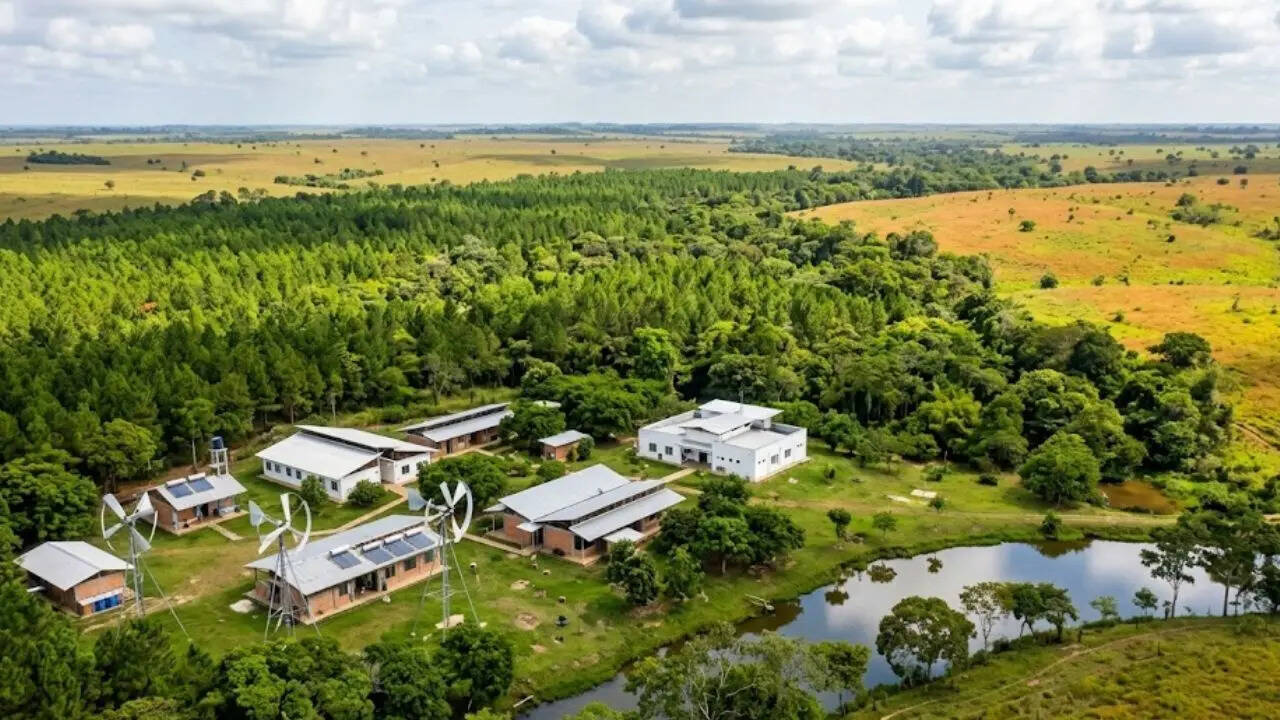
Stop worshipping at the altar of Las Gaviotas.
The story sounds like a fever dream for the degrowth crowd: a group of visionaries heads into the barren Llanos of Colombia, builds a self-sustaining village, plants a massive pine forest, and powers it all with whimsical solar heaters and manual water pumps. It is the go-to case study for every "Green New Deal" enthusiast looking for a spiritual home.
But if you look at Las Gaviotas and see a scalable model for the planet, you are suffering from a dangerous lack of economic literacy.
What the glowing documentaries and soft-focus articles won’t tell you is that Las Gaviotas isn't a blueprint for the future. It is a high-cost, hyper-specific experiment that survived on the back of massive external subsidies and a botanical fluke. It is a boutique eco-village masquerading as a global solution.
If we actually tried to "Gaviotize" the world, we wouldn't save the planet. We would bankrupt it.
The Myth of the "Self-Sustaining" Miracle
The primary argument for Las Gaviotas is its supposed independence. The narrative claims they turned a "wasteland" into a garden using nothing but local ingenuity.
This is a fundamental misunderstanding of how the project began. Paolo Lugari, the founder, didn’t start with a handful of seeds and a dream. He started with deep pockets and high-level political connections. For decades, the project was propped up by international aid, the United Nations, and the Colombian government.
True sustainability is not just biological; it is fiscal.
If a system requires a constant infusion of outside capital to keep its solar-powered hospital running, it isn't an "alternative" to the modern world. It is a hobby. I’ve seen Silicon Valley startups burn through $50 million on "disruptive" green tech that functions perfectly in a lab but collapses the moment it has to face a real market. Las Gaviotas is the social equivalent of a subsidized lab experiment.
When the funding dried up in the 1990s, the village didn't thrive on "utopian" ideals. It survived because it pivoted to an industrial commodity: pine resin.
The Pine Forest is an Ecological Monoculture
Environmentalists love to talk about the 8,000 hectares of forest planted at Las Gaviotas. They claim it brought back biodiversity and changed the local microclimate.
Let's get precise about what that "forest" actually is. It’s a plantation of Pinus caribaea.
The Caribbean Pine is not native to the Colombian Llanos. The "miracle" that occurred—where native plants began growing under the pine canopy—happened because the pines provided shade in a region that was naturally a savanna.
We need to stop calling every collection of trees a "restoration." In many ways, Las Gaviotas performed a massive biological hack on the landscape. They introduced a non-native monoculture to produce resin for the chemical industry. While it’s better than a barren field, calling it a "Utopia" ignores the fact that their entire economic survival depends on an invasive species and an industrial extraction process.
If a corporation did this—planted thousands of acres of non-native trees to sell the sap—the same people praising Las Gaviotas would be screaming about "greenwashing" and "ecological imperialism."
The Low-Tech Trap
The village is famous for its "appropriate technology": double-action pumps that use children’s seesaws for energy, and solar kettles that don't require electricity.
This is where the sentimentality becomes truly toxic.
Appropriate technology is often just a polite way of saying "technology that keeps people poor." While these inventions are clever engineering feats, they are incredibly inefficient when compared to modern grid infrastructure.
Let’s run the numbers on energy density.
The solar water heaters at Las Gaviotas were a breakthrough in the 70s. But today, the cost of standard photovoltaic (PV) panels has plummeted by over 90%. A single modern solar farm can produce more energy in a day than a decade’s worth of "innovative" Gaviotas seesaw pumps.
By fetishizing the "manual" and the "simple," we ignore the scale required to actually lift billions of people out of poverty. You cannot run a high-tech surgical suite or a global communications network on a seesaw.
The obsession with Las Gaviotas-style tech is a form of "poverty tourism" for the Western mind. It allows people in New York or London to feel good about the idea of a simpler life, while they personally enjoy the benefits of a $10,000-per-kilowatt-hour energy grid.
The Llanos is Not the World
The most common question asked about Las Gaviotas is: "Why don't we do this everywhere?"
The answer is simple: geography is not a suggestion.
The Llanos of Colombia has a specific set of variables that made this experiment possible. It has a massive, shallow aquifer. It has intense, consistent tropical sun. It has acidic soil that happens to be the perfect pH for Pinus caribaea.
Try applying the "Gaviotas Model" to the Sahel in Africa, or the Great Plains in the US, or the outskirts of Jakarta. It fails instantly.
A solution that only works in one specific corner of the world under specific political protection isn't a "paradigm shift." It’s an anomaly. We waste billions of dollars trying to replicate "community-led" eco-villages in places where the ecology and the economy simply don't support them.
Instead of chasing the Gaviotas ghost, we should be looking at scalable, high-density solutions. Urbanization, nuclear power, and intensive vertical farming do more for the environment than a thousand tiny towns in the jungle. Why? Because they leave a smaller footprint.
The true green utopia isn't a village where everyone pumps their own water. It’s a dense, efficient city that leaves 90% of the surrounding nature untouched. Las Gaviotas, for all its beauty, is a form of sprawl. It requires vast amounts of land to support a tiny population.
The Hidden Cost of "No Rules"
The lore of Las Gaviotas often highlights its lack of hierarchy. No police, no locks on doors, no formal government.
This works for a population of 200 people who have all self-selected to be there. It is a classic "survivorship bias" trap. Of course there is no crime; anyone who didn't want to play by the rules left decades ago or was never invited.
Using a tiny, homogeneous community to argue for the dismantlement of modern social structures is intellectually lazy. Scaling a society requires complexity. It requires contracts, specialized labor, and—yes—centralized systems.
The "peace" of Las Gaviotas is the peace of a monastery. It is maintained by shared belief and isolation. That is a valid lifestyle choice, but it is not a political system for the 21st century.
The Resin Reality Check
Let's talk about the resin factory. This is the part the "back-to-nature" crowd usually glosses over.
Las Gaviotas didn't survive because they were "green." They survived because they became a chemical processing plant. They harvest resin from the pines, process it using steam heat from forest waste, and sell it to the paint and varnish industry.
They are participants in the global industrial market.
They aren't "outside" the system; they are a niche supplier to it. This isn't a critique of their work—it's a critique of the people who pretend they've found a way to live without the global economy.
If the price of resin drops tomorrow, or if a synthetic alternative becomes cheaper, Las Gaviotas faces a crisis. They are as vulnerable to market fluctuations as a soy farmer in Iowa or a coal miner in West Virginia.
The Dangerous Allure of the Micro-Fix
We love stories like Las Gaviotas because they make us feel that the solution to climate change is small, local, and manageable. It suggests that if we just "return to the land" and get a little bit smarter with our plumbing, everything will be fine.
This is a lie.
The climate crisis is a problem of gigatons and terawatts. It is a problem that requires massive, industrial-scale intervention. By focusing on the "tiny town in Colombia," we distract ourselves from the hard work of decarbonizing the steel industry, shipping, and the global power grid.
Las Gaviotas is a beautiful piece of performance art. It is a living museum of 1970s environmental idealism. But it is not the future.
The future isn't going to be built by hand-pumping water in the savanna. It’s going to be built in laboratories, in high-density urban hubs, and through the very industrial systems that the Gaviotas narrative tries to escape.
Stop looking for utopia in the jungle. Start looking for efficiency in the machine.
If you want to save the world, don't move to a village. Move to a skyscraper and figure out how to make it run on fission. That's the only "green miracle" that actually matters.