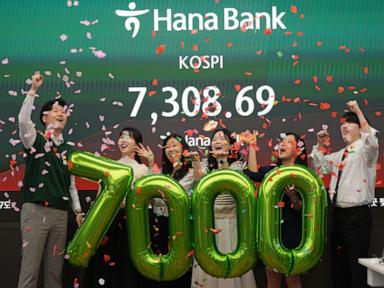
South Korea’s Kospi is hitting records, and the financial press is tripping over itself to credit the "AI boom." It is a convenient narrative. It is also dangerously incomplete. While retail investors pile into SK Hynix and Samsung Electronics thinking they are buying a ticket to a permanent tech utopia, they are actually buying into a cyclical hardware squeeze that has more in common with 19th-century commodities than 21st-century intelligence.
The consensus says AI demand is the new oil. The reality? High Bandwidth Memory (HBM) is a brutal, capital-intensive arms race where the margins are thinner than the silicon wafers themselves. The Kospi isn’t rising because of a fundamental shift in Korean economic productivity. It is rising because of a temporary bottleneck in the global supply chain.
The HBM Fallacy
Everyone talks about the "AI rally" as if it’s a unified front. It isn't. The current surge in the Kospi is a lopsided bet on a single component: memory. Specifically, HBM.
The market is treating SK Hynix like a software company with infinite scalability. But SK Hynix is a manufacturer. It deals with physical yields, massive depreciation, and the crushing weight of capital expenditure. When Nvidia wins, Nvidia scales. When a memory maker wins, they have to build a multi-billion dollar fabrication plant and pray the cycle doesn't turn before the concrete dries.
I have watched these cycles play out for decades. The pattern is always the same.
- A new technology creates a sudden spike in data requirements.
- Memory prices skyrocket because of "undersupply."
- Every player in the space over-invests in capacity to capture the premium.
- The market saturates, prices collapse, and the Kospi bleeds out for three years.
The "AI boom" hasn't changed the laws of physics or the laws of economics. It has just increased the stakes.
Why the Chaebol Structure is a Drag, Not a Driver
The mainstream media loves the story of the "mighty Chaebols" leading the charge. They view Samsung’s massive scale as an unassailable moat. This ignores the "Korea Discount" for a reason.
The governance structures of these conglomerates are designed for stability and family control, not for the hyper-agile pivot required in an AI-first world. While Samsung struggles to perfect its HBM3E yields to satisfy Nvidia’s grueling standards, it is still weighed down by legacy businesses in mobile and appliances that are getting cannibalized by Chinese competitors.
Buying the Kospi to "play AI" is like buying a whole department store because you like the brand of sneakers they sell in the basement. You are taking on massive amounts of unrelated risk—global consumer spending slumps, stagnant smartphone innovation, and geopolitical tension—just to get a sliver of exposure to the AI backend.
The Myth of the Record High
When the Kospi hits a record, the headlines scream "Growth!"
Adjust for inflation. Adjust for the devaluation of the Won against the Dollar. Look at the valuation multiples compared to the S&P 500 or even the Nikkei 225. The Kospi remains one of the cheapest major indices for a reason: it doesn't innovate; it fulfills orders.
A "record high" based on a supply-side crunch is a house of cards. True value is created at the application layer—the companies actually using AI to disrupt industries. South Korea is the world’s foundry and its warehouse. Being the world’s warehouse is a great business until the person renting the space decides they have enough inventory.
The Intellectual Property Gap
Here is the question no one asks: Where is the South Korean LLM? Where is the Korean software stack that will rival OpenAI or Anthropic?
It doesn't exist on a global scale.
South Korea is excellent at the "hard" side of tech. Hardward. Chips. Screens. Batteries. But in the AI era, hardware is a race to the bottom. Once HBM becomes a standardized commodity—and it will—the margins will evaporate. The real wealth is being captured in California, where the models are built. Korea is providing the picks and shovels for a gold mine it doesn't own.
I’ve seen this movie before with 5G. Remember when 5G was going to "unleash" a new era of Korean tech dominance? The chipmakers made a killing for eighteen months, and then the world realized that 5G was just a faster pipe for the same American apps. AI is the same script with a larger budget.
The Geopolitical Anchor
The "AI rally" ignores the elephant in the room: China.
South Korean tech is caught in a pincer movement. On one side, the U.S. is demanding loyalty and restricting exports. On the other, China—formerly Korea's biggest customer—is aggressively localizing its own semiconductor supply chain.
The Kospi’s "record" is being printed in a vacuum. It assumes that the current trade status quo will hold. But if China successfully ramps up its domestic memory production, or if the U.S. increases pressure on Samsung’s China-based fabs, that "AI growth" evaporates overnight.
The Counter-Intuitive Play
If you want to actually profit from the AI shift, stop looking at the index level. The Kospi is a blunt instrument.
The real opportunity isn't in the companies making the chips; it’s in the energy infrastructure required to run the data centers those chips live in. But that doesn't make for a sexy headline about "Tech Shares."
Investors are currently blinded by the "Nvidia Halo Effect." They believe that because Nvidia is up 200%, the companies that sell to Nvidia must also be worth 200% more. This is a fundamental misunderstanding of the supply chain. Nvidia has pricing power. The memory makers have "price taking" power. They are at the mercy of the buyer.
The Brutal Truth About "Buying the Dip"
People ask: "If the Kospi pulls back, should I load up?"
Only if you enjoy catching falling knives. The current valuation of the Kospi is predicated on a "Goldilocks" scenario:
- Interest rates must fall.
- AI demand must remain exponential.
- Yield rates on HBM must reach 90%+.
- Geopolitical tensions must stay simmered.
If even one of those pillars cracks, the record high becomes a generational ceiling.
The "consensus" is that we are at the start of a multi-decade super-cycle. I've been in this industry long enough to know that "super-cycles" are just regular cycles with better marketing. The AI boom is real, but the Kospi’s ability to capture its long-term value is a fantasy sold by brokers who need you to keep trading.
Stop buying the narrative. Start looking at the depreciation schedules. If you can’t explain the difference between DRAM spot prices and long-term HBM contracts, you aren't investing in AI; you’re gambling on a headline.
The record high isn't an invitation. It's a warning.