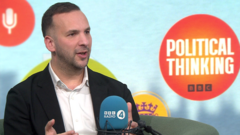
The air in the committee room usually smells of stale coffee and the slow, rhythmic grinding of bureaucracy. It is a place where radical ideas often go to die, smothered by the weight of "procedural feasibility." But Zack Polanski doesn't look like a man who came to attend a funeral for his convictions. He sits with a certain stillness, the kind possessed by people who know something you don't. He isn't just looking for a seat at the table. He is looking for the lever that moves the world.
To understand the deputy leader of the Green Party, you have to look past the recycling bins and the cycle lanes. You have to look at the math of a fractured nation. For decades, British politics has been a binary choice, a see-saw that tilts violently from blue to red and back again. Most of us have grown used to the creak of that metal. We expect one side to win, the other to howl, and the rest of us to wait five years for the roles to reverse.
Polanski wants to break the see-saw.
He talks about the "balance of power" not as a political buzzword, but as a survival strategy. It is the dream of the third option. Imagine a morning after an election where neither of the giants has enough height to reach the light switch. The room is dark. They are fumbling. And there, in the corner, stands a small group of people who hold the only matches in the building. That is the leverage Polanski is hunting.
The Ghost at the Feast
Consider a hypothetical voter named Sarah. She lives in a coastal town where the sea is getting uncomfortably close to the high street during winter storms. She’s worried about her rent, yes. She’s worried about the local hospital, obviously. But she also has this nagging, cold dread that the people in charge are treating the planet like a rental car they don't plan on returning.
When Sarah enters the polling booth, she feels the pressure of the "wasted vote." The narrative tells her that if she doesn't pick one of the big two, her voice vanishes into the ether. It is a form of soft disenfranchisement that we’ve all accepted as the price of admission.
Polanski’s entire mission is to tell Sarah that her vote is the most dangerous thing in the room.
He isn't pitching a majority. He isn't delusional. He knows the Green Party isn't moving into 10 Downing Street next year. But he knows that in a hung parliament, the smallest cog can stop the largest machine. If the Greens hold ten, fifteen, or even five seats in a tight race, they become the gatekeepers. They become the "Kingmakers." And the price of their keys? A radical, unapologetic commitment to the future.
The Arithmetic of Change
The logic is simple, even if the execution is a marathon. In our current First Past the Post system, the two main parties spend most of their time fighting over a tiny sliver of "middle ground" voters in a few dozen swing constituencies. This leads to a grey, muted politics where everyone tries to offend as few people as possible.
Polanski is betting that the public is tired of vanilla.
He points to the local elections, those quiet tremors that happen while the national media is looking elsewhere. The Greens have been sweeping up council seats in places nobody expected. They aren't just winning in leafy, bohemian enclaves; they are winning in post-industrial towns and rural villages. Why? Because when the local stream turns orange from chemical runoff or the bus route is cut for the third time in a year, the grand ideologies of Westminster feel very far away.
The strategy is "insurgent persistence." By building a fortress of local support, Polanski is creating a launchpad for a national breakthrough. He isn't asking for permission to lead. He is making it impossible to ignore him.
The Human Cost of "Business as Usual"
There is a specific kind of exhaustion that comes from watching a political system fail to address an obvious crisis. It’s like being in a car that’s heading for a wall while the driver and the front-seat passenger argue about what radio station to listen to.
"We are the only ones talking about the wall," is the unspoken subtext of every Polanski speech.
He speaks with the urgency of someone who has read the climate reports and actually believed them. While other politicians treat environmental policy as a "nice to have" when the economy is booming, Polanski views it as the foundation of the economy itself. You cannot have a flourishing stock market on a dead planet. It’s a basic law of physics that somehow gets lost in the translation to economic theory.
But it’s not just about carbon. It’s about the soul of how we live. Polanski’s vision includes the four-day work week and a Universal Basic Income. To his critics, these are fairy tales. To his supporters, they are the only logical response to a world where automation is eating jobs and burnout is the leading cause of middle-class collapse.
He frames these not as luxuries, but as a redistribution of time. And time, as any parent working two jobs knows, is the only currency that truly matters.
The Pressure Cooker of Coalition
If Polanski gets his wish, he will find himself in a room with people who have spent their lives mocking his platform. He will have to trade. He will have to compromise. This is where the "human-centric" part gets messy.
In 2010, the Liberal Democrats entered a coalition and were essentially digested by the Conservative Party. They traded their soul for a few years of cabinet positions and a failed referendum on voting reform. The memory of that collapse haunts every third-party leader in Britain.
Polanski, however, seems to be carving a different path. He isn't looking for a ministerial car. He is looking for a "confidence and supply" agreement—the ability to keep a government upright only as long as they meet specific, non-negotiable demands. Imagine a government that can only pass a budget if they agree to stop all new oil and gas licenses in the North Sea. Or a government that can only stay in power if they agree to reform the very voting system that keeps the Greens on the sidelines.
That is the "balance of power." It is a hostage situation where the hostage is the status quo.
The Invisible Stakes
Why does this matter to someone who doesn't care about politics?
Because the decisions made in those backroom deals dictate the price of your energy bill, the quality of the air your children breathe, and whether or not your local park gets turned into a luxury apartment complex. When Polanski talks about holding the balance of power, he is talking about giving a megaphone to the people who feel like they are currently screaming into a vacuum.
There is a vulnerability in his approach. He admits that the path is narrow. He knows that the media will paint him as a "spoiler" or a radical. But there is a quiet power in being the person who refuses to accept that the current way of doing things is the only way.
We are living through a period of profound uncertainty. The old certainties—that the economy will always grow, that the weather will always be predictable, that the two-party system is eternal—are all dissolving. In that dissolution, figures like Zack Polanski move from the fringe to the center. Not because they have changed, but because the world has moved toward them.
The Final Count
The next election won't just be about who wins. It will be about how we define "winning." If a party gets 40% of the vote and 100% of the power, is that a victory for democracy? Or is it a failure of representation?
Polanski is betting that a significant portion of the British public is ready to demand a more complex, more honest version of power. He is betting that the "Kingmaker" isn't a person, but an idea: the idea that we can no longer afford to leave the future in the hands of people who are only worried about the next five years.
As the campaign cycles begin to spin and the noise levels rise, look for the man in the green cardigan. He isn't shouting as loud as the others. He doesn't need to. He knows that when the giants finally stumble and the room goes dark, everyone will be looking for a match.
He is just waiting for the right moment to strike it.