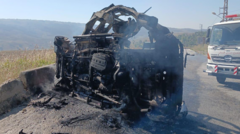
The fatal interdiction of a Lebanese Armed Forces (LAF) military vehicle on the Khardali-Nabatieh road reveals a critical flaw in current tactical de-escalation frameworks. The strike, which killed Brigadier General Samer Sabra, Captain Elie Khoury, and soldier Hassan Ghazzal, occurred directly amid U.S.-brokered truce negotiations in Washington. This friction highlights a persistent systemic failure: the severe mismatch between strategic diplomatic intent and real-time kinetic engagement criteria in active combat zones.
The incident cannot be understood as an isolated tactical error. It represents a predictable breakdown when asymmetric combat operations overlap with a highly conditional, fragile ceasefire framework. While political leaders negotiate "pilot zones" for LAF deployment, the operational reality on the ground remains governed by immediate force-protection rules of engagement (ROE).
The Dual-Logic Conflict Framework
The divergence in strategic objectives between the Israel Defense Forces (IDF), the LAF, and Hezbollah creates an environment where tactical miscalculations become mathematically probable. This friction operates across three distinct operational layers.
1. The Asymmetric Air-to-Ground Detection Latency
The IDF stated the vehicle was "moving suspiciously" toward frontline positions near Kfar Tebnit within an active combat zone. In high-readiness environments, intelligence collection assets utilize behavioral algorithms and localized threat signatures to determine target status. When an official military vehicle operates without synchronized, real-time electronic blue-force tracking or pre-cleared corridor coordination, the detection system defaults to a high-threat classification. The mechanism driving this outcome is simple: time-to-impact optimization. If forces receive actionable intelligence regarding imminent Hezbollah fire from a specific grid, any unscheduled vehicle entering that sector undergoes rapid target acquisition, bypassing prolonged identity verification cycles.
2. The Sovereign Enforcement Paradox
The political strategy negotiated in Washington mandates that the LAF deploy to southern pilot zones to exercise exclusive security control and displace Hezbollah forces south of the Litani River. This creates a severe structural contradiction. To assert sovereign control and enforce a truce, the LAF must maintain physical mobility throughout the theater. However, the physical terrain remains heavily contested, subject to active IDF enforcement operations and retaliatory drone deployments by Hezbollah. The LAF is effectively tasked with policing a combat zone without possessing the tactical airspace control or the robust deconfliction infrastructure required to shield its units from dominant air assets.
3. The Deconfliction Communication Bottleneck
Operational coordination between a state military (the IDF) and a separate national armed force (the LAF) during an active counter-insurgency campaign requires instantaneous, cross-border data sharing. The current infrastructure relies on indirect communication channels brokered by international intermediaries or historical UNIFIL linkages. When a tactical commander observes an anomalous target moving toward frontline troops, the latency of this indirect communication chain exceeds the engagement window. The decision-making loop collapses, and kinetic action takes precedence over identity verification.
Strategic Realities of the Conditional Truce
The political blowback from this kinetic event alters the bargaining equilibrium in Washington. The diplomatic assertions of Lebanese President Joseph Aoun and Parliament Speaker Nabih Berri demonstrate how tactical casualties are rapidly converted into political leverage.
| Actor | Strategic Position | Operational Manifestation |
|---|---|---|
| Lebanese Presidency | Asserts sovereign immunity; demands international accountability for LAF casualties. | Utilizes the incident to pressure Western mediators for stricter limits on IDF operational freedom of action. |
| Israel Defense Forces | Maintains strict force-protection ROE; prioritizes threat neutrality over political signaling. | Continues active interdiction of uncoordinated movements within defined combat sectors north of the border. |
| Hezbollah | Rejects conditional withdrawal; exploits LAF casualties to undermine the legitimacy of the Western-brokered deal. | Leverages the strike to argue that state-led sovereign enforcement cannot protect Lebanese territory without asymmetric resistance assets. |
This alignment matrix shows that the truce framework is fundamentally unstable. The core assumption of the Washington negotiations—that the LAF can act as a neutral, stabilizing buffer force—ignores the physical realities of the theater. A state military cannot easily execute a stabilization mandate while operating inside the active target-acquisition parameters of a superior air power.
The internal political landscape in Beirut further complicates this dynamic. The public rift between President Aoun's administration and Iranian influence highlights a deep domestic struggle for strategic autonomy. Projects such as the redevelopment of Qlayaat Airport in northern Lebanon represent concrete steps to build infrastructure outside of Hezbollah's geographical control. Yet, these long-term institutional shifts are highly vulnerable to immediate security shocks in the south.
Tactical Resolution Requirements
To prevent repeat occurrences of fratricide and secure the viability of any future security agreement, negotiators must move away from ambiguous verbal understandings and establish hard technical protocols.
First, a joint, real-time tactical coordination cell must be established. This mechanism requires direct electronic data links between the IDF northern command and the LAF southern command, removing third-party mediation latency.
Second, defined humanitarian and military transit corridors must be digitized. Any LAF movement within active zones must be pre-logged into a shared situational awareness platform, establishing a clear digital perimeter that overrides automated threat-detection signatures.
Without these concrete, high-fidelity technical protocols, the strategic objective of deploying the Lebanese army as a stabilizing sovereign force will continue to break down against the raw mechanics of frontline force protection. Diplomatic agreements signed in Washington mean little if they cannot survive the immediate, cold logic of a tactical engagement loop.