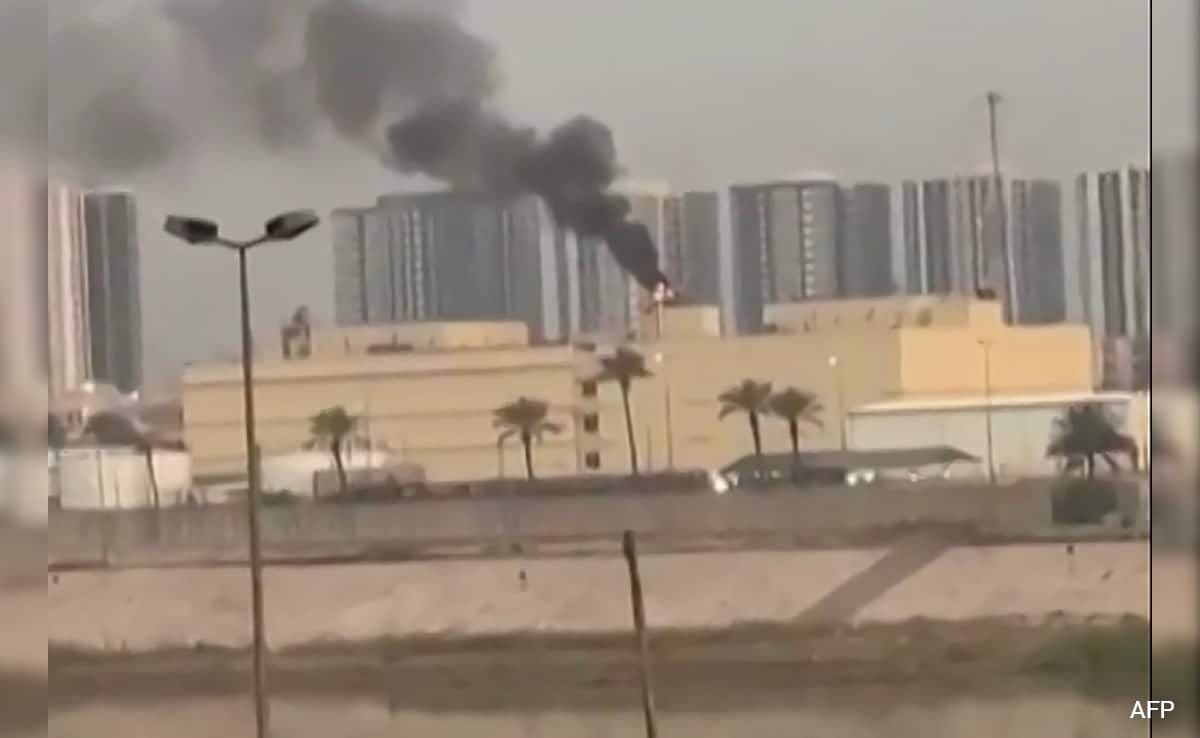
The simultaneous targeting of the US Embassy, the Mansour Hotel, and the Mansuriyah oilfield in Iraq by loitering munitions represents a shift from symbolic harassment to a calculated stress test of integrated air defense systems (IADS) and energy infrastructure resilience. This tripartite strike logic suggests a deliberate calibration of risk, where the objective is not total destruction but the demonstration of a persistent capability to bypass conventional security perimeters at a negligible cost-to-effect ratio. The operational framework behind these attacks relies on three distinct pillars: topographic saturation, the economic inversion of defense, and the weaponization of deniability.
The Tri-Node Target Profile
The selection of these three specific locations reveals a strategic intent to impact the political, commercial, and energy sectors simultaneously. Mapping the logic of these strikes requires looking at the functional value of each site:
- The Diplomatic Node (US Embassy): Attacks on the Green Zone serve as a barometer for regional friction. By utilizing low-radar-cross-section (RCS) drones rather than traditional Katyusha rockets, the operators increase the probability of penetrating the C-RAM (Counter Rocket, Artillery, and Mortar) envelopes that typically protect the facility.
- The Commercial/Intelligence Node (Mansour Hotel): Historically used by foreign dignitaries and media, targeting this site disrupts the perception of a "secure" civil environment in Baghdad. It creates a psychological tax on foreign investment and diplomatic presence.
- The Resource Node (Mansuriyah Oilfield): This is a shift toward economic warfare. By targeting production infrastructure, the actor signals that Iraq’s primary revenue stream is held hostage to regional geopolitical alignments.
The Economic Inversion of Modern Siege
Traditional warfare relies on symmetric resource expenditure. The Baghdad strikes, however, utilize an "inversion of cost" model. A typical loitering munition used in these theaters—often a variant of the Shahed or locally assembled equivalent—costs between $20,000 and $50,000. In contrast, the interceptors required to neutralize them, such as the RIM-116 Rolling Airframe Missile or even high-volume 20mm C-RAM rounds, carry a significantly higher price tag when accounting for logistics, maintenance, and the depletion of finite magazine depth.
This creates a Attrition Differential. The defender must be successful 100% of the time to maintain the status quo; the attacker only needs a single breach to achieve a strategic "win" in the form of media coverage or infrastructural damage.
Performance Constraints of Low-Slow-Small (LSS) Threats
Defending against these drones is technically difficult due to their flight profile. Most radar systems are optimized for high-velocity, high-altitude targets. Drones operating in the LSS category often disappear into "ground clutter"—the interference caused by buildings, trees, and terrain.
- Detection Latency: The time between initial radar contact and engagement is compressed because these drones often launch from mobile platforms within a 50km radius of the target.
- Kinetic Saturation: By launching multiple units from different vectors, the attacker can overwhelm the target acquisition sensors of a single defense battery.
The Mechanism of Deniable Escalation
A defining characteristic of these strikes is the use of "proxy insulation." By utilizing Iranian-designed hardware operated by local militias, the primary state actor avoids the immediate repercussions of a direct state-on-state confrontation. This creates a strategic gray zone where the US and Iraqi governments are forced to choose between ignoring the provocation or engaging in a disproportionate retaliatory strike that could further destabilize the host nation.
The cause-and-effect relationship here is cyclical:
- The Provocation: A drone strike occurs with high visibility but moderate lethality.
- The Attribution Gap: Official investigations confirm the origin of the technology but cannot definitively prove the chain of command back to a sovereign capital in a timeframe that allows for immediate legal or military recourse.
- The Policy Paralysis: The defender is forced into a defensive posture, pouring resources into expensive, localized protection (hardened structures, jamming equipment) rather than addressing the source of the threat.
Vulnerabilities in Energy Infrastructure
The strike on the Mansuriyah oilfield highlights a specific vulnerability in the global energy supply chain: the concentration of value in unprotected geographic nodes. Unlike the Green Zone, which is a concentrated "island" of security, oilfields are sprawling networks of pipelines, pumping stations, and processing plants.
The defense of such a wide area is mathematically impossible with current kinetic systems. This necessitates a transition to electronic warfare (EW) and directed-energy weapons (DEW). However, the second-order effect of jamming in a civilian or industrial area is the disruption of legitimate communications and GPS-dependent industrial automation. The attacker exploits this friction, knowing that the defender is hesitant to "black out" the local spectrum.
Strategic Realignment Requirements
To counter this mode of asymmetric aggression, the current defense paradigm must move beyond localized kinetic responses. The reliance on $2 million missiles to down $20,000 drones is a terminal strategy.
- Automated EW Integration: Deployment of passive RF detection arrays that can triangulate drone signals without emitting their own radar signature, reducing the footprint of the defense system.
- Infrastructure Hardening: Moving away from a "detect and destroy" model toward a "resilience" model, where critical components of oilfields are shielded against small-payload impacts.
- Supply Chain Interdiction: Since these drones rely on commercially available GPS modules and flight controllers, international regulatory pressure on the component level is the only long-term method to increase the manufacturing cost for the attacker.
The Baghdad strikes are a proof-of-concept for a new era of regional leverage. The tactical success of these drones is secondary to their strategic utility as tools of persistent, low-boil instability. The failure to address the underlying economic and technical advantages of these systems ensures their continued use as the primary instrument of regional negotiation.
Counter-drone operations should focus on disrupting the command-and-control links and the logistics of the launch phase. This requires high-fidelity intelligence on the ground to identify launch sites before the "loitering" phase begins. Without a proactive shift to interdiction, the defender remains in a perpetual state of reactive, and ultimately unsustainable, expenditure.