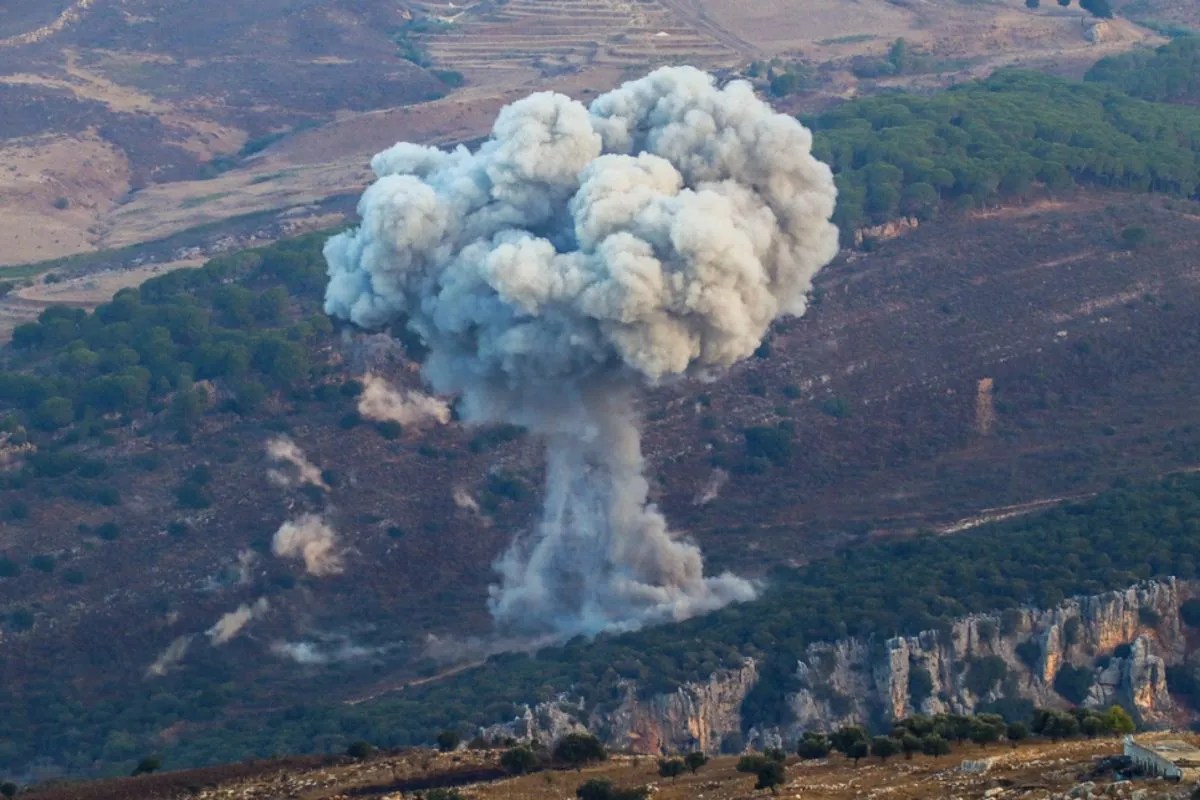
The breakdown of ceasefire initiatives between Israel and Hezbollah is not a failure of diplomacy but a predictable outcome of asymmetric deterrence optimization. Media narratives routinely categorize renewed air strikes as sudden violations of stability. This view misinterprets the strategic calculus. Military engagement along the Israel-Lebanon border operates under a strict cost-benefit framework where kinetic action serves as a signaling mechanism. Both state and non-state actors evaluate the utility of a ceasefire through the lens of tactical reconstitution versus immediate strategic leverage.
When a state actor executes high-intensity air strikes following a period of relative calm, it is rarely an emotional or reactionary response. Instead, it represents a calculated shift toward a doctrine of escalation dominance. The objective is to alter the adversary's operational calculus by imposing costs that outpace their capacity to absorb punishment. Understanding this dynamic requires examining the structural elements of cross-border conflict, the mechanics of kinetic signaling, and the logistical realities that dictate when a ceasefire becomes a strategic liability for either side.
The Tri-Axiom Framework of Border Friction
The continuation or collapse of a cessation of hostilities depends on three interdependent structural vectors.
1. The Reconstitution Asymmetry
Ceasefires are inherently unstable when they offer unequal utility to the opposing forces. A conventional military infrastructure relies on open supply chains, state-level procurement, and formal defensive installations. A non-state proxy network operates via decentralized command nodes, concealed subterranean infrastructure, and asymmetric supply lines.
During a operational pause, the state actor focuses on intelligence gathering, target bank expansion, and mechanical maintenance of airborne platforms. The non-state actor utilizes the window to reposition mobile launch platforms, replenish munitions caches via clandestine routes, and cycle personnel. If the state actor perceives that the non-state actor is gaining a disproportionate advantage in defensive readiness during a pause, the strategic utility of the ceasefire drops to zero.
2. The Deterrence Equilibrium Threshold
Deterrence is not a static state; it decays over time. Every day of operational silence without a long-term political settlement alters the perceived threshold of what constitutes an acceptable provocation. If a non-state actor conducts low-level reconnaissance or minor cross-border incursions without provoking a kinetic response, the baseline of deterrence shifts. The state actor must eventually execute a disproportionate strike to reset the equilibrium and re-establish its red lines.
3. Structural Vulnerability of Urban Interconnection
Unlike conventional battlefields defined by clear geographic separation, the Israel-Lebanon theater features a high density of civilian infrastructure intertwined with military assets. Non-state networks use human geography as passive armor. This spatial integration creates a binary operational choice for an advanced military force: accept a permanent threat vector on its border or accept the significant political and physical collateral damage associated with structural degradation strikes.
The Escalation Mechanics of Air Supremacy
Air strikes are often analyzed purely through the metric of immediate destruction. In a rigorous strategic assessment, kinetic air operations are broken down into three distinct functional layers, each designed to achieve a specific psychological and operational outcome.
[Kinetic Air Operations]
   │
   ├── Layer 1: Degradation of Command and Control (C2)
   ├── Layer 2: Interdiction of Supply Chains (Logistical Chokepoints)
   └── Layer 3: Area Denial and Structural Depopulation
The first layer targets the adversary’s Command and Control (C2) architecture. By eliminating mid-level field commanders and disrupting communication hubs, the attacking force induces temporary paralysis within the adversary's ranks. This disruption prevents coordinated retaliatory strikes, rendering the defender's response fragmented and less effective.
The second layer focuses on logistical interdiction. This involves striking transit corridors, weapon storage facilities, and smuggling routes. The goal is not necessarily to destroy every piece of hardware, but to create friction in the distribution network. When supply lines are broken, the front-line combatants exhaust their immediate stockpiles without the possibility of rapid replenishment, limiting their sustained firing capacity.
The third layer involves area denial. Striking specific geographic zones renders those areas unusable for launching counter-offensives. When applied to a border zone, this mechanism forces the adversary to pull its assets back from the frontier, expanding the buffer zone and reducing the accuracy of short-range ballistic systems targeting the state’s homeland.
The Logistics of Ceasefire Degradation
A ceasefire does not fail because negotiations break down in a vacuum. It fails because the physical realities on the ground shift to a point where maintaining the peace poses a higher strategic risk than resuming active warfare. This transition is governed by a specific logistical equation.
When the cost of inaction—measured in terms of adversary fortification, loss of intelligence clarity, and political vulnerability—exceeds the cost of active military engagement (munitions expenditure, international political capital depletion, and domestic economic strain), the state will choose to strike.
- The Intelligence Horizon: During an extended pause, mobile targets move, camouflage is improved, and electronic signatures change. As the state’s real-time intelligence data on high-value targets begins to degrade, the pressure to strike before the target bank becomes obsolete increases.
- The Munitions Calculus: Both sides continuously calculate their depletion rates against projected replenishment windows. A state actor backed by a robust defense industrial complex can afford a high burn rate of precision-guided munitions if it secures a rapid tactical outcome. A non-state actor relies on asymmetric volume to overwhelm active defense systems.
- The Economic Strain of Mobilization: Maintaining a state of high readiness along a hostile border requires massive financial expenditure. For a state utilizing a large reserve component, prolonged mobilization without active operational objectives drains the domestic economy, forcing leadership to either demobilize and risk a surprise attack, or launch an offensive to resolve the security threat.
Limitations of Precision Kinetic Campaigns
While air campaigns provide a high degree of escalation dominance, they possess fundamental structural limitations that prevent them from achieving absolute victory in isolation.
First, air strikes cannot hold territory. They can neutralize assets and displace personnel, but they leave a physical vacuum that will eventually be re-occupied by the adversary unless followed by a ground stabilization force. This creates a cycle where the same geographic points must be struck repeatedly over time.
Second, the law of diminishing returns applies to target banks. Initial strikes yield high strategic returns by destroying primary command centers and major depots. As the campaign continues, remaining targets become smaller, more dispersed, and harder to verify. The cost per strike increases relative to the strategic value of the destroyed asset.
Third, kinetic operations generate a permanent narrative vulnerability. Even when utilizing high-precision munitions, the destruction of dual-use infrastructure creates visual collateral that erodes international diplomatic shielding. This erosion places a hard timeline on how long a state can sustain an intense air campaign before external political pressures force a halt.
Strategic Trajectory and Operational Realities
The conflict along the Israel-Lebanon border is moving toward a phase characterized by permanent calculated volatility rather than a decisive resolution. The underlying geopolitical drivers ensure that any future ceasefire agreement will serve merely as a temporary operational pause rather than a durable peace.
To achieve sustained stability, a security framework must decouple the non-state actor from its external logistical lifelines while establishing an verifiable demilitarized zone along the frontier. Until those structural conditions are met, the optimal strategy for a state actor remains the execution of periodic, high-intensity kinetic interventions to disrupt adversary capabilities and maintain deterrence equilibrium. Operational planners must prepare for a prolonged campaign of attrition where success is measured by the duration of the subsequent degradation cycle rather than the complete elimination of the threat vector.