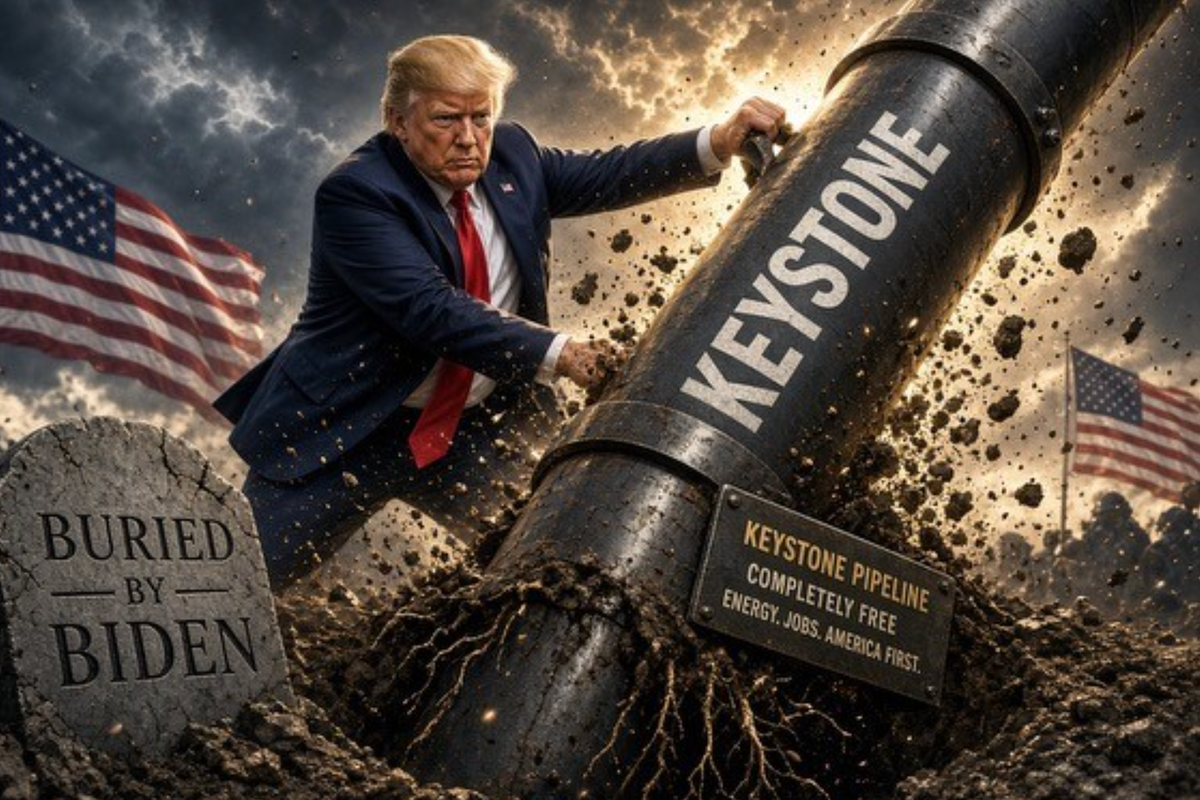
The vision of a massive, trans-continental pipeline snaking across the Great Plains has long served as a shorthand for national energy policy. When Donald Trump recently touted the potential return of the Keystone XL project from the metaphorical grave, he tapped into a decade-old vein of political sentiment. For supporters, it remains a symbol of North American energy sovereignty. For opponents, it is a relic of carbon-intensive planning that ignores modern climate realities.
Yet, the conversation surrounding a potential revival misses the underlying mechanics of energy logistics. Pipelines are not light switches. They are multi-billion-dollar commitments reliant on regulatory certainty, geopolitical stability, and long-term economic forecasting.
The Anatomy of a Canceled Ambition
The original Keystone XL project was officially terminated by its backer, TC Energy, in June 2021, shortly after the Biden administration revoked its cross-border permit. That decision triggered a series of messy legal and financial unwindings, including a claim filed by the Alberta government under the Canada-United States-Mexico Agreement to recoup billions in lost investment.
This history underscores the primary obstacle to any future project: the sheer volatility of the regulatory environment. Energy infrastructure requires a timeline spanning decades. When the rules of engagement shift every four years, institutional investors and private firms inevitably recoil. The prospect of starting a project that could be dismantled by a single executive order creates a risk profile that few balance sheets can absorb without massive government guarantees.
Modern Realities and the Infrastructure Gap
In April 2026, President Trump moved to restart a pipeline expansion between South Bow and Bridger, often colloquially linked to the legacy of the original Keystone efforts. This project represents a shift in strategy. Instead of the massive, highly publicized northern leg of the original Keystone XL, contemporary efforts appear more focused on targeted expansions and utilization of existing corridors.
There is a fundamental difference between a political rallying cry and an engineering reality. Critics have long pointed out that even at its peak efficiency, a pipeline does not automatically equate to lower domestic gasoline prices. Crude oil is a global commodity, and the infrastructure connecting Alberta to the Gulf Coast refineries is more about global market access than local supply chain relief.
For instance, consider a hypothetical scenario where a firm builds an 800-mile pipeline across sensitive federal lands. The capital expenditure involves not just steel and labor, but the exhaustive cost of navigating the National Environmental Policy Act and potential litigation from affected stakeholders. If the market price of crude oil fluctuates, or if refined product demand drops due to shifts toward alternative fuels, the pipeline operator faces a stranded asset scenario.
Geopolitical Leverage and the Tariff Nexus
The recent discussion regarding the pipeline is inseparable from broader trade negotiations with Canada. By positioning the project as a bargaining chip to postpone or remove 50 percent tariffs on Canadian goods, the administration is utilizing the pipeline as an instrument of trade diplomacy.
This creates a peculiar incentive structure. Canada’s economic health is tightly bound to U.S. trade policy, and the threat of tariffs on commodities like cement or steel forces a reactive stance from Ottawa. When energy projects are introduced as part of a "grand bargain," they become secondary to the immediate goal of easing trade tensions. This is an approach that prioritizes short-term political wins over the long-term integrity of energy logistics.
The Cost of Uncertainty
The industry is currently grappling with a landscape where administrative changes are common. For a project to reach completion, it must survive:
- Permitting Cycles: Obtaining federal, state, and local permits is a labyrinthine process that can take years to clear.
- Legal Challenges: Environmental groups and Indigenous nations have consistently and effectively used the court system to stall or halt construction on federal lands.
- Market Viability: The shift toward electrification and the global push to lower greenhouse gas emissions create a long-term demand forecast that is increasingly difficult to predict with absolute certainty.
The "grave" from which this project is supposedly being exhumed is paved with billions in sunk costs and a decade of partisan gridlock. Even if the political will exists to expedite a new iteration, the operational hurdles remain formidable.
Successful infrastructure development in the current era requires more than just presidential permits or executive orders. It demands a consensus that transcends electoral cycles. Without it, the Keystone name will continue to function more as a political totem than a functional piece of industrial infrastructure. The reliance on executive actions to force construction creates a fragile foundation, one that is perpetually vulnerable to the next pivot in Washington.
The path forward is rarely as straightforward as a single policy shift. It involves reconciling the undeniable economic interest in energy transport with the growing demand for regulatory consistency. Until the underlying issues of legal, environmental, and financial risk are addressed, the promise of new pipelines will remain caught in a cycle of rhetoric, disconnected from the hard reality of what it takes to break ground and keep it open.