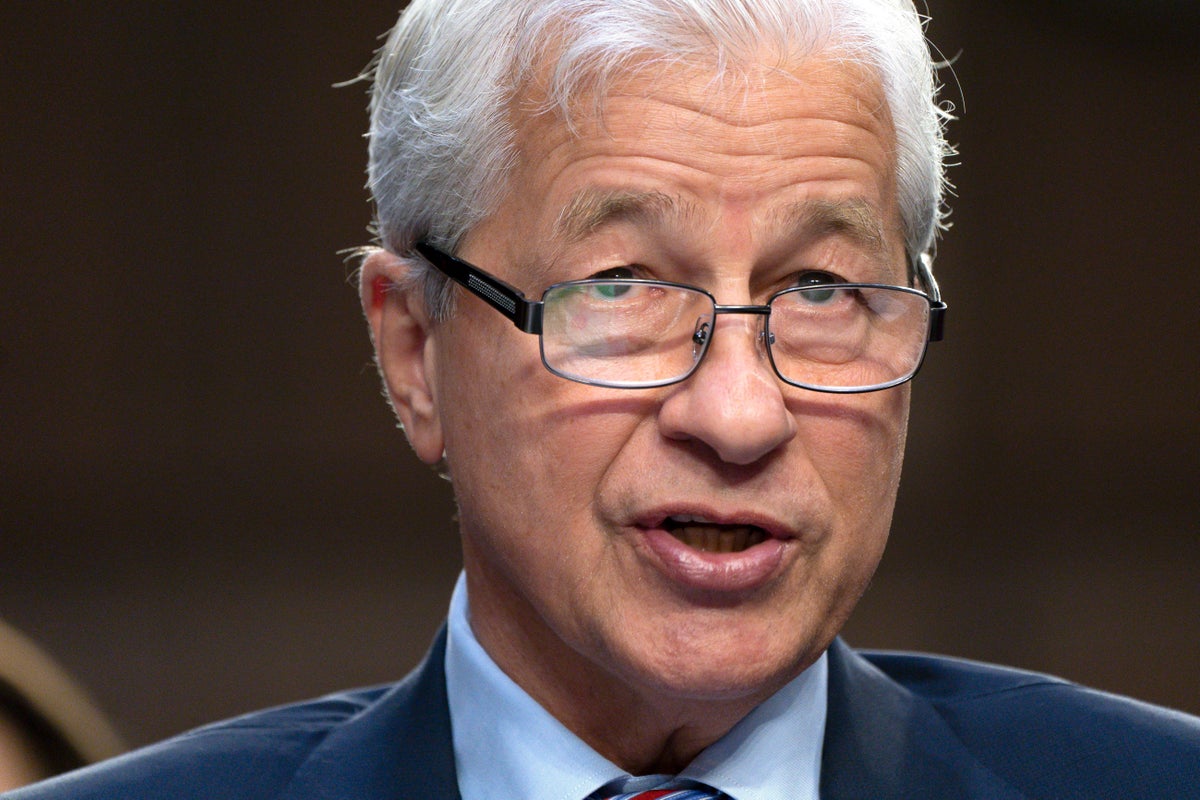
The headlines are screams of disbelief. Jamie Dimon, the titan of JP Morgan-Chase, is supposedly banging the war drums for a conflict with Iran. The ivory tower critics and the recession-obsessed pundits are hyperventilating. They see a "lapse in judgment" or a "reckless pivot" from a man who usually moves with the surgical precision of a high-frequency trading algorithm.
They are missing the math.
When a man who manages $4 trillion in assets speaks on geopolitics, he isn't checking his moral compass or seeking a legacy in the Pentagon. He is looking at the structural decay of the global petrodollar and the imminent collapse of the post-WWII energy settlement. Dimon isn't "pro-war." He is pro-stability in a world that is rapidly losing its grip on the one thing that keeps the West solvent: predictable energy flow through the Strait of Hormuz.
The lazy consensus says a war in the Middle East triggers a global depression. The nuanced reality? Avoiding a decisive resolution with Iran ensures a slow, agonizing strangulation of Western liquidity that will last decades.
The Myth of the "Recession Fear" Constraint
Financial media loves a binary choice. They argue that we are either in a period of growth or a period of recession. Because the U.S. economy looks fragile, the consensus logic dictates that we must avoid conflict at all costs to protect the "recovery."
This is a fundamental misunderstanding of how the world’s biggest bank views risk. Dimon knows that a shallow recession is a rounding error. What keeps him awake at night is structural stagflation.
If Iran continues to exert asymmetric control over the global energy transit points, the "inflation tax" on every single product in the Western world becomes permanent. You can raise interest rates until the housing market turns to ash, but you cannot "tighten" your way out of a blocked shipping lane. Dimon isn't ignoring the recession risk; he is choosing a sharp, localized shock over a thirty-year slide into irrelevance.
I’ve spent twenty years watching C-suite executives trade away their long-term dominance for quarterly peace. It’s a coward’s game. Dimon is signaling that the era of "strategic patience" has reached a point of negative returns.
Why the "Overdue" Comment Is Pure Calculus
When Dimon says a conflict is "overdue," the bleeding hearts hear bloodlust. The bankers hear Mean Reversion.
Geopolitical tensions are like forest fires. If you suppress every small blaze for fifty years, the undergrowth builds up until the entire continent burns. By using the word "overdue," Dimon is referencing the massive buildup of geopolitical debt.
- The Strait of Hormuz Bottleneck: Roughly 20% of the world's petroleum flows through a gap 21 miles wide. Iran’s ability to threaten this chokepoint gives them a "veto" over the global economy.
- The Proxy Cost: The U.S. is currently spending billions on "defense-only" maneuvers in the Red Sea and surrounding waters. It is an economic war of attrition where $2 million interceptor missiles are used to stop $20,000 drones.
- The Hegemony Premium: The U.S. Dollar is the reserve currency because it is backed by the most powerful military on earth. If that military is seen as unable or unwilling to protect the most vital trade routes in history, the "security premium" of the Dollar evaporates.
Dimon is doing the ledger work. He has realized that the cost of not acting has finally surpassed the projected cost of a kinetic engagement. It is a brutal, cold-blooded entry on a balance sheet.
Dismantling the "War Is Bad for Business" Trope
The common retort is that "War destroys value."
Historically, this is a half-truth. While war destroys physical capital and lives, it also resets the global hierarchy and creates new winners. The post-1945 boom wasn't an accident; it was the result of a total reset that left one superpower with the keys to the vault.
Imagine a scenario where the U.S. continues to "manage" the Iran situation for another decade. We see 5% annual spikes in energy costs, constant shipping delays, and the gradual migration of the BRICS nations toward a non-dollar energy settlement. The net present value of JP Morgan's holdings in that scenario is significantly lower than in a world where the U.S. asserts dominance, secures the lanes, and resets the energy status quo.
Is there a risk? Of course. A direct conflict could send oil to $200 a barrel overnight. But Dimon isn't looking at the price of oil next Tuesday. He is looking at the price of oil in 2035. He is betting that a temporary spike is better than a permanent premium.
The E-E-A-T Reality Check: What We Get Wrong About Bank CEOs
People think Jamie Dimon is a politician. He isn't. He is the ultimate risk manager.
In my time advising on capital allocation for mid-market firms, the biggest mistake I see is "status quo bias." Managers assume that doing nothing is the "safe" option. It rarely is. Usually, doing nothing is just a way to delay a catastrophe until it’s someone else’s problem.
Dimon is too old and too rich to care about being "liked" by the Twitter mob. He is practicing Antifragility, a concept popularized by Nassim Taleb. By advocating for a resolution now, he is trying to force a "stress test" on the system while the U.S. still has the military and economic margin to survive it. If we wait until we are in a deep, 1930s-style depression to handle the Iran problem, we won't have the resources to win.
The Hidden Variable: The Nuclear Threshold
The competitor article misses the most vital piece of the puzzle: the nuclear clock.
A nuclear-armed Iran changes the math for every bank on Wall Street. You cannot "sanction" a nuclear power effectively without risking a global exchange. Once that threshold is crossed, the U.S. loses its ability to dictate terms in the Middle East forever.
If you are the CEO of the world’s most important bank, you are looking at a "terminal value" problem. If the terminal value of your Middle Eastern interests goes to zero because of nuclear blackmail, you have failed your shareholders. Dimon’s "overdue" comment is likely a coded reference to the fact that the window for a conventional resolution is closing.
The Actionable Truth for Investors
Stop listening to the moralists and start looking at the flow of funds.
- Volatility is a Tool: Dimon’s comments create market tremors. For a bank with a massive trading desk, volatility isn't a threat; it's a revenue stream.
- Defense Rebalancing: If the leader of the financial world is signaling conflict, you should be looking at the defense sector—not as a "war bet," but as a structural hedge.
- Energy Independence is a Myth: Even if the U.S. produces its own oil, the price of that oil is set globally. You cannot decouple your portfolio from the Strait of Hormuz.
The downside to this contrarian view? It’s ugly. It involves admitting that our global prosperity is built on a foundation of force and energy control. It requires acknowledging that "peace" is often just a period of silent decay.
Dimon isn't losing his mind. He is finally being honest. He is tired of pretending that a broken global order can be fixed with "dialogue" and "monetary policy." He wants a resolution because he knows that in the world of high finance, uncertainty is the only thing worse than a fight.
The "lazy consensus" wants to wait for a better time for conflict. Dimon knows there is no better time. There is only "now" and "too late."
Pick your side, but don't pretend the man hasn't done the math.