Ice does not negotiate. It accumulates silently over millennia, crushing stone beneath its weight, storing the history of Earth's atmosphere in frozen bubbles, and ignoring the petty friction of human borders. For centuries, the world treated Greenland as a white blur at the top of the map—a geographic afterthought, a frozen spacer between North America and Europe, useful only for distant weather stations and the occasional polar expedition.
Then came a single headline in August 2019. If you enjoyed this article, you should look at: this related article.
It arrived like a sudden fracture on a calm sea. The President of the United States wanted to buy Greenland.
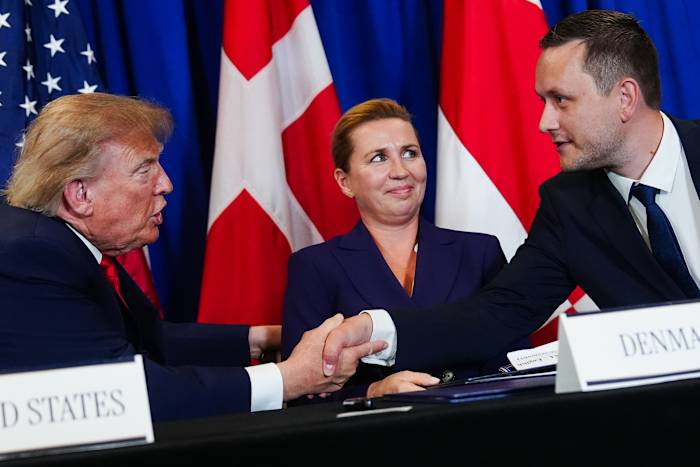
In Washington, it was floated as a casual real estate inquiry, a quirky geopolitical thought experiment tossed into the Sunday news cycle. In Copenhagen, it was met with stunned disbelief and cold diplomatic fury. Prime Minister Mette Frederiksen called it absurd. The reaction in Nuuk, the wind-swept capital of Greenland, was a mixture of wry laughter and deep, ancestral unease. How do you purchase a home that has been inhabited for thousands of years by people who view the land not as property, but as an extension of their own flesh and blood? For another look on this development, refer to the recent update from The New York Times.
The diplomatic fallout was swift. A state visit was abruptly canceled. Pundits on cable news scrambled to find Greenland on a globe, while seasoned diplomats quietly swallowed their coffee, realizing that the post-Cold War architecture of the West had just suffered a hairline fracture. NATO, an alliance forged in the fires of mutual defense and shared democratic values, suddenly looked remarkably fragile over a conversation about real estate.
Yet, beneath the diplomatic theater and the viral memes, something profound shifted. The superpower scramble for the Arctic had broken into the open, and in the center of the storm stood fifty-six thousand people.
To understand why a massive island of ice became the epicenter of Western anxiety, you have to look down from a satellite.
Imagine looking at the globe from the North Pole down. North America, Europe, and Asia wrap around the Arctic Ocean like a jagged collar. Greenland sits squarely in the middle, a massive geographic pivot point guarding the GIUK gap—Greenland, Iceland, and the United Kingdom—the historic maritime chokepoint through which any Russian naval vessel must pass to reach the Atlantic. During the Cold War, this was the domain of sonar buoys, nuclear submarines, and secret radar arrays buried under miles of ice, such as the infamous Camp Century.
When the Soviet Union collapsed, the Arctic went into a deep freeze of neglect. Washington turned its gaze toward the deserts of the Middle East and the economic rise of China in the South China Sea. The top of the world was forgotten.
Climate change shattered that amnesia.
As global temperatures rose twice as fast in the Arctic as anywhere else on Earth, the ice began to retreat. The ancient glaciers, long viewed as an impenetrable shield, started to calve into the sea, releasing monumental bergs that drifted south into shipping lanes. But where ice vanished, opportunity emerged. The receding freeze unlocked access to shipping routes that could cut transit times between Asia and Europe by weeks. More importantly, it exposed virgin earth—mountains packed with rare earth elements, iron ore, zinc, uranium, and oil reserves that had remained sealed away since the dawn of human civilization.
China saw an economic highway. Russia saw a militarized frontier. And the United States saw a vulnerability.
When Washington cast its covetous eye northward, it was not merely playing a game of geopolitical Monopoly. It was reacting to a terrifying realization: the Arctic was no longer a frozen moat. It was an open theater of great power competition, and the West was dangerously underequipped to defend its northern flank.
Consider the perspective of Malik, a hypothetical fisherman sitting on the rocky shore of the Nuup Kangerlua fjord, watching a trawler break through the thin early-winter ice. Malik does not think in terms of grand strategy or NATO article formulations. He thinks in terms of cod stocks migrating further north, the thinning ice that makes dog-sledding treacherous in late spring, and the rising cost of imported groceries in a supermarket where a single head of lettuce costs as much as a fine bottle of wine in Paris.
For generations, Greenlanders have lived in a state of suspended animation between two worlds. Politically, they are tied to the Kingdom of Denmark, which still subsidizes a massive chunk of their public budget through the bloktilskud, an annual block grant. Culturally, linguistically, and historically, they are Inuit, deeply connected to the land and sea, holding memories of survival in an environment that offers zero margin for error.
Independence has always been the ultimate horizon. Every politician in Nuuk dreams of the day when the flag of Greenland—the Erfalasorput, with its red and white sun sinking into the polar sea—flies proudly over a fully sovereign nation. But independence requires economic muscle. You cannot pay for hospitals, schools, and coast guard cutters with seal skins and ice cubes alone.
This is where the mineral wealth beneath the ice comes in.
For years, mining companies from across the globe had circled Greenland like gulls over a fishing boat. Rare earth elements—critical for electric vehicle motors, wind turbines, and advanced defense systems—lay embedded in the ancient rocks of the Kvanefjeld and other sites. To extract them meant inviting foreign capital, likely from Chinese state-backed firms, raising alarm bells in Washington and Brussels.
When the Trump administration made its public play for the island, it laid bare a brutal truth: Greenland was too valuable, too strategically vital, and too resource-rich to remain a sleepy, forgotten colony at the edge of the world.
The immediate result was panic. Pundits warned that NATO was fracturing. Commentators worried that an aggressive American posture would alienate Denmark, an ally of nearly a century. But beneath the surface turbulence, a different dynamic took root.
Greenland was no longer a passive object to be bought, sold, or forgotten. It was an actor.
In the months and years following the acquisition debacle, the diplomatic floodgates opened. European leaders who had never visited Nuuk suddenly found reasons to fly north. Diplomats from Washington, London, and Berlin began courting Greenlandic ministers with unprecedented respect. Consulates were reopened. Investment funds were whispered about. The message from the capitals of the West was unmistakable: We see you, we value you, and we cannot afford to lose you.
This newfound leverage changed the political calculus in Nuuk overnight.
Independence is no longer a distant dream whispered in coffee shops; it is an active negotiation. Greenlandic leaders began playing a sophisticated diplomatic game, balancing American security demands against European economic partnerships, while strictly regulating foreign extraction to protect their fragile environment and traditional way of life. They discovered that in a world waking up to the realities of a melting Arctic, small nations with critical geography hold immense cards.
The irony is striking. The very clumsiness of the American bid—its sheer audacity and disregard for diplomatic norms—shattered the status quo that had kept Greenland politically marginalized for decades. It forced the West to wake up from its post-Cold War slumber and forced Greenlanders to accelerate their own journey toward self-reliance.
Today, the Arctic wind still howls across the great ice sheet, indifferent to treaties, summits, and mining licenses. The glaciers continue their slow, majestic retreat toward the sea. But the human story at the top of the world has changed forever.
The superpowers thought they were playing a game of acquisition. They thought they could draw new lines across the ice and claim the spoils of a warming planet. Instead, they woke a sleeping giant of self-determination.
The ice is melting, but the people of Greenland are standing firmer than ever on the rock beneath. They were never for sale. And as the rest of the world scrambles to catch up to the realities of the north, the true winner of the geopolitical storm is the oldest soul in the room—an ancient island finally charting its own course into an uncertain, brilliant future.


