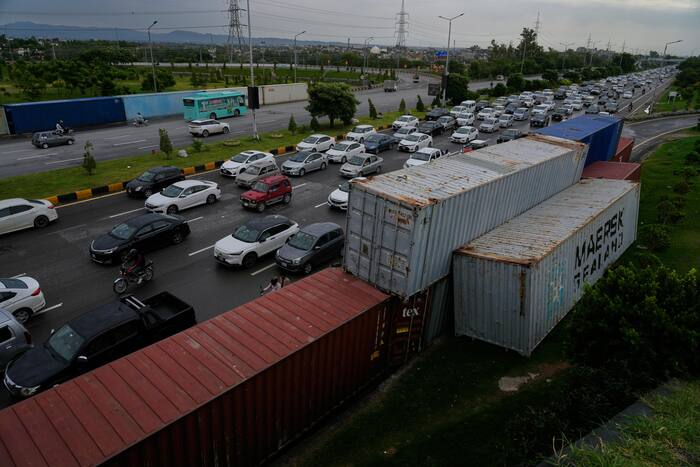
Whenever political friction hits the Pakistani capital, a predictable script plays out across international media. Reporters rush to photograph towering corrugated steel walls dropped across major intersections, diagnosing the metal barricades as frantic symptoms of state collapse, democratic backsliding, or imminent executive panic. The lazy consensus in foreign newsrooms treats these makeshift walls as chaotic speedbumps thrown together in the dead of night, representing a government losing its grip on the streets.
This analysis is entirely backwards.
The deployment of thousands of rented shipping containers across Islamabad is not a sign of administrative panic. It is a calculated, highly systematized, and chillingly effective piece of state-engineered urban friction. To view these barricades simply as reactive clutter is to misunderstand modern spatial deterrence.
The Economics of Containerized Denial
Let us dispense with the amateur narrative that the state is throwing random blocks of steel onto highways on a whim. The logistics of requisitioning up to two thousand transport modules—shifting heavy cranes, coordinating flatbed trailers, and locking down transit corridors across the twin cities—requires an immense bureaucratic apparatus.
When analysts complain about the cost, citing tens of millions of rupees per day in rental fees and paralyzed supply chains, they miss the strategic calculus. From a hard-nosed state security perspective, financial bleeding is an acceptable overhead for what economists call spatial neutralization. Modern political opposition movements rely heavily on momentum, optical density, and the psychological impact of a mass march swelling down open boulevards.
By erecting physical architecture that breaks a city down into isolated, indefensible pockets, the state shifts the entire physics of a protest. A crowd cannot build critical mass when every arterial highway is fractured into a localized cul-de-sac. The shipping container is the ultimate equalizer against populist momentum because it turns urban design into a defensive weapon. It forces movement out of open channels and into bottlenecks where traditional crowd control doctrines operate with maximum mechanical advantage.
The Misunderstood Reality of Containerabad
Critics love to dub the capital "Containerabad," treating the moniker as a punchline about a paralyzed city. They point to stranded supply trucks carrying vital goods, idle drivers trapped near fuel pumps without proper sanitation, and foreign shipping containers racking up daily demurrage fees that drain capital outward.
All of these economic harms are real. But treating them as unintended operational glitches ignores how power actually maintains itself in high-stakes political contests. For the security apparatus, collateral commercial friction is a feature, not a bug. A city brought to a controlled standstill stops functioning as an engine for opposition coordination. When small businesses lose revenue, when daily commuters stay home, and when transit grinds to a halt, the baseline energy required to sustain a massive street agitation evaporates.
People cannot organize a siege on the seat of government when they are spending four hours trying to navigate a maze of redirected traffic and checkpoints. The state trades economic velocity for absolute political containment—and in that exchange, containment always wins.
The True Function of Spatial Interruption
We must look past the superficial outrage over blocked roads and examine how spatial architecture dictates political outcomes. Democracies are designed to run on open access, but states under existential stress revert to hard boundaries. When political actors test the limits of institutional legitimacy through mass mobilization, the ruling elite responds with the oldest tool in the book: spatial denial.
You do not defeat a political movement by winning a debate on television. You defeat it by making the physical act of gathering logistically impossible. The steel boxes lining the Red Zone are physical manifestations of administrative survival. They represent a cold, rational determination that keeping challengers outside the gates is worth any amount of temporary economic disruption.
Until opposition strategists figure out a way to bypass the physics of steel barricades and decentralized urban blockades, the containers will remain right where they are. They are not a sign of weakness. They are the physical architecture of a state refusing to blink.