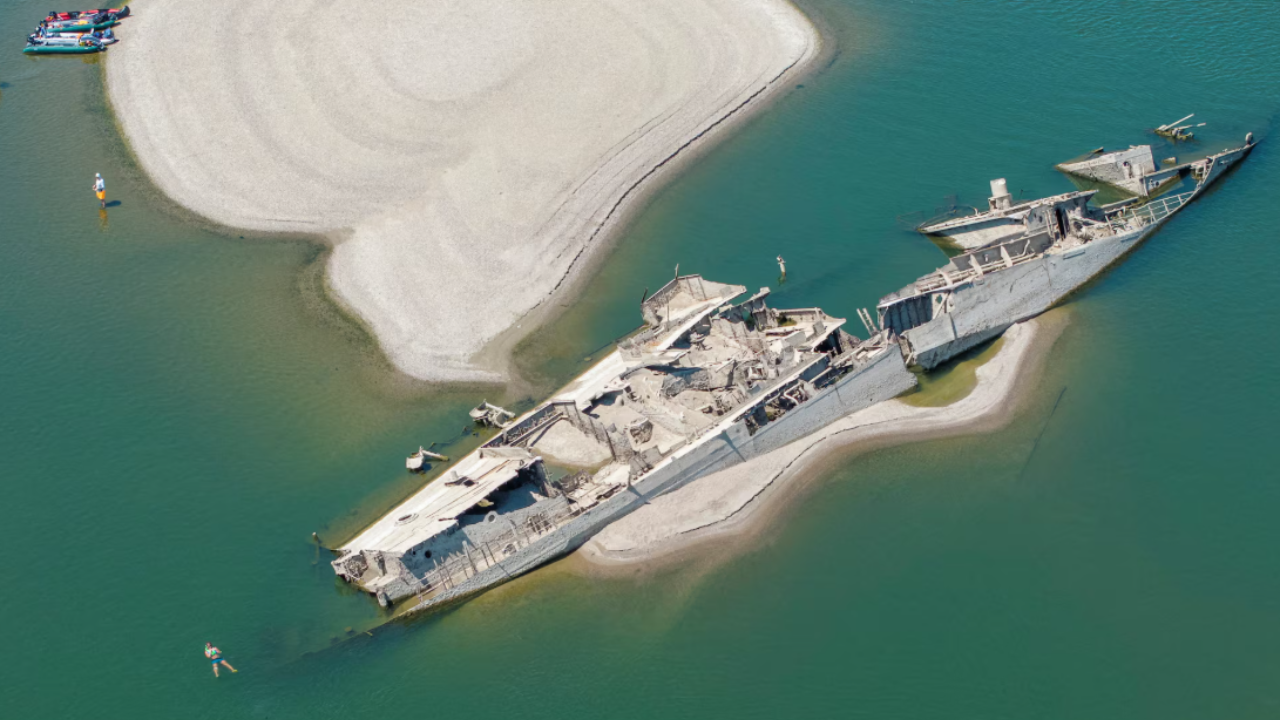
Droughts do not just wither crops and empty reservoirs. They pull back the curtain on history, dragging forgotten iron and dead weight from the mud.
Along the Danube River near Prahovo, Serbia, extreme low water levels have once again exposed a lethal fleet from the past. These are not ordinary shipwrecks. They are the skeletal remains of Nazi Germany's Black Sea fleet, scuttled in 1944 to avoid capture by the advancing Soviet Red Army. For decades, they rested silently beneath murky currents, treated as navigation hazards by local authorities and little more than local lore by passersby. Now, shrinking rivers have thrust them back into the light.
These exposed warships are dangerous relics packed with unexploded ordnance. They are also physical manifestations of a broader ecological and economic crisis gripping Central Europe. When a river drops low enough to reveal a war zone, it signals a systemic failure of water management, climate stability, and infrastructure design that affects millions of people.
Operation Donnerschlag and the Great Scuttling
To understand why these vessels are emerging now, we have to look back at the chaotic final months of the Second World War. By late summer 1944, the tide had turned irrevocably against the Axis powers. Romania had switched sides, turning its guns against its former German allies. The Red Army was surging westward through the Balkans, threatening to trap the entire German naval contingent operating in the Black Sea.
The escape route was simple on a map but impossible in reality. The only way out was up the Danube River, navigating the narrow gorge known as the Iron Gates.
Rear Admiral Paul-Willy Zieb commanded the retreat. It was a desperate mission dubbed Operation Donnerschlag. Hundreds of vessels, including destroyers, escort ships, patrol boats, and supply barges, packed with thousands of German troops and wounded soldiers, began a hazardous journey upstream against a strong current.
They never made it. As the fleet approached the Prahovo bottleneck, Soviet forces and partisan resistance blocked their path, while mines and coastal artillery batteries pounded them from the banks. Realizing escape was hopeless, the German command issued a grim order.
Scuttle the ships.
On September 6, 1944, hundreds of vessels were systematically blown up and sunk. Crew members opened sea cocks, placed demolition charges in engine rooms, and sent their own fleet to the bottom. The goal was twofold: block the Danube to prevent Soviet shipping and deny the enemy any usable naval hardware.
They succeeded entirely too well. The sunken hulks created an underwater dam of twisted steel, armor plating, and ammunition boxes. For nearly eighty years, this aquatic graveyard remained submerged, changing the riverbed morphology and creating a persistent bottleneck for commercial navigation.
The Engineering Nightmare Beneath the Surface
Most people see a rusty warship on a mudflat and think of a tourist attraction. Engineers and river pilots see a nightmare.
The German fleet did not sink neatly in straight lines. They went down in chaotic heaps, piled on top of one another across the riverbed. Each vessel carried fuel, lubricants, and thousands of rounds of high-explosive ammunition. Over the decades, the river silted over them, burying the hazard out of sight but never neutralizing the danger.
When a severe drought strikes the Danube basin, water levels plummet by meters. Suddenly, the hulls break the surface.
This creates immediate hazards for commercial shipping. The Danube is a vital European economic corridor, stretching from the Black Forest to the Black Sea. Barges carrying coal, grain, oil, and manufactured goods rely on a consistent channel depth. When the sunken warships emerge, they narrow the navigable width of the river to a fraction of its normal capacity.
In recent years, cargo vessels have run aground on these hidden obstacles, forcing shipping companies to lighter their loads—offloading cargo onto smaller boats just to pass the bottleneck. This adds millions of dollars in transit costs and delays supply chains across multiple nations.
The Serbian government has attempted removal operations before. In 2022, authorities awarded contracts to salvage and defuse the ordnance on these vessels. It is painstaking, perilous work. Divers must operate in near-zero visibility, navigating unstable metal structures laden with unstable explosives that have sat underwater for eighty years. Chemical degradation makes the fuses unpredictable. A single mistake can detonate a torpedo warhead or an artillery shell buried in the silt.
Climate Realities and the Shrinking Danube
The emergence of the Prahovo wrecks is not an isolated historical curiosity. It is a symptom of a systemic hydrological collapse.
Central Europe is experiencing hotter summers, declining snowpacks in the Alps, and more erratic rainfall patterns. The Danube relies heavily on glacial melt and seasonal precipitation. When those inputs fail, the river shrinks.
We are witnessing a structural shift in European river systems. Low-water events that used to occur once every generation are now happening with alarming frequency. In 2003, 2018, 2022, and again in subsequent dry spells, the riverbeds have cracked open.
This exposes a harsh truth about modern infrastructure. Canals, locks, and shipping channels were designed for a twentieth-century climate that no longer exists. Engineers planned around historical flood and drought baselines calculated over a hundred years ago. Those baselines are now obsolete.
When the river drops, it does not just reveal Nazi warships. It exposes municipal water intake pipes hanging dry in the air. It reveals agricultural irrigation systems starved of supply. It grounds hydroelectric power generation because the turbines lack the hydraulic head required to spin efficiently.
The sunken warships of Prahovo serve as dark, physical markers of this decline. They are monuments to human destruction in the past, resting inside a modern ecological crisis driven by climate disruption.
The Cost of Ignoring the Iron
Governments often treat river remediation as a reactive expense rather than a proactive investment. Clearing the Prahovo wrecks has been delayed for decades due to high costs, political friction among riparian states, and the sheer technical difficulty of the task.
It is expensive to lift a rusted destroyer hull filled with unstable explosives out of a major international river. It is cheaper to wait, hope for rain, and issue warnings to commercial captains.
That strategy has an expiration date, and that date arrives every time a drought drops the water level below the danger threshold.
When you look at these skeletal hulls rising from the Danube mud, you are looking at layers of failure. You see the military failure of a collapsing regime desperate to deny resources to its enemy. You see the infrastructural failure of a transport network unprepared for environmental volatility. And you see the political failure of nations sharing a vital waterway failing to coordinate comprehensive, permanent cleanup operations before crisis strikes.
The river will rise again. Autumn rains and spring melts will eventually swallow the warships back into the murky depths, hiding the iron ghosts from view.
Until the next drought.