The statistics arrive in neat, bloodless columns on government letterheads. Ir
The Architecture of Walls When the Tide Recedes
news
Note: This article contains hypothetical scenarios clearly labeled as such to ground abstract European migration policy data in human reality.
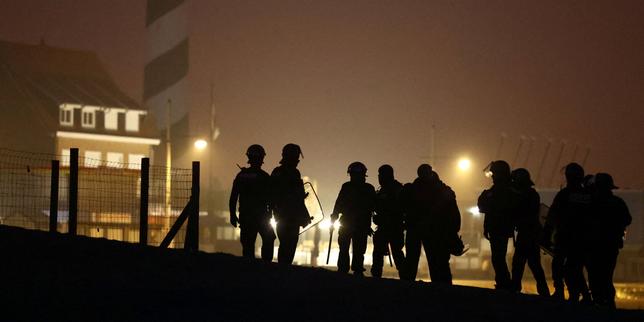
The checkpoint at the edge of the border does not smell of history. It smells of diesel, damp asphalt, and the cold sweat of a Tuesday morning three hours before sunrise.
For three years, the ledgers have told a specific story in neat, bureaucratic columns. Irregular entries into Europe are down. The frantic waves of arrivals that dominated front pages and rattled parliaments have ebbed. If you look only at the graphs issued by border agencies, you see a downward slope—a receding tide, a crisis stabilizing under the weight of reinforced fences, externalized patrols, and closed ports.
Yet, the concrete mixers are still running.
Across capitals from Berlin to Rome, lawmakers are not exhaling. They are drafting harsher restrictions, lowering thresholds for asylum, expanding detention facilities, and tightening the screws on a system that is already showing strain lines. Why build higher walls when the flood is apparently slowing to a trickle?
To understand that paradox, you have to step away from the macroeconomic charts and look at what happens when numbers stop being digits on a screen and start walking down a dusty road with a plastic bag of belongings.
Consider a hypothetical traveler whom we will call Tariq, though he could be anyone from a dozen provinces where the soil has turned to dust or the currency has turned to ash. Tariq does not read border statistics. He does not know that irregular crossings dropped by double-digit percentages compared to the previous year. He only knows that his phone battery is at four percent, his shoes have separated at the sole, and the forest ahead of him is said to be watched by men with thermal cameras.
Tariq represents the statistical anomaly that policymakers fear most: the persistence of desperation.
When a river floods, people flee the rising water in a panic. But when the river settles into a permanent, sluggish trickle of mud, life doesn't return to normal. The banks simply erode. The danger becomes chronic, invisible, and woven into the landscape. That is the reality European migration policy is currently grappling with. The drop in sheer volume has not lowered the political temperature; it has shifted the anxiety from quantity to permanence.
Governments are reacting to a phantom that refuses to dissipate. Every arriving boat, no matter how small, acts as a magnifying glass for domestic political fractures. In the quiet corridors of ministries, the calculation is cold: a lower total number of arrivals does not appease a public conditioned to view migration as an existential threat. In fact, when numbers drop but political rhetoric remains fixed on crisis mode, the demand for absolute containment only grows louder.
It is a strange human trick—the belief that if you lock a door hard enough, the weather outside will simply cease to exist.
Step inside a European interior ministry meeting room on a rainy Thursday afternoon. The air is stale with stale coffee and the hum of fluorescent lights. Officials stare at spreadsheets showing fewer detections at the external borders. Yet, the atmosphere is tense. Someone points out that while sea crossings dropped, secondary movements—people moving quietly across internal Schengen borders inside the bloc—are ticking upward. Another official notes that the legal pathways are so choked with red tape that even legitimate applicants are slipping into irregular channels out of sheer exhaustion.
The response is rarely to open a valve. The response is to weld the pipes shut.
Proposals circulate to outsource processing centers to non-EU nations, to extend detention periods without trial, to strip away appeal processes under the banner of efficiency. These measures are marketed as pragmatic necessities. But they carry a hidden cost that rarely makes it into the press releases: they trade legal stability for psychological deterrence, betting that if you make the destination harsh enough, the origin story won't matter.
Think of it like an old dam with microscopic hairline fractures. The water pressure has dropped, but the concrete has already cured in a warped shape. The engineers know that the next real storm—whether driven by climate collapse, regional conflict, or economic ruin—will test a structure that has been patched with emergency resin rather than rebuilt with foresight.
So they rush to pour more concrete.
This is the central contradiction of our current era. We live in a paradox where declining arrivals are met with escalating panic. The political machinery, once triggered into a defensive posture, finds it nearly impossible to unwind. Every law passed to restrict entry sends a signal not just to migrants, but to voters: We are under siege, and the walls must be thicker.
When Tariq finally reaches a secondary road and sees the patrol vehicle parked fifty yards ahead, he doesn't calculate the geopolitical shifts of the European Union. He simply turns into the trees, adjusting the strap of his bag, stepping into the dark.
The policy debates in the marbled halls of power will continue long after he disappears into the brush. Laws will be tightened. Budgets for surveillance will swell. Headlines will celebrate or decry the latest percentage shift in border apprehensions. But the underlying human current—stubborn, quiet, and relentless—remains untouched by decrees.
The walls are taller now. The guards are better equipped. The statistics look precisely how the architects of deterrence wanted them to look.
Yet, out in the dark, the footsteps continue, finding the spaces between the words, measuring the distance between what Europe wishes to be and what the world actually is.


