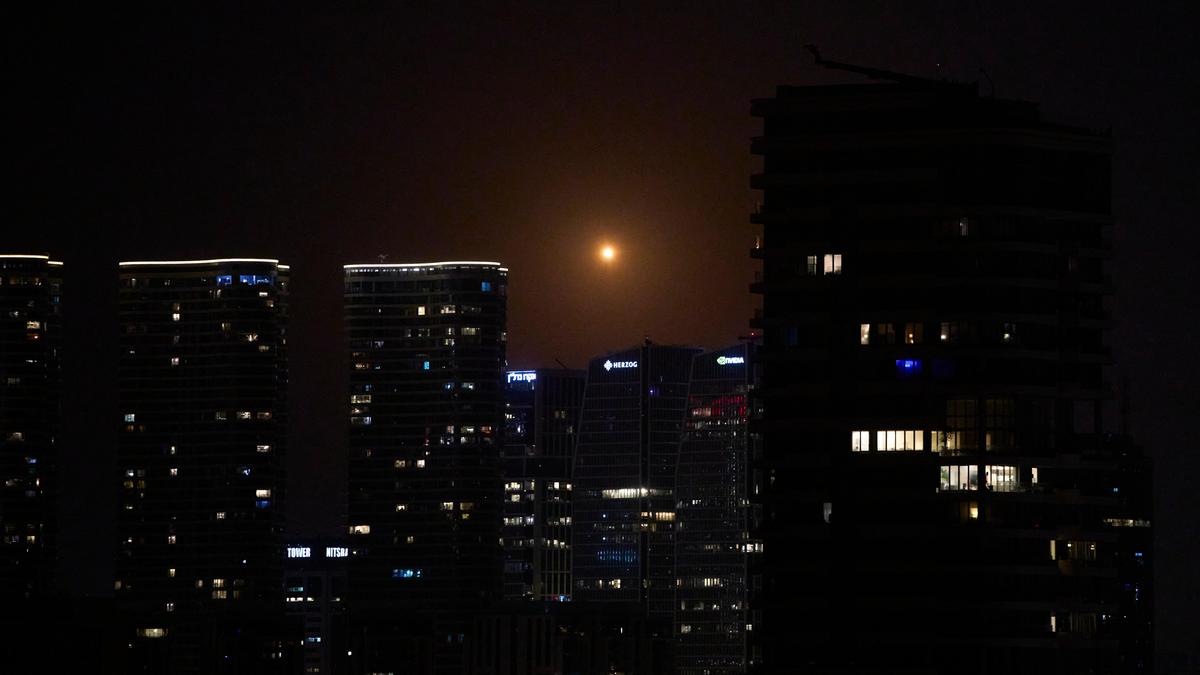
The headlines are predictable. They read like a Mad Libs template for regional conflict: "Two killed," "Missiles launched," "Medics report." This lazy reporting frames the recent Iranian missile strike near Tel Aviv as a tragic anomaly in an otherwise impenetrable defense system. It treats human casualties as a glitch in the software.
It’s time to stop pretending. These deaths aren't a failure of technology. They are the inevitable result of a defense strategy built on a lie. We have been sold a narrative of total safety—a "Tapestry" of protection (to use a word the bureaucrats love)—that actually invites more danger by lowering the threshold for escalation. When you tell a population they are invincible, they stop looking for cover. And when the math of saturation attacks finally catches up to reality, people die because they trusted a percentage that was never 100%.
The Interception Illusion
The media obsesses over interception rates. They cite "90% effectiveness" as if it’s a grade on a high school math test. In the world of ballistic physics and kinetic energy, 90% is a failing grade when the volume is high enough. If an adversary launches 200 projectiles, a 90% success rate means 20 warheads are hitting the ground.
We need to talk about Probabilistic Risk Assessment (PRA). The standard news cycle focuses on the "hit," but it ignores the "shrapnel." Even a successful interception creates a debris field traveling at Mach speeds. Physics doesn't care about your political borders. When a kinetic interceptor hits a medium-range ballistic missile, the conservation of momentum dictates that the mass has to go somewhere.
I’ve spent years analyzing defense procurement and the physics of terminal-phase intercepts. Here is the uncomfortable truth: A "successful" intercept over a densely populated area like Tel Aviv is often just a redistribution of lethality. You aren't "stopping" a missile; you are turning one big explosion into ten thousand jagged, supersonic projectiles.
The Economic Asymmetry Nobody Admits
The competitor article focuses on the "two killed." It’s a tragedy, but it’s a symptom of a much larger structural rot in how we view modern warfare. We are fighting an asymmetrical economic war that the West is losing.
Consider the cost-to-kill ratio.
- The Iranian Perspective: A low-cost, liquid-fuel missile or a swarm of "suicide" drones might cost $20,000 to $100,000.
- The Defensive Perspective: An interceptor missile, like those used in the Iron Dome or Arrow systems, costs between $50,000 and $3.5 million per shot.
Often, the doctrine requires firing two interceptors per incoming target to ensure a "kill." Do the math. You are spending $7 million to stop $100,000. This is not a sustainable defense; it is a controlled bankruptcy. By focusing on the immediate casualties, the press misses the fact that the defense system itself is a primary target. The goal isn't just to hit Tel Aviv; the goal is to force the defense to empty its magazines. Once the magazines are empty, the "interception rate" drops to zero.
The Moral Hazard of Magic Shields
There is a psychological phenomenon called Risk Compensation. When people feel safer, they take more risks. In the early days of these conflicts, people ran for the bunkers the moment the sirens wailed. Today, you see people standing on balconies with their smartphones, trying to film the "fireworks" for social media.
This is the moral hazard of the Iron Dome. It has created a false sense of security that prevents political solutions because the "cost" of the status quo feels low. Until it isn't. Those two deaths near Tel Aviv aren't just casualties of war; they are casualties of a population that has been conditioned to believe that the sky is a solid ceiling.
The media plays right into this by framing the event as a sudden escalation. It’s not an escalation; it’s the predictable outcome of a long-term strategy where we swapped bunkers for batteries. We’ve traded physical protection (concrete) for digital protection (algorithms), and algorithms have bad days.
Dismantling the "Precision" Narrative
The public is told these defense systems are surgical. They aren't. They are frantic.
When an Iranian Fattah or Ghadr-110 enters the terminal phase, it is traveling at multiple times the speed of sound. The decision-making window for an automated defense system is measured in milliseconds. In that window, errors are baked into the cake.
- Sensor Ghosting: In high-saturation environments, radar can struggle to differentiate between the warhead and the booster separation.
- Terminal Maneuvering: Modern missiles are no longer simple parabolas. They can shift their path.
- Human Interference: The "man in the loop" is often the weakest link, pressured to authorize launches against targets that might already be falling into uninhabited areas, wasting precious inventory.
The competitor's piece makes it sound like a fluke that people died. It wasn't a fluke. It was a statistical certainty. If you play Russian Roulette enough times, the cylinder eventually lines up.
The Actionable Truth for the Survivalist
If you are waiting for a government-issued "all clear" or relying on a headline to tell you when it’s safe, you’ve already lost the initiative. Here is what you do when the status quo breaks:
- Ignore the Interception: Never assume an interception means the threat is gone. The debris field of a neutralized missile is often more unpredictable than the missile itself.
- Verticality is the Enemy: If you are in an urban center like Tel Aviv, the higher you are, the more exposed you are to the lateral fragmentation of an intercept. Get low, stay internal.
- Watch the Inventory, Not the News: The safety of a city isn't determined by the last "successful" night; it’s determined by the remaining stock of interceptors. When the interceptors run low, the strategy changes from "protect everything" to "protect high-value assets." Your neighborhood isn't a high-value asset.
The Failure of the "Two-Person" Focus
The "two killed" headline is designed to elicit a specific emotional response. It’s small-scale enough to feel tragic but not so large that it causes a systemic panic. This is "sanitized" reporting. It keeps the population calm while the underlying reality—that the shield is cracking—is ignored.
We are witnessing the end of the era of defensive dominance. For decades, the West believed that superior tech could negate the costs of geography and history. We thought we could build a wall in the sky and go back to our lattes.
The reality is that no amount of code can rewrite the laws of physics or the grit of an adversary willing to throw a thousand $50,000 rockets at a $3 million shield. The two people who died near Tel Aviv are the first indicators of a shift in the gravity of power. The shield is not a solution; it is a temporary, expensive delay.
Stop looking at the sky and start looking at the ledger. The math is failing, and no amount of "90% success" headlines will change the trajectory of the fragment that finally finds its mark.
Go to the basement. The sky is falling, even when they tell you they've caught it.