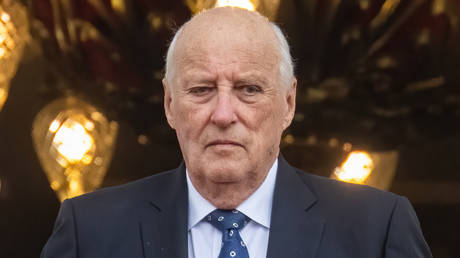
King Harald V of Norway died at the age of 89 at Rikshospitalet in Oslo, closing a thirty-five-year reign defined by quiet resilience, institutional survival, and an absolute refusal to abdicate. His passing immediately elevates his son, Crown Prince Haakon, to the throne as King Haakon VIII. Yet the transition arrives at a fragile hour for the House of Glücksburg. While international headlines focus on Harald's wartime childhood as an exile in Washington and his historic marriage to a commoner, the structural reality of the Norwegian monarchy is far more complex. Harald did not merely modernize an ancient office; he shielded it from obsolescence through sheer personal gravity, leaving behind a throne now exposed to modern political turbulence and profound family scandals.
To understand Harald V is to understand a monarch forged by catastrophe. Born in 1937, he was three years old when Nazi bombers shattered Norwegian neutrality, forcing his family into a fractured exile that took him across the Atlantic to the safety of the White House. That early dislocation instilled a distinct form of constitutional duty. When he inherited the crown in 1991 following the death of his father, Olav V, Norway was transforming rapidly through North Sea oil wealth. A traditional, aloof crown would have ruptured against a newly affluent, egalitarian society. Harald recognized this danger early. He systematically dismantled the velvet rope, steering the royal household toward transparency, public financial accounting, and an intentional informality that transformed the palace from an elite fortress into a national anchor. Also making news recently: Inside the Dryland Farming Revolution Refusing to Die of Thirst.
The cornerstone of his popularity was not accidental charm, but radical empathy delivered at moments of national trauma. Following the 2011 terrorist attacks by Anders Behring Breivik, which claimed seventy-seven lives, political leaders stumbled to find the right register of grief. Harald stepped forward with a raw, unscripted address insisting that the answer to hatred was a stronger, more open democracy. Five years later, in a speech that ricocheted globally, he defined Norwegian identity not by bloodline or geography, but by human connection: "Norwegians are girls who love girls, boys who love boys, and girls and boys who love each other". That messaging positioned him not merely as a constitutional figurehead, but as the moral conscience of a nation of 5.6 million people.
Yet, the institutional armor Harald built is now being tested by the generation that follows him. King Haakon VIII ascends the throne amid severe reputational strains. Over the preceding years, the royal family absorbed compounding blows from auxiliary scandals, most notably scrutiny surrounding Crown Princess Mette-Marit and her past communications with convicted sex offender Jeffrey Epstein, alongside the eccentric public turns of Princess Märtha Louise and her marriage to an American spiritual practitioner. Harald resisted all calls to step aside, maintaining until his final months that his coronation oath was a lifetime contract that could not be broken by exhaustion or illness. By holding the line until his final breath, he protected the institution from premature succession battles, but he also left his successor to inherit a compound of unresolved familial liabilities. More information on this are detailed by TIME.
The mechanics of Norway's constitutional monarchy leave very little room for political error. Unlike nations where executive power rests in royal hands, the Norwegian sovereign exists by the consent of public affection and parliamentary alignment. Haakon lacks his father's decades-earned immunity to criticism. As the country navigates shifting geopolitical pressures in the Arctic and domestic economic adjustments, the new king must prove that the monarchy is more than just a sentimental habit for a prosperous social democracy. The crown is light on power, but heavy on symbolism, and symbolism requires absolute moral clarity to survive.
The flag above the Royal Palace in Oslo flies at half-mast, and the church bells have finished their midday toll. Harald V leaves behind a nation deeply grateful for a steady hand that steered them through decades of quiet change. Whether that stability outlives his generation depends entirely on how quickly the new court can rebuild public trust in an institution that has lost its most effective shield.