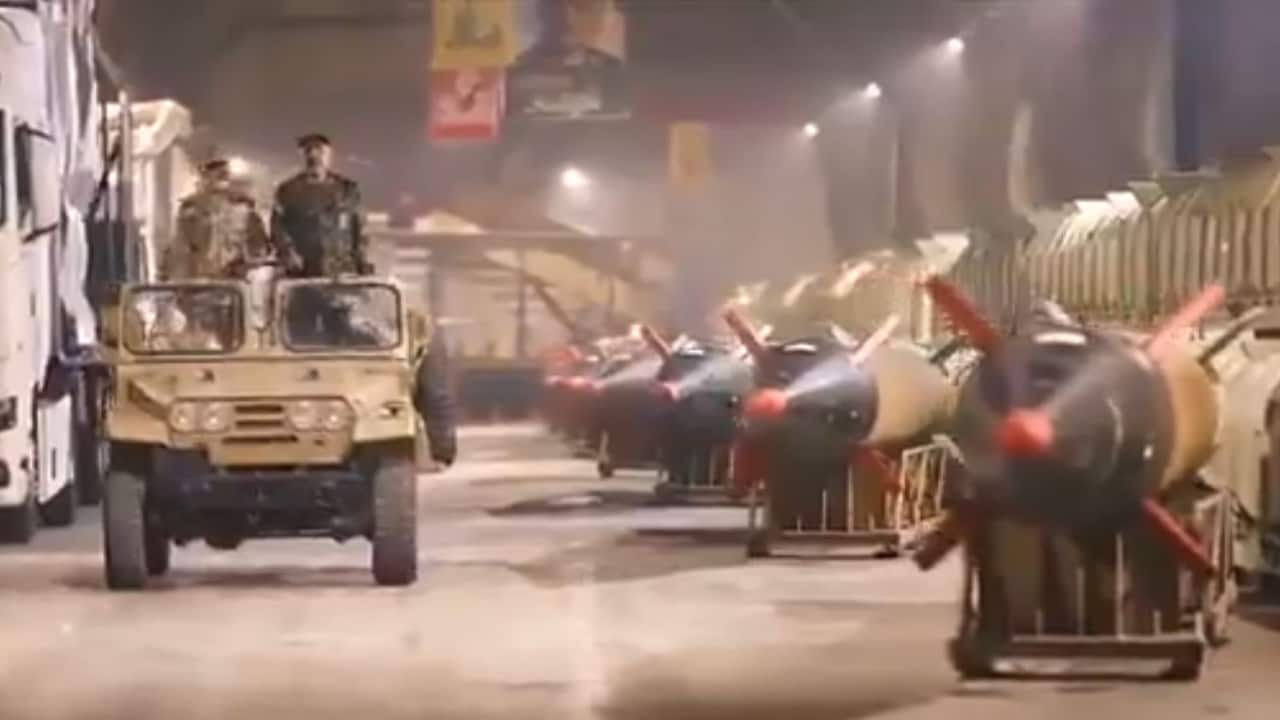
Mainstream defense coverage treats every state-sponsored propaganda video out of Tehran like a plot twist in a Tom Clancy novel. A camera pans across concrete tunnels, dramatically lit with harsh fluorescent tubes, revealing endless rows of transporter-erector-launchers and sleek ballistic hardware. Within hours, wire services and defense blogs dutifully regurgitate the exact headline the Islamic Revolutionary Guard Corps (IRGC) wanted them to write: Iran has unveiled a secret, impenetrable underground missile city.
The lazy consensus is predictable. Analysts wring their hands over the sheer volume of ordnance, declare deterrence broken, and imply that burying hardware beneath fifty meters of granite renders modern airpower obsolete. You might also find this similar story useful: Why Louisiana's Forced Heirship Laws Are Actually Protecting Families From Modern Estate Traps.
They are falling for the oldest magic trick in military history. You show the enemy the illusion of invulnerability so they stop looking at your crippling logistical bottlenecks.
If you actually understand modern strike warfare, intelligence, surveillance, and reconnaissance (ISR), and the brutal physics of subterranean warfare, those viral videos do not look like an unstoppable juggernaut. They look like a self-inflicted operational coffin. As discussed in detailed reports by NPR, the effects are significant.
The Myth Of The "Secret" Bunker
First, dismantle the word "secret." Nothing that requires the excavation of millions of tons of rock, the pouring of tens of thousands of cubic meters of reinforced concrete, and the installation of industrial-grade ventilation systems is secret.
Commercial satellite constellations—companies like Maxar, Planet Labs, and BlackSky—image the Iranian plateau with sub-meter resolution on a near-daily basis. Long before a single missile rolls into a tunnel, open-source intelligence (OSINT) analysts and state intelligence agencies have tracked the spoil piles, the concrete batching plants, the widened access roads, and the high-voltage power lines routed to the mountainside.
When Tehran invites state television cameras into a facility, they are not revealing a hidden asset. They are admitting the asset is already burned. In military doctrine, you never broadcast the layout, ceiling height, turning radius, and internal spacing of a genuinely covert strategic reserve. Doing so hands targeting officers free battle-damage assessment metrics and structural engineering data. You only stage a media tour when you have decided the propaganda value of domestic chest-thumping outweighs the operational security of the site.
The Chokepoint Fallacy
Burying weapons deep underground solves one problem—protection from conventional blast fragmentation—while creating three catastrophic vulnerabilities. Defense reporters rarely discuss the second-order effects of subterranean basing because concrete tunnels make for great B-roll, whereas logistics diagrams put readers to sleep.
1. The Portal Problem
A tunnel is not an airfield. An underground missile base is fundamentally a giant stone bottle with a very narrow neck. You do not need to collapse three hundred feet of solid granite to neutralize a facility housing two hundred ballistic missiles. You only need to collapse the concrete portals, destroy the blast doors, or crater the apron directly outside the exit.
Modern precision-guided munitions do not need to penetrate the main cavern to achieve a "mission kill." By dropping specialized earth-penetrating warheads or runway-cratering submunitions directly onto the ingress and egress points, an adversary traps the entire arsenal inside. A missile locked behind ten thousand tons of collapsed rock is functionally identical to a missile destroyed on the pad. It cannot fire. It cannot contribute to a salvo. It becomes an expensive museum piece in the dark.
2. The Salvo Rate Bottleneck
In modern missile warfare, volume per minute matters far more than total inventory. Advanced integrated air and missile defense (IAMD) networks—combining systems like Patriot PAC-3, THAAD, Arrow, and Aegis—are designed to calculate intercept solutions against incoming trajectories. The only reliable way to defeat a layered defense is through saturation: firing enough warheads simultaneously to overwhelm radar tracking channels and exhaust interceptor magazines.
Underground facilities actively sabotage saturation tactics. Look closely at the IRGC propaganda footage. The tunnels are narrow. The vehicles are parked nose-to-tail in single file.
Imagine a scenario where a commander orders a massive retaliatory strike of one hundred missiles from a single subterranean complex. To launch, each massive, multi-axle transporter-erector-launcher (TEL) must crawl out of the tunnel mouth, drive to a pre-surveyed firing point, deploy hydraulic stabilizers, erect the missile tube, run final inertial guidance alignment, and fire. Then, the next vehicle in line has to maneuver around the scorching exhaust plume and debris before repeating the process.
This takes time. Dozens of minutes. Sometimes hours. In the era of persistent space-based infrared tracking, the moment the first missile ignites, overhead sensors detect the thermal bloom. Within minutes, loitering munitions, stealth strike aircraft, and long-range standoff cruise missiles are inbound on those exact coordinates. The remaining ninety-nine trucks are now sitting in a traffic jam inside a dead-end tunnel, waiting to be picked off one by one as they emerge into the daylight.
3. Maintenance In A Concrete Tomb
Liquid-fueled ballistic missiles—which still make up a substantial portion of Iran’s long-range heavy hitters—are notoriously temperamental beasts. Their propellants are wildly corrosive and toxic. Storing them fueled degrades seals, valves, and airframes; storing them empty means you have to pump volatile oxidizers and fuels inside an enclosed, poorly ventilated space right before a launch.
Even solid-fuel rockets, which are vastly easier to store and launch quickly, are not immune to their environment. Subterranean rock formations sweat. Humidity fluctuates. Dust from concrete spalling and vehicle exhaust infiltrates delicate electronics and guidance gyros. Keeping hundreds of high-precision munitions combat-ready in a damp cave requires relentless climate control, dehumidification, and diagnostic testing. Every piece of HVAC equipment requires external air intakes and exhaust vents—and every external vent is another thermal and structural signature for an enemy targeting pod to lock onto.
Why Tehran Actually Builds Them
If underground missile cities are logistical bottlenecks vulnerable to portal denial, why has Iran spent billions of dollars carving them out of the Zagros Mountains?
Because strategy is rarely about pure military optimization. It is about political survival and asymmetric signaling.
First, Iran lacks an air force capable of contesting airspace. Its fleet consists largely of aging F-4 Phantoms, F-14 Tomcats, and MiG-29s kept flying through heroic domestic cannibalization and reverse engineering. Because Tehran cannot protect its territory from the sky, it has effectively turned its ballistic missile force into a substitute air force. When your doctrine relies entirely on ground-based rockets for long-range strike, you have no choice but to harden them against an enemy that owns the sky. Underground bases are not a sign of offensive dominance; they are an admission of total aerial inferiority.
Second, the audience for these videos is not the Pentagon. The audience is domestic and regional. Every time Tehran suffers an intelligence failure, an economic downturn, or a strategic setback, the state media apparatus releases fresh footage of subterranean tunnels. It projects permanence, technological prowess, and inevitability to a domestic population and to regional proxy networks that need reassurance that the patron is strong.
Third, it forces the adversary to spend money. While digging tunnels is expensive, forcing a rival to maintain fleets of stealth bombers, develop ultra-heavy bunker-busting munitions like the GBU-57 Massive Ordnance Penetrator, and dedicate constant satellite revisit rates imposes a real financial cost. It is economic attrition disguised as engineering.
What Serious Defense Analysts Look For Instead
If you want to know whether Iran’s missile capabilities are actually becoming more lethal, stop counting the trucks in the tunnels. Ignore the dramatic synthesizer music over the state TV broadcasts. Look at the unglamorous, boring metrics that actually dictate battlefield outcomes:
- Dispersal Infrastructure: Watch for hardened, decentralized highway strips and camouflaged roadside firing positions. A mobile launcher hidden under a highway overpass or disguised as a commercial shipping container is infinitely harder to find and kill than a launcher parked inside a billion-dollar concrete bunker with a giant front door.
- Solid-Fuel Transition: Track the shift away from liquid propellants toward advanced solid-fuel motors. Solid fuel cuts launch preparation times from hours to minutes, allowing a crew to drive out of cover, fire, and vanish before counter-battery or aerial strike packages can react.
- Guidance and Terminal Maneuverability: Ten missiles that hit within ten meters of a command bunker are infinitely more dangerous than two hundred missiles that land in the surrounding desert. Look for advancements in optical terminal guidance, maneuvering reentry vehicles (MaRVs), and decoys designed to spoof interceptors, rather than raw stockpile numbers.
- Command and Control Redundancy: A missile is useless if the launch order never arrives. The real indicator of survivability is buried fiber-optic networks, hardened mobile command posts, and decentralized firing authority—not the rooms where the hardware is parked.
The Honest Caveat
To be clear, dismissing the strategic invulnerability of these underground bases does not mean dismissing the threat of the weapons inside them. That would be equally reckless.
If a conflict erupts without warning, and Iran initiates hostilities on its own timeline, those subterranean complexes can surge a devastating initial wave of munitions before an adversary can establish air superiority and seal the portals. Even if seventy percent of an arsenal is eventually trapped underground, the thirty percent that escapes in the opening hours can still inflict catastrophic damage on regional bases, energy infrastructure, and civilian centers. Quantity has a quality all its own, especially when defenders are forced to trade multi-million-dollar interceptors for comparatively cheap rockets.
The danger lies in misdiagnosing the problem. When journalists frame these underground facilities as impregnable fortresses, they validate the exact narrative Tehran wants to sell: that conventional deterrence has failed and military options are off the table.
In reality, geology cuts both ways. Granite stops bombs from getting in, yes. It also stops armies from getting out. Until an underground base can launch a coordinated, simultaneous salvo without exposing its vehicles to a single narrow choke point, those endless rows of missiles are not a guarantee of victory. They are just targets waiting in line.