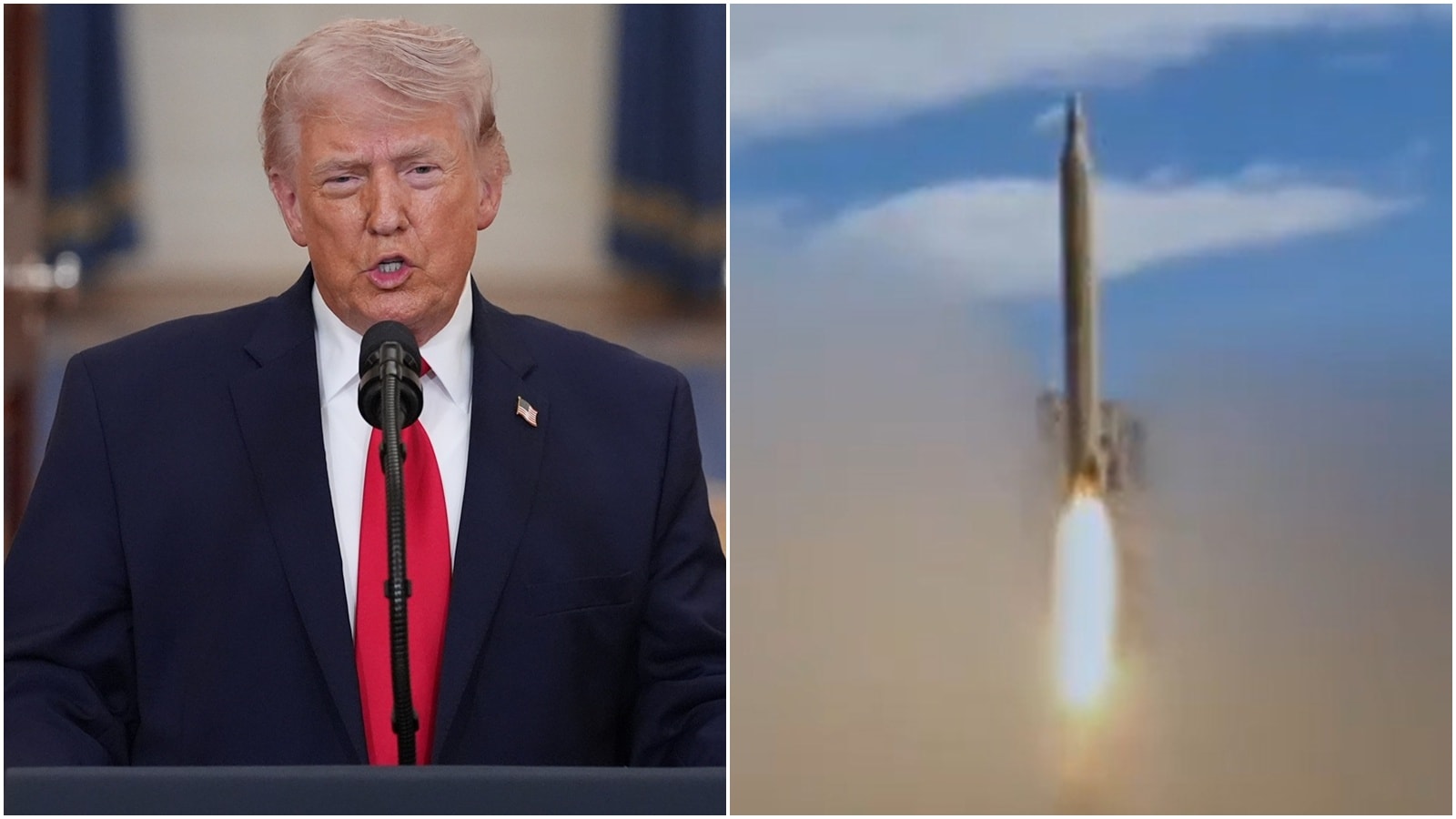
The mainstream media is obsessed with the theater of the absurd. When Iran’s state media trolls a former U.S. President with footage of a missile launch, the "lazy consensus" editors at major outlets rush to frame it as a playground spat. They call it mockery. They call it a clapback. They miss the entire point of how modern kinetic warfare intersects with digital psychological operations.
Donald Trump claims the Iranian military is decimated. Iran posts a video of fire in the sky. The media laughs. But if you’re looking at this through the lens of a "Twitter beef," you’ve already lost the plot. This isn't about feelings or "owning" a political opponent. It’s about the strategic calibration of deterrence in an era where pixels are as cheap as dirt and medium-range ballistic missiles (MRBMs) are the only currency that buys a seat at the table.
The Decimated Military Fallacy
To understand why the "decimated military" claim is such a dangerous piece of rhetoric, we have to look at the math of modern defense. The Western perspective often equates military strength with aircraft carrier groups and fifth-generation stealth fighters. It's a top-heavy, expensive, and fragile way to project power.
Iran doesn't play that game. They can't.
Since the 1980s, Iran has developed a doctrine of "defensive deterrence" rooted in the realization that they will never win a conventional dogfight against a Western power. Instead, they’ve built a massive, redundant infrastructure of underground "missile cities" and drone manufacturing hubs. When a politician claims a military like this is "decimated," they are applying a 20th-century definition of destruction to a 21st-century decentralized threat.
You don't "decimate" a swarm. You don't "decimate" a subterranean network with a few rounds of sanctions. By reacting with a missile launch video, Iran isn't just trolling; they are providing a visual receipt that their primary deterrent—the ability to saturate regional defenses—remains operational.
The Cost of the Kinetic Meme
Let's talk about the specific mechanics of the launch shown. The footage isn't just "fireworks." It’s a demonstration of a solid-fuel rocket motor capability.
In the world of missile tech, the transition from liquid to solid fuel is everything. Liquid-fueled missiles are the equivalent of a dial-up modem: they are slow to prep, easy to spot from a satellite, and dangerous to handle. Solid-fuel missiles are "plug and play." You can pull them out of a tunnel, point them at a target, and fire in minutes.
When Iran shows multiple launches, they are signaling a specific capability: Saturation.
$P_d = 1 - (1 - p)^n$
In this formula, $P_d$ is the probability of a successful hit, $p$ is the probability of a single missile evading defense systems, and $n$ is the number of missiles fired. Even if a defense system like the Iron Dome or a Patriot battery has a high intercept rate, if $n$ is large enough, $P_d$ inevitably approaches 1.
By framing these launches as a "meteor shower," Iran is mocking the very idea of missile defense. It’s a terrifyingly logical joke. They are saying: "We have enough $n$ to make your $p$ irrelevant."
Why the Media's "Mockery" Narrative is Weak
The "mockery" angle is the easy way out. It sells clicks because it feeds into the partisan divide. But it ignores the E-E-A-T (Experience, Expertise, Authoritativeness, and Trustworthiness) required to actually analyze a geopolitical flashpoint.
I’ve spent years watching how defense contractors and state actors manipulate public perception. Most "leaked" or "released" military footage serves a dual purpose.
- Internal Consolation: Reminding their own population that they aren't defenseless.
- External Calculation: Forcing an adversary's intelligence analysts to update their threat models.
When the competitor article focuses on the "burn" of the tweet, they ignore the fact that every frame of that video is being analyzed by DARPA-funded AI and human intelligence officers. They aren't looking at the captions; they're looking at the telemetry, the plume color, the launch interval, and the vibration patterns of the gantry.
The media calls it a meme. The Pentagon calls it data.
The High Price of Miscalculating Weakness
History is littered with the corpses of empires that believed their rivals were "decimated."
Imagine a scenario where a naval commander believes an opponent has no teeth because their "navy" consists of small, fast-attack boats rather than destroyers. On paper, the destroyer wins. In reality, twenty small boats equipped with C-802 anti-ship missiles create a multi-axis threat that a single Aegis system struggles to track.
This is the "asymmetric trap."
Iran knows they are the underdog in a total war scenario. Their entire strategy is built on making the cost of that war too high for the U.S. or its allies to pay. Every missile video is a reminder of the price tag. It’s not a joke; it’s a quote for services rendered.
The Myth of Sanction-Induced Paralysis
There is a persistent, lazy belief that if you choke an economy enough, their high-tech weapons programs will wither away. This ignores the "Scrapheap Innovation" principle.
Look at the Shahed-136 drones. They use off-the-shelf components, civilian GPS chips, and engines that sound like lawnmowers. They cost about $20,000 to make. The missiles used to shoot them down cost $2,000,000.
Who is winning that math?
The "decimated military" claim assumes that military power is a linear function of GDP. It isn't. It’s a function of engineering efficiency and the will to deploy. Iran has spent forty years learning how to build high-impact weapons in a basement. A "meteor shower from Mars" isn't a boast about wealth; it's a boast about resilience.
Stop Reading the Captions, Start Reading the Physics
The competitor’s piece failed because it stayed on the surface. It treated a geopolitical maneuver like a celebrity feud on TMZ. To actually understand what happened, you have to look past the "mockery" and see the hardware.
The video showed a salvo launch. This requires sophisticated command and control (C2) infrastructure. It requires synchronized guidance. It requires a logistical chain that is very much alive and kicking.
If you want to know if a military is decimated, don't listen to a stump speech. Look at the launch cadence. Look at the range. Look at the accuracy.
The "meteor shower" wasn't a joke about Trump. It was a demonstration of a lethal, functioning, and highly integrated kill-chain that doesn't care about your political rhetoric.
In the world of realpolitik, the only thing more dangerous than a strong enemy is an enemy you’ve convinced yourself is weak. When the missiles start flying, "I thought they were decimated" is a poor excuse for a failed defense strategy.
The next time you see a state-sponsored "troll" video, stop looking for the punchline. Look for the payload. Because while the media is busy laughing at the tweet, the engineers are busy calculating the trajectory.
Don't mistake a PR stunt for a lack of potency. The fire in the sky doesn't care if you think it's a meme or a meteor. It only cares about the target.
Log off the theater and look at the telemetry.