Standing on the banks of the Bidasoa River, where the Atlantic crashes into the Basque coast, you cannot see a border anymore. The rusting iron gates are gone. The customs booths have been turned into tourist offices or left to the weeds. If you walk across the Santiago Bridge from Hendaye in France to Irun in Spain, the only indication that you have left one nation and entered another is the sudden change in the language on the street signs and the smell of roasting coffee shifting from dark French roast to bitter Spanish torrefacto.
Yet, beneath the soil, high above the mountains in the humming copper wires of the electrical grid, and inside the sterile conference rooms of the Élysée Palace and the Moncloa, an invisible wall still stands.
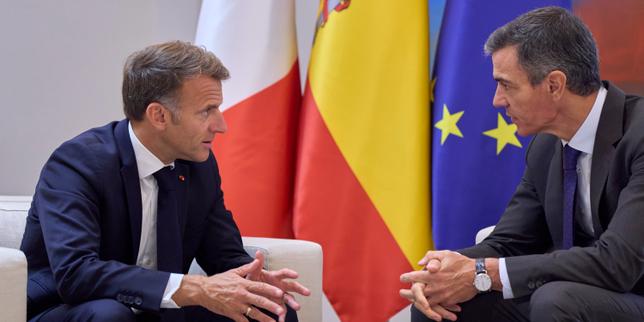
Earlier this week, French President Emmanuel Macron stepped onto the tarmac in Madrid, flashing the practiced, kinetic smile of a man who treats diplomacy like a high-stakes sprint. He was there to meet Spanish Prime Minister Pedro Sánchez. To the cameras, the choreography was flawless. Warm handshakes. Backslaps. Phrases like "extraordinary relations" tossed effortlessly into the crisp Castilian air. And yet, behind the velvet ropes, an awkward truth hung over the tapas and the diplomatic briefings like an uninvited guest. France and Spain—two founding pillars of modern Europe, neighbors sharing a 623-kilometer border and an intertwined history stretching back to the Roman Empire—still do not have a formal treaty of friendship and cooperation.
Think about that for a second.
France signed the Élysée Treaty with Germany in 1963, turning centuries of bloodshed into the engine of the European Union. It signed the Quirinal Treaty with Italy in 2021, cementing a deep institutional bond across the Alps. Even Spain and Portugal have their Iberian Summits and deeply integrated frameworks. Meanwhile, Paris and Madrid have been living together for decades without ever bothering to sign the marriage certificate. They call their relationship extraordinary. They praise their shared vision for Europe. But when the cameras turn off, the lack of a binding legal treaty reveals a quiet, stubborn friction that affects everything from the price you pay to heat your home to the speed of the train that takes you on vacation.
The Ghosts of the Pyrenees
To understand why two neighbors who claim to love each other cannot seem to put a ring on it, you have to look at the mountains. For centuries, the Pyrenees were not just a geological feature; they were a psychological barrier. "Africa begins at the Pyrenees," Alexandre Dumas famously sneered in the nineteenth century, capturing a Parisian arrogance that viewed Spain as an exotic, backward cousin rather than an equal partner.
I remember the first time I crossed that border by train in the late nineteen-nineties, long before high-speed rail was even a whisper in the region. At the border station of Portbou, every single passenger had to haul their heavy suitcases off the French train, trudge through a cavernous, echoing hall, and board a waiting Spanish train. Why? Because in the nineteenth century, Spain deliberately built its railway tracks wider than the European standard gauge. They did it out of sheer terror that Napoleon’s armies would march south again. They literally engineered their infrastructure to keep the French out.
The tracks have mostly been modernized now, and Napoleon is long dead, yet that muscle memory of suspicion never truly vanished. It merely mutated into modern bureaucracy, energy protectionism, and quiet political rivalry.
Consider a hypothetical character—let us call her Elena. Elena is thirty-four, an agricultural engineer living in Perpignan, just thirty minutes north of the Spanish border. Every morning, she drives past vineyards and peach orchards that look identical to the ones across the ridge in Catalonia. Elena speaks both French and Spanish fluently. Her grandmother was a Republican refugee who fled Franco’s dictatorship in 1939, crossing those very mountains on foot in the dead of winter. For Elena, the border is an absurdity. Her life is fluid. Her friends live in Girona; her clients are in Montpellier.
Yet, when Elena tries to get funding for a cross-border water management project to combat the devastating droughts choking both southern France and northern Spain, she hits a brick wall. There is no unified bilateral mechanism to streamline the paperwork. Instead, she faces two entirely different legal universes, two competing ministries in Paris and Madrid that rarely speak to each other unless a crisis forces them into the same room. Without a treaty of friendship—which is not merely a symbolic piece of parchment, but a legal architecture that forces ministries, judges, and local governors to meet regularly and harmonize laws—people like Elena are left stranded in the bureaucratic no-man's-land.
The Energy Island and the Pipeline War
If you want to feel the real, visceral heat of the Franco-Spanish stalemate, do not look at diplomatic communiqués. Look at your utility bill.
For years, Spain and Portugal have existed as what energy experts call an "energy island." While Spain has invested billions into transforming itself into a powerhouse of solar and wind energy—bathed in relentless Iberian sun and swept by Atlantic gales—it has almost no way to send that cheap, clean electricity to the rest of Europe. The Pyrenees stand in the way, and France has historically been in no rush to drill tunnels through them for power lines.
Why? The answer comes down to cold, hard self-interest.
France’s economy is built on the back of its massive nuclear power fleet. For decades, Paris viewed cheap Spanish renewables not as a European asset, but as direct competition to French nuclear exports. If Spain could easily pump green electricity into Germany and central Europe through France, the French energy giant EDF would lose market share and geopolitical leverage.
This tension exploded into the open during the European energy crisis triggered by Russia’s invasion of Ukraine. Suddenly, Germany was desperate for gas, and Spain was sitting on a third of Europe’s liquefied natural gas terminals, ready to help. Madrid and Berlin pushed hard for the MidCat pipeline, a massive project designed to pump gas from Catalonia straight through the Pyrenees into France.
Macron’s answer was a flat, uncompromising non.
Paris argued that a fossil fuel pipeline made no ecological sense and would take too long to build. Madrid saw it differently: as a classic display of French protectionism disguised as environmental virtue. The standoff was so bitter that Pedro Sánchez eventually bypassed the Pyrenees altogether, striking a deal with Macron and Portuguese Prime Minister António Costa to build the H2Med—an underwater hydrogen pipeline running beneath the Mediterranean Sea from Barcelona to Marseille.
Think about the sheer absurdity of that engineering feat. It was easier, politically, to lay a pipe across the bottom of the Mediterranean seabed than to convince French local authorities and Parisian bureaucrats to dig a trench across a shared land border. That is what "extraordinary relations" look like when there is no treaty to force compromise.
Two Men, Two Europes
On the surface, Emmanuel Macron and Pedro Sánchez ought to be natural soulmates. Both are tall, telegenic, multilingual leaders who came to power as charismatic outsiders promising to modernize their respective nations. Both are fiercely pro-European, fluent in the language of Brussels, and terrified of the rising tide of far-right populism threatening to tear the continent apart.
Watch them walk together down the halls of the Moncloa Palace, and you see two men who genuinely enjoy each other's company. They speak English to one another, bypassing the historical baggage of French and Spanish, projecting an image of effortless, twenty-first-century cosmopolitanism.
Look closer, however, and you see two leaders fighting very different domestic wars.
Macron is a president entering the twilight of his second term, weakened by a fractured parliament at home, haunted by fierce protests over pension reforms, and struggling to maintain France’s traditional role as the undisputed intellectual and military leader of Europe. For Paris, a treaty of friendship with Spain carries a subtle psychological cost. France likes being the senior partner in Europe, the indispensable nation alongside Germany. Signing a formal treaty with Madrid elevates Spain to the exact same diplomatic tier as Berlin and Rome. In the rigid hierarchy of the French foreign ministry, the Quai d’Orsay, admitting that Spain is an equal peer takes a level of humility that does not come naturally.
Sánchez, meanwhile, is a master political survivor leading a fragile minority coalition in Madrid, constantly balancing the demands of Catalan and Basque separatists against a fiercely combative conservative opposition. For Sánchez, a formal treaty with France would be a massive domestic trophy. It would prove to Spanish voters that their country has finally shed the ghosts of the twentieth century—the isolation of the Franco years, the humiliation of the 2008 financial crisis—and taken its rightful place at the head table of European power.
Spain wants the wedding. France prefers to keep things casual.
The High Cost of Polite Neglect
Does a piece of paper actually matter? Skeptics will tell you that treaties are just ink and ribbons, photo opportunities for politicians who want to look busy while real problems fester. After all, France and Spain already cooperate closely on counter-terrorism—a bond forged in blood during the dark decades when French police helped Spain dismantle the Basque separatist group ETA. Their trade numbers are staggering, exceeding ninety billion euros a year. Millions of French tourists flood Spanish beaches every summer; thousands of Spanish nurses, engineers, and architects keep French hospitals and tech firms running.
If the relationship already works, why fix it?
Because what works in fair weather breaks in a storm.
Right now, Europe is staring down the barrel of the most dangerous geopolitical era since the end of the Cold War. War rages on the continent’s eastern flank. The transatlantic alliance with the United States feels increasingly volatile, subject to the whims of American domestic politics. China is flooding European markets with cheap electric vehicles and green tech, threatening to hollow out the industrial heartlands of both France and Spain.
In this brutal new reality, informal goodwill is not enough. Polite neglect has a price.
When French farmers block Spanish trucks at the border and dump thousands of liters of Spanish wine onto the asphalt—a recurring ritual of rural rage that happened yet again during the agricultural protests—the lack of a deep, institutionalized Franco-Spanish crisis mechanism turns a local dispute into a diplomatic embarrassment. When Paris unilaterally reimposes strict border controls to stem illegal migration, stranding commuters in Hendaye and Irun for hours, Madrid is often informed at the last minute rather than consulted as a true partner.
A treaty of friendship—like the Élysée Treaty with Germany or the Quirinal Treaty with Italy—does something boring yet revolutionary. It forces the two governments to create permanent joint committees. It mandates that the French Minister of Transport and the Spanish Minister of Transport sit in the same room twice a year, whether they like each other or not. It creates exchange programs for young civil servants so that a twenty-five-year-old bureaucrat in Paris actually knows the first name and cell phone number of her counterpart in Madrid.
Without that institutional glue, the relationship depends entirely on personal chemistry at the very top. Macron and Sánchez get along today. What happens in 2027, when Macron leaves office and a far-right nationalist potentially steps into the Élysée Palace? What happens if a conservative coalition takes power in Madrid, allergic to the progressive policies of Paris? Without a binding treaty anchored in national law, decades of quiet progress can evaporate overnight.
The View from the Bridge
It is easy to get lost in the grand chess games of geopolitics, to reduce nations to arrows on a map and trade deficits in a spreadsheet. To truly understand the stakes of Macron’s visit to Madrid, you have to leave the marble halls of the palaces and go back to the border.
Go to the town of Puigcerdà, high in the eastern Pyrenees, where the French village of Bourg-Madame seamlessly bleeds into Spanish territory. In the middle of this valley sits Llívia, a tiny Spanish town completely surrounded by French soil—a bizarre historical accident dating back to the Treaty of the Pyrenees in 1659, when Spain ceded thirty-three villages to France, only for Spanish diplomats to realize that Llívia was technically a town, not a village, and therefore exempt from the handover.
For nearly four hundred years, the residents of Llívia have lived inside a geopolitical paradox. To get to the rest of Spain, they have to drive down a neutral road cutting straight through French farmland. During the COVID-19 pandemic, when both Paris and Madrid slammed their borders shut in a panic, the people of Llívia found themselves trapped, separated from their nearest hospital by armed gendarmes who did not know which country’s rules applied to a seventeenth-century loophole.
During Macron’s visit to Madrid, the official press releases glowed with optimism. The two leaders spoke of European defense, of artificial intelligence, of green transitions, of defending democracy. They smiled for the photographers, shook hands firmly, and promised to keep talking. Once again, they left the border without signing the treaty that would finally erase the invisible wall between them.
Down in Llívia, as dusk settles over the snow-dusted peaks and the lights begin to flicker on in the stone houses, nobody is reading the diplomatic transcripts from Madrid. A French baker closes his shutters for the night. Across the street, a Spanish family sits down to dinner. Between them runs a line drawn on a map four centuries ago by kings who are long turned to dust—a line that everyone insists no longer exists, yet nobody has the courage to finally erase.