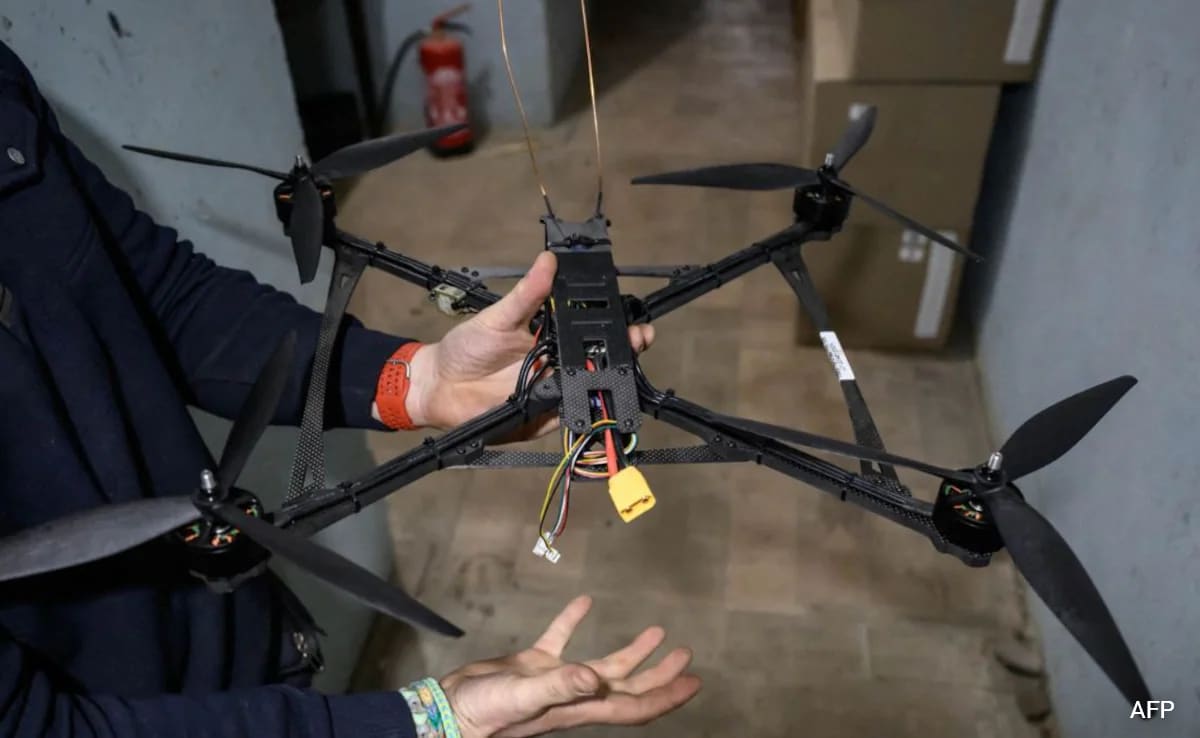
The modern battlefield is supposed to be a wireless one. For years, the Israeli Defense Forces (IDF) have built a multi-layered defense strategy predicated on the idea that they can own the electromagnetic spectrum. If an enemy flies a drone, Israel jams its GPS. If a pilot tries to steer a remote vehicle, Israel severs the radio link. But a low-tech solution from the past is currently shredding this high-tech security blanket. Hezbollah is now deploying drones connected to their controllers by a physical strand of fiber-optic cable. These machines do not emit radio signals. They do not rely on satellites. They are essentially flying torpedoes with a physical leash, making them immune to the most sophisticated electronic warfare suites in the world.
The Physical Link That Defies Logic
Electronic warfare works by shouting louder than the signal it wants to disrupt. When a jammer targets a standard drone, it floods the airwaves with "noise," preventing the drone from hearing the commands sent by the operator or the positioning data sent by GPS satellites. This has been the primary defense against the cheap, off-the-shelf FPV (First Person View) drones that have come to define 21st-century insurgency. Meanwhile, you can read related stories here: The Brutal Truth About Why Light Stunts Plant Growth.
Fiber-optic drones sidestep this entire struggle. Instead of transmitting data through the air, these drones unspool a thin, hair-like thread of glass as they fly. The command signals travel through light pulses inside that glass. Because the data stays inside the cable, there is no signal to jam. There is no frequency to "spoof." To an Iron Dome battery or a specialized jamming unit, these drones are ghosts. They appear on radar—assuming they are large enough to be detected—but the tools used to neutralize them are suddenly useless.
This technology isn't actually new, which makes its sudden prominence even more frustrating for military planners. Wire-guided missiles, like the TOW or the Sagger, have been around since the Cold War. However, those old systems used copper wire, which was heavy, limited in range, and prone to snapping. Modern fiber optics have changed the math. A spool of fiber can extend for several kilometers while weighing only a few grams. It provides a high-bandwidth connection that allows for crystal-clear, 4K video feeds with zero latency, even in environments where every radio frequency is being saturated with interference. To explore the full picture, we recommend the detailed article by Engadget.
A Failure of Technological Hubris
Israel’s "Digital Ceiling" was designed to be impenetrable. By investing billions into the Iron Beam laser system and various electronic signal-interruption platforms, the IDF banked on the assumption that an enemy would always try to communicate through the air. This was a massive oversight in risk assessment. Hezbollah has observed the war in Ukraine, where both sides have been forced into a constant cat-and-mouse game of shifting frequencies to keep drones in the air. By adopting fiber-optic tethers, Hezbollah has opted out of that game entirely.
The tactical implications are grim. In a standard engagement, an Israeli platoon might detect an incoming drone and activate a localized jammer. Usually, the drone would then drop from the sky or return to its launch point. With a tethered drone, the pilot continues to see a perfect image of the target. They can fly around obstacles, enter buildings, and hover directly over a hatch with surgical precision, all while the Israeli electronic warfare units are "screaming" into an empty void.
There is also the issue of "back-tracking." In traditional drone warfare, sophisticated signal-intelligence tools can sometimes triangulate the location of the operator by tracing the radio waves back to the source. A fiber-optic drone emits nothing. The operator can sit in a reinforced bunker or a hidden tunnel, completely invisible to electronic detection, and steer the device with total impunity.
The Engineering Behind the Spool
To understand why this is a nightmare to stop, you have to look at the physics of the spooling mechanism. The fiber-optic cable is wound in a way that allows it to pay out from the drone itself, rather than being pulled from the ground station. This prevents tension from snapping the line as the drone maneuvers around trees or corners.
Breaking Down the Specs
- Weight: A 10-kilometer spool of military-grade fiber can weigh less than 2 kilograms.
- Bandwidth: Light-based transmission allows for data speeds that radio-controlled drones can only dream of. This means the pilot has a high-fidelity view that makes hitting small, moving targets much easier.
- Stealth: Zero electromagnetic signature. Unless you physically see the drone with your eyes or a thermal camera, you don't know it’s there.
Hezbollah isn't building these from scratch in a basement. The technology has been maturing in industrial and niche military sectors for years. What we are seeing is the weaponization of high-speed data transmission in its most literal, physical form. The "dumb" wire has become the ultimate counter to "smart" defense.
The Kinetic Solution Problem
If you can't jam it, you have to hit it. This moves the conflict from the realm of invisible signals back to the realm of "bullets on targets." But hitting a small, fast-moving drone with a physical projectile is notoriously difficult and expensive. Using a million-dollar Tamir interceptor missile from an Iron Dome battery to take out a drone that costs less than a used motorcycle is a losing financial strategy.
Furthermore, the "tether" itself provides a secondary challenge. Even if the drone is detected, the pilot can fly it low to the ground, using the terrain for cover. Since there is no worry about losing signal behind a hill or a building, the drone can stay in the "clutter" where radar has trouble distinguishing it from the environment.
Why Conventional Anti-Drone Tech Fails
- Smart Jammers: These look for specific frequencies. The tethered drone uses none.
- GPS Spoofers: These trick a drone into thinking it is somewhere else. The tethered drone doesn't need GPS; the pilot is flying by sight via a direct line.
- Signal Triangulation: This finds the pilot. With fiber, there is no signal to triangulate.
This shifts the burden of defense to kinetic interceptors like "Coyote" drones or rapid-fire cannons. However, deploying these in enough quantity to cover an entire border is a logistical nightmare. It requires a 360-degree visual or thermal watch that must be active every second of the day.
The Fragility of the Glass Thread
For all its advantages, the fiber-optic drone has a glaring weakness: the cable itself. If the line snags on a sharp piece of metal or is cut by a person with a pair of scissors, the drone is dead. It becomes a paperweight. But finding a strand of glass that is thinner than a human hair while it’s moving at 60 miles per hour is nearly impossible.
It is a mistake to think of this as a "super-weapon." It is a specialized tool. It has a limited range—you can only carry so much cable on a small frame. It cannot be used for deep-penetration strikes far behind enemy lines. But for the "gray zone" of the Lebanese border, where the distances are short and the terrain is rugged, it is the perfect weapon for an asymmetric force.
Hezbollah is essentially turning the border into a giant, wired network of mobile mines. They are exploiting a gap in Western military doctrine that assumes every advanced threat will be electronic. By going back to basics, they have forced one of the most advanced militaries on Earth to reconsider how it protects its soldiers on the front lines.
Adaptation and the New Reality
Israel is now scrambling to pivot. There are reports of increased interest in "hard-kill" systems that use nets, or even trained birds of prey, though the latter is more of a curiosity than a viable military strategy. The real focus is shifting toward automated high-rate-of-fire guns and localized "active protection systems" similar to the Trophy system used on tanks, but scaled for smaller, more numerous threats.
This isn't just an Israeli problem. Every modern military that has invested heavily in electronic warfare—including the United States—is currently vulnerable to this specific workaround. The assumption that we can simply "turn off" the enemy's ability to communicate is being proven wrong. Sometimes, the most effective way to send a message is through a physical connection that no amount of digital noise can touch.
The era of the "un-jammable" drone has arrived, and it didn't require a breakthrough in quantum physics or artificial intelligence. It just required a very long piece of string.
The immediate challenge for the IDF is not just detecting these drones, but rethinking the entire architecture of border security. If the electromagnetic spectrum can no longer be relied upon as a primary defensive layer, the military must return to a state of constant, visual vigilance. This is labor-intensive, expensive, and prone to human error. Hezbollah knows this. They are not just attacking targets; they are attacking the very concept of technological superiority.
In the coming months, expect to see an increase in "low-tech" defenses. We may see the return of barrage balloons or fine-mesh netting over sensitive positions. It is a strange sight in 2026: some of the world's most advanced soldiers hiding behind literal fishing nets to stop a piece of glass wire. But in the brutal logic of the battlefield, if it works, it isn't stupid. The tether has changed the power dynamic, and the solution won't be found in a software update.


