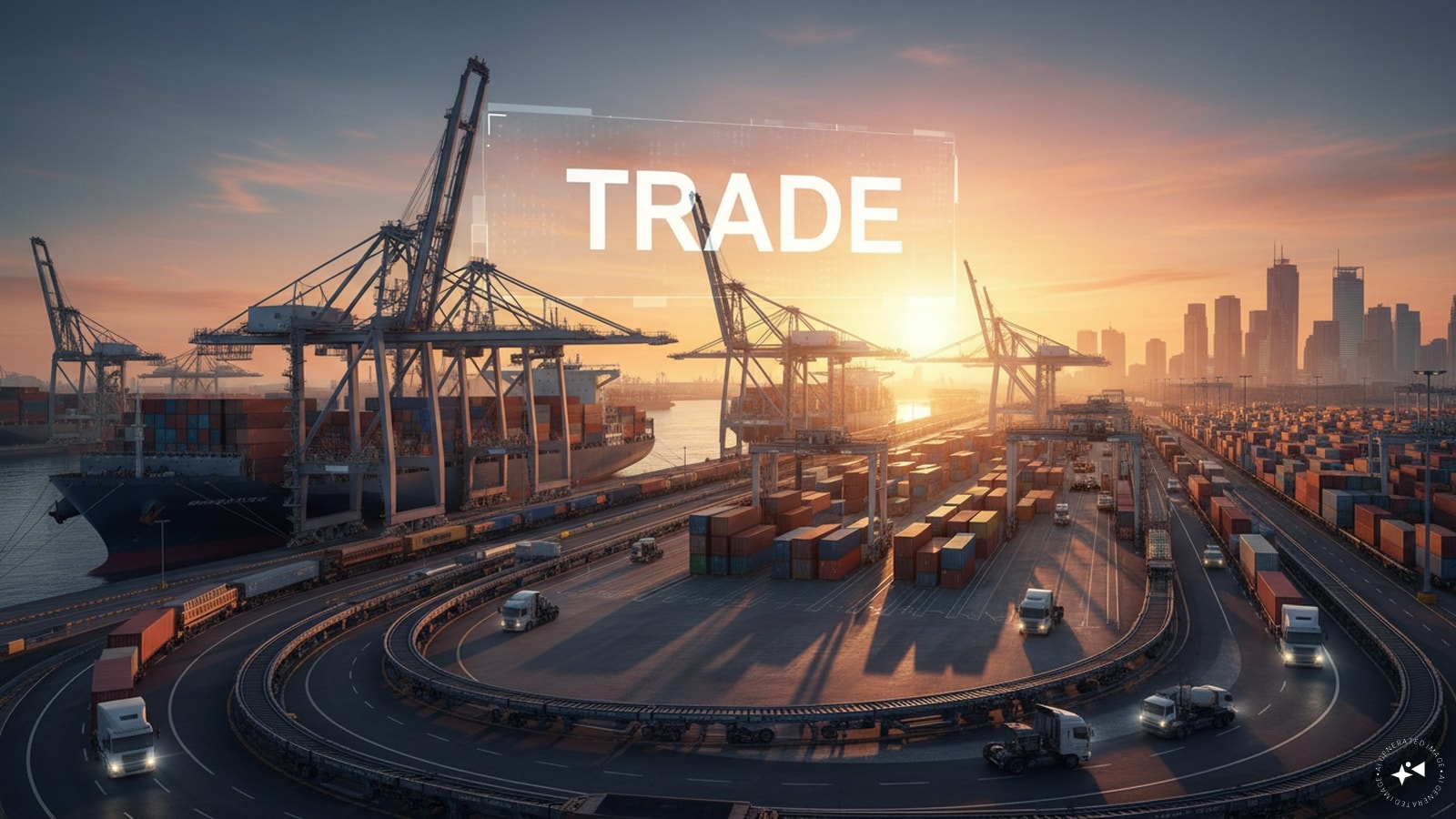
The Invisible Silk Road
Listen closely.
If you stand in the right warehouse in Almaty, or near a dusty rail freight yard outside Tashkent, you can hear the modern world shifting its weight. It does not sound like a revolution. It sounds like the heavy, metallic sigh of a gantry crane hoisting a forty-foot container. It sounds like diesel engines idling in the freezing dawn, and the rustle of manifests being stamped by inspectors who have seen empires rise and fall through their tiny sliding windows. For a different view, check out: this related article.
We rarely think about these sounds. We only notice the silence when they stop.
Consider what happened when global supply chains fractured a few years ago. Ships stacked up outside ports like floating bricks. Components for cars, refrigerators, and medical equipment sat rusting on decks while manufacturers two continents away panicked, dialing phone numbers that went straight to voicemail. Prices spiked. Shelves emptied. The illusion of an effortless, frictionless global market vanished overnight. Related coverage on the subject has been published by Reuters Business.
Out of that chaos came a quiet scramble to redraw the lines of commerce. And recently, during a gathering of the Shanghai Cooperation Organisation, India stepped up to the microphone with a proposal that sounds bureaucratic on paper, but carries seismic weight in reality: lower the barriers, increase intra-SCO trade, and stop letting geography act as a tollbooth on human progress.
To understand why this matters, you have to look past the acronyms. You have to look at a box of medicine.
Imagine a pharmaceutical plant in Gujarat. Inside, automated mixers hum, turning raw chemical powders into life-saving antibiotics. The science is brilliant. The labor is precise. But when that medicine has to travel north—past mountain ranges, across borders, through a maze of conflicting tariffs, shifting currency regulations, and customs checkpoints that can stall a shipment for weeks—the cost changes.
By the time the package reaches a clinic in Central Asia, the price has inflated not because the medicine got better, but because the journey got harder.
That is the tax of friction. And it is paid by everyone.
Economists call it supply chain resilience. But on the ground, it is simply the difference between a family being able to afford treatment or having to do without. When trade routes are narrow and guarded by endless red tape, every unexpected storm, every geopolitical tremor, every sudden border closure sends shockwaves through the system.
India’s pitch to its SCO partners is fundamentally an argument for widening the road.
Right now, the volume of trade moving between the nations of the Shanghai Cooperation Organisation sits far below its potential. Think about the sheer economic mass represented here: rising manufacturing power, vast energy reserves, burgeoning technology sectors, and millions of young consumers hungry for connection. Yet, trade between these nations often takes the long way around. Goods that should move overland in days are routed through maritime bottlenecks thousands of miles away, adding time, carbon emissions, and vulnerability to every single transaction.
Why? Because historical mistrust is a heavy cargo. Because standardizing customs procedures across nations with vastly different legal frameworks is agonizingly slow work. Because it is easier to maintain the status quo than to build new bridges—literally and metaphorically.
Yet necessity is a ruthless editor.
When you watch supply chains buckle, you realize that isolation is a luxury no region can afford. India’s argument is that lowering intra-bloc trade costs is not merely an economic strategy; it is an act of collective insulation. By knitting together regional markets through better transport corridors, simplified digital documentation, and predictable trade agreements, these countries can buffer themselves against external shocks originating half a world away.
Step back for a moment and look at the map.
Draw a line from Mumbai through Central Asia toward the markets of Eurasia. This is not a new path. It is the ghost of the ancient Silk Road, updated for an era of container ships, digital ledgers, and multimodal transport networks like the International North-South Transport Corridor.
For decades, modern trade was obsessed with a single metric: absolute efficiency at the lowest possible cost, regardless of distance. If the cheapest microchip came from an ocean away, you bought it from an ocean away. We optimized ourselves into a corner. We built a global economy that looked like a spiderweb spun across a chasm—impressive in its span, but devastatingly fragile if a single strand snapped.
What India is advocating is a return to regional resilience. Not economic autarky—not closing the doors to the rest of the world—but strengthening the local neighborhood so that if the global wind blows hard, the house doesn't collapse.
Let us be honest about the hurdles.
Bureaucracy does not surrender easily. Old suspicions do not vanish because of a joint communique at a summit. Infrastructure projects across mountainous terrain and unstable borders are hideously expensive and prone to endless delays. Corruption at border crossings can turn a twenty-four-hour transit into a two-week ordeal of palms needing grease.
These are not minor details. They are the bedrock reality of international commerce. Anyone who tells you that regional integration is simple is selling something.
Yet, consider the alternative.
The alternative is accepting that every time a canal gets blocked, or a regional conflict flares up, your local economy must hold its breath. The alternative is watching small businesses suffocate under the weight of unpredictable shipping costs and volatile input prices.
Change rarely arrives with a fanfare. It usually sneaks in through dusty conference rooms where tired officials argue over tariff codes until three in the morning. It arrives when a government finally realizes that a border should act as a sieve for security, not a wall against prosperity.
When trade costs drop, something invisible happens in the real world. A small manufacturer in Pune can suddenly compete for a contract in Samarkand. An agricultural exporter in Punjab can get fresh produce to markets before it spoils. A software startup finds it easier to deploy cross-border services because regulatory friction has been shaved away.
These are human victories. They translate into jobs kept, expansions funded, and possibilities unlocked.
The trade ministers will pack their bags, the press releases will fade from the headlines, and the grand speeches about multilateral cooperation will quiet down. But out there on the steppe, and down on the docks, the real work remains.
The road is long, the checkpoints are many, and the paperwork is thick. But the direction is set. We are watching the rewiring of the world's commercial nervous system, one customs union, one rail link, and one pragmatic negotiation at a time.
And somewhere in the dark, a crane operator leans against the control lever, waiting for the signal to lift the next box into the light.


