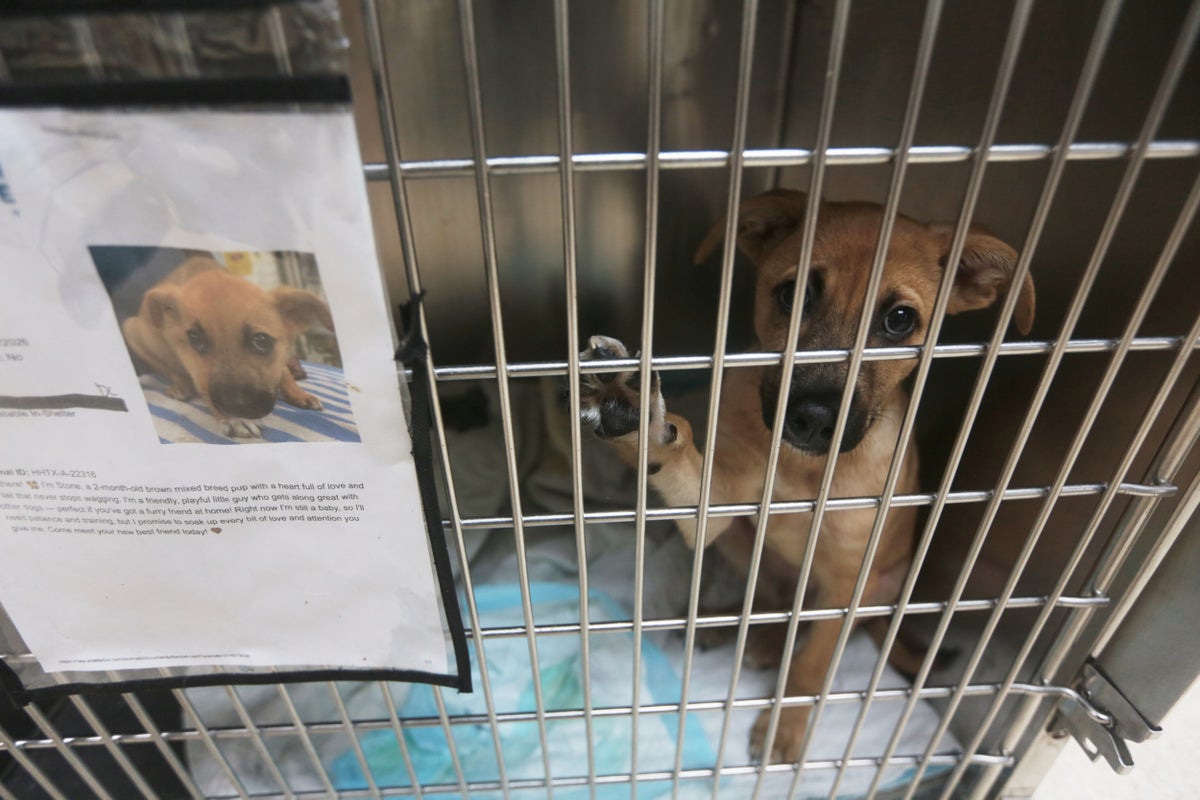
The New World screwworm is not merely a biological threat to livestock. It has become a silent executor for thousands of animals trapped in the Texas shelter system. While federal officials focus on the economic stability of the beef industry, the reality on the ground is a stalled transport network that has left shelters gasping for air. Because forty-four states have restricted the movement of animals from infested zones, the pipelines that once exported thousands of dogs and cats to safety have effectively evaporated. The result is a surge in population density that turns manageable facilities into death chambers.
Texas is a state of paradoxes. It manages the highest volume of animal transfers in the nation, with nearly 89,000 dogs and 53,000 cats moved out-of-state in 2025 to alleviate its chronic surplus. When that valve closes, the pressure is instantaneous. In Corpus Christi, for instance, the Gulf Coast Humane Society saw its population swell from roughly 325 to 450 animals in a matter of weeks, a margin of error that is the difference between life and death for the next intake.
The screwworm, Cochliomyia hominivorax, is a devastating organism. It does not simply infest a host; it liquefies living tissue. The adult fly deposits eggs in open wounds or moist body openings. Upon hatching, the larvae burrow into the flesh, using specialized hooks to tear through healthy muscle. The wound deepens, the tissue dies, and if left unchecked, the host eventually succumbs to systemic infection or secondary complications. The parasite was largely eradicated from the United States in the 1960s using sterile insect techniques, but its return after six decades has caught the state’s massive, under-resourced rescue network completely off guard.
The economic impact on shelters is perhaps the most overlooked facet of this crisis. While the USDA constructs a $750 million facility to breed sterile flies, local shelters are left to absorb the cost of mandatory veterinary inspections and preventative treatments. For an organization operating on a shoestring budget, the expense of certifying every outgoing animal—a process now often shortened from a 30-day window to as little as three days—is a barrier that prohibits lifesaving movement.
Consider the logistical hurdle. A mid-sized rural shelter might have a monthly operating budget that barely covers food and basic vaccines. Now, they are tasked with paying for professional examinations that verify an animal is free of a parasite that is, by definition, difficult to detect in its early stages. If they cannot afford the inspection, the animal stays. If the animal stays, the kennel space vanishes. If the kennel space vanishes, the shelter must euthanize to make room for the next emergency call. This is not a choice; it is a brutal, arithmetic necessity.
The stress on the animals is equally palpable. In a confined, high-density environment, cortisol levels spike, immunity wanes, and aggressive behavior manifests. Shelter directors report that prospective adopters are shunning the highly stressed, barking animals in favor of those that appear calm. This behavioral bias further compounds the stay-duration, locking animals into a cycle of neglect that precedes the inevitable end.
State-level responses have been reactive. The Texas Animal Health Commission has established quarantine zones, but the enforcement of these zones creates a chilling effect on even the most well-intentioned rescue efforts. The uncertainty surrounding interstate regulations has forced many northern transport partners to pause operations entirely, fearing they might inadvertently import an infestation.
Public perception also plays a role in the unfolding tragedy. There is a prevailing myth that working dogs—those used on ranches or farms—should not be spayed or neutered because it diminishes their drive. This cultural resistance contributes to a high population of unsterilized animals, creating an endless supply of strays that the system cannot hope to absorb. When warm weather allows for longer breeding cycles, the stray count balloons, ensuring that shelters are always operating at the threshold of catastrophe.
What remains largely unsaid is that the current crisis is a failure of infrastructure rather than a failure of intent. Texas has built a rescue model that is entirely dependent on the goodwill of other states. It exports its surplus because it cannot, or will not, manage the volume of its own unwanted animal population. When that export mechanism breaks, the fragility of the entire system is exposed.
The promise of a $750 million solution in 2027 offers little comfort to the animals currently pacing the concrete floors of Texas shelters. They are caught in a temporal trap, waiting for a technological fix for a biological problem, while the economic reality of the state’s shelter system continues to dictate a grim, high-velocity cycle of disposal.
The struggle to eradicate the screwworm is a monumental task of science and persistence. Yet, for the thousands of animals trapped behind kennel doors, the immediate danger is not the parasite itself, but the paralysis of the human systems meant to protect them. The final tally of this outbreak will not be measured solely in veterinary charts or laboratory slides, but in the quiet, empty cages where thousands of animals will never be seen again. The clock is ticking, and for many, the time has already run out.

_Nick_Merrick_for_Hedrich_Blessing_(9).jpg?1508608572)