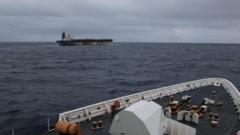
Britain is quietly preparing for a high-stakes maritime confrontation. Reports indicate that the Royal Navy and specialized boarding teams have increased their readiness to intercept and board vessels belonging to the Russian "shadow fleet" as they navigate the English Channel and North Sea. This isn't just about naval posturing. It is a desperate attempt to plug a multi-billion-dollar leak in the global sanctions regime and prevent an environmental catastrophe that could bankrupt local coastlines.
The shadow fleet consists of hundreds of aging, poorly maintained tankers that operate under murky ownership and flags of convenience. These ships transport Russian crude oil above the $60 price cap imposed by the G7, effectively funding the Kremlin's war chest while skirting the safety standards required by the international maritime community. When these vessels enter UK territorial waters, they represent a dual threat: a defiance of Western economic policy and a ticking ecological time bomb.
The Mechanics of Sovereign Defiance
For decades, the law of the sea has prioritized the right of "innocent passage." This principle allows vessels to transit through a nation's territorial waters without interference, provided they do not engage in activities prejudicial to the peace or security of the coastal state. Russia has exploited this legal loophole with clinical precision. By using shell companies based in jurisdictions like Dubai or Hong Kong, the Kremlin has assembled a ghost navy that exists outside the reach of traditional maritime law.
These ships often turn off their Automatic Identification Systems (AIS), a practice known as "going dark." In the congested lanes of the English Channel, this is the maritime equivalent of driving a semi-truck on a highway at night without headlights. The Royal Navy’s mission is no longer just about monitoring; it is about establishing a physical presence that forces these "dark" ships to comply with safety inspections or face expulsion from British waters.
Boarding a sovereign-flagged vessel in international waters is an act of war. However, within the 12-nautical-mile limit of UK territorial waters, the rules change. British authorities have the right to inspect any vessel suspected of violating environmental regulations or posing a direct threat to navigation. The shadow fleet fits both descriptions perfectly.
Why Sanctions Failed to Stop the Ghost Ships
The initial goal of the price cap was to keep Russian oil flowing to stabilize global prices while stripping Moscow of its profits. It was a clever economic theory that crashed into a brutal reality. The Russians simply stopped using Western-insured tankers. Instead, they bought up old scrap-heap ships that should have been sent to the breakers years ago.
These vessels are often insured by non-transparent Russian or domestic firms that lack the capital to cover a major oil spill. If a 20-year-old Aframax tanker breaks apart off the coast of Cornwall, the British taxpayer will be left holding the bill for the cleanup. The shadow fleet is a massive transfer of risk from the Russian state to the British public.
The Problem of Sovereign Immunity
Many of these vessels are registered in countries like Gabon or the Cook Islands. These nations lack the oversight or the inclination to police the ships flying their flag. When a British boarding team steps onto the deck of one of these tankers, they aren't just facing a disgruntled crew; they are challenging the legal fiction that these ships are independent commercial entities.
The UK government has begun designating specific ships by name, effectively banning them from UK ports and services. But designation is a slow, bureaucratic process. The ships simply change their names, paint over the hull, and re-register under a new front company. It is a game of maritime Whac-A-Mole that the Royal Navy is now being tasked to end through physical enforcement.
Tactical Realities of the Boarding Strategy
Boarding a tanker is a dangerous, technical feat. These are massive structures, often several stories high from the waterline to the deck. The crew on board, often comprised of low-paid sailors from third countries, may be under orders to refuse entry or maneuver the ship aggressively to prevent a boarding party from gaining a foothold.
Royal Marine Commandos and the Special Boat Service (SBS) are the primary units for these operations. They use Fast Rovers and helicopters to fast-rope onto the deck. Once on board, the primary objective is to secure the bridge and the engine room. They aren't looking for contraband in the traditional sense; they are looking for the ship’s papers, insurance certificates, and proof of the cargo’s origin.
The Environmental Stakes
The English Channel is one of the busiest shipping lanes in the world. It is also an area of significant ecological sensitivity. A single collision involving a shadow fleet tanker could release millions of gallons of heavy crude. Because these ships operate outside the P&I (Protection and Indemnity) clubs that cover 90% of the world’s shipping, there is no guaranteed fund to pay for the damage.
Consider a hypothetical scenario: A shadow fleet tanker loses power in a storm off the Isles of Scilly. The tugs required to salvage the vessel refuse to engage because the ship's insurance is invalid under sanctions law. The ship drifts onto the rocks. This is the nightmare scenario that keeps maritime authorities awake. By boarding these ships pre-emptively, the UK is attempting to verify "seaworthiness" before a disaster occurs.
The Economic Counter-Attack
Interdicting the shadow fleet is not merely a military exercise; it is an economic offensive. Every day a tanker is delayed by an inspection is a day that Russian oil isn't reaching its destination. Time is money in the world of commodity trading. If the UK can make the English Channel a "high friction" zone for Russian oil, the cost of transporting that oil rises.
The goal is to make the shadow fleet commercially unviable. If the risk of seizure or prolonged delay becomes too high, the shell companies will find it harder to find crews and insurers willing to take the gamble.
Global Precedent and Legal Fallout
The international community is watching the UK's moves closely. If Britain successfully establishes a protocol for boarding and inspecting these ships, other nations—particularly those bordering the Baltic Sea and the Mediterranean—are likely to follow suit. This would effectively squeeze the shadow fleet out of European waters entirely, forcing them to take longer, more dangerous routes around the Cape of Good Hope.
However, there is a significant risk of escalation. Moscow has already signaled that it views these measures as "piracy." There is a non-zero chance that Russia could provide naval escorts for its tankers, leading to a direct confrontation between the Royal Navy and the Russian Navy in the North Sea.
The Intelligence Gap
To win this fight, the UK needs more than just ships and marines. It needs granular, real-time intelligence. Tracking the ownership of a shadow tanker requires a deep dive into the world of offshore finance and shell companies.
The UK’s Joint Maritime Security Centre (JMSC) has become the nerve center for this effort. They use satellite imagery, radio frequency monitoring, and human intelligence to track ships from the moment they leave Russian ports like Primorsk or Novorossiysk. They look for "ship-to-ship" transfers, where a shadow tanker meets a larger vessel in the middle of the ocean to offload its cargo and hide its origin.
Verification Challenges
Even when a ship is boarded, the paperwork is often forged. Modern scanners and forensic accounting are required to determine if the "Indonesian crude" on the manifest is actually Russian Urals. The boarding teams now include technical experts who can sample the oil and analyze its chemical signature to prove its origin.
The Cost of Inaction
Critics argue that boarding ships is an unnecessary provocation that could lead to a hot war. But the alternative is to allow a lawless, uninsured, and dangerous fleet to operate with impunity just miles from the British coast. The status quo is an invitation to disaster.
If the shadow fleet is allowed to continue its operations unchallenged, the entire concept of international maritime law begins to dissolve. We would return to an era where the sea is a lawless frontier, governed only by the strength of the actors involved. For a maritime nation like the UK, that is an unacceptable outcome.
The focus on the shadow fleet highlights a broader shift in national security. Defense is no longer just about protecting borders from invasion; it is about protecting the integrity of global systems—finance, shipping, and environmental standards. The Royal Navy is being repurposed as a high-seas regulator, enforcing rules that the Russians are trying to erase.
The next few months will determine if this strategy works. If the UK can successfully deter the shadow fleet through targeted boardings and inspections, it will have provided a blueprint for how a mid-sized power can exert influence in a multipolar world. If they fail, or if a ship breaks apart during an enforcement action, the political and environmental fallout will be felt for generations.
The UK must now decide if it is willing to sustain the high operational tempo required to police the Channel 24/7. This requires more than just political will; it requires a sustained investment in the fleet and the legal framework to back them up. The shadow fleet is moving, and the window for effective intervention is closing.
Would you like me to analyze the specific maritime insurance laws that the shadow fleet is currently circumventing?